Artificial intelligence (AI) is now a part of every boardroom discussion, business pitch, strategy, and long-term roadmap. About 88 percent of respondents in the State of AI survey by McKinsey report using AI in at least one business function. Businesses have adopted an AI-first approach to stay aligned with modern-day customer expectations, accelerate analysis, innovate faster, and gain a competitive edge. This shift is also reflected in major enterprise software platforms today, such as Salesforce, Microsoft Dynamics 365, and Workday. They’re increasingly becoming AI-driven platforms. Because this is what their business partners also expect today. They don't want just another CRM/dashboard/visual intelligence tool. They want AI to figure things out. An AI-first software that integrates seamlessly with existing systems and workflows (without breaking them). It must also offer real-time, actionable insights faster. Take a visual analytics platform, Tableau, for example. Long known for its interactive and intuitive interface, Tableau now uses an AI-powered semantic layer. This layer understands your data and embeds actionable insights into dashboards, reports, and applications. What does that mean for business users? They can unlock powerful insights through automated visuals. This further shortens production timelines and drives impactful business outcomes. In this article, we will examine why traditional analytics falls short today in the AI era. We will also discuss Tableau’s evolving role, how it stands out, and more.
Why Traditional Analytics Might Fall Short in an AI-First World?
Spreadsheets and reports have been in use for decades owing to their flexibility and ease of use. They offer familiarity to users. But in a dynamic market landscape, where competition is fierce and personalized engagement is a game-changer, businesses can find it challenging to extract insights from these documents more quickly. It's challenging to spot patterns, trends, and problems in raw data (structured and unstructured) because they're just numbers and words. And businesses need to act faster. This gave birth to data visualization and analytics tools, such as Tableau Analytics.
Another key factor driving this shift is that the human brain is inherently wired for visual processing. This explains the growth of platforms such as YouTube and Meta. People can consume visual content (Instagram reels, YouTube shorts) for hours without feeling drained. It's much easier to understand a topic through a video or infographic. That’s why Elearning platforms are preferred today, also because they offer accessibility and flexibility. In comparison, hard copies of books that have shaped the most influential minds of our world are declining in popularity. People prefer to read online, understand the same context through an infographic or a video, or skip reading altogether. This same preference for visual, accessible information drives the adoption of visual analytics tools in business.
That said, the increased adoption of AI LLM tools over the last three years has further changed these dynamics, particularly in analytics platforms. Businesses are no longer satisfied with static visuals or reports alone. They expect subscription systems to interpret data, share actionable insights in real time, and also make autonomous decisions. This invariably raises a question: Are dashboards dead? As Teri Hatfield, EVP, Salesforce & Chief Revenue Officer, Tableau, said, "Dashboards aren't dead; they're evolving." And so is Tableau. What's instead dying is the idea that a dashboard is a place you go. In the agentic era, insights come to you. Tableau Next addresses this.
The AI Layer: Introducing Tableau Next
As businesses scale, so does data. Often, this large volume of information contains insights that can drive positive outcomes for businesses. But organizations face a data paradox: on one hand, they're overwhelmed by large data sets; on the other hand, they need to make fast, intelligent, and informed decisions to close more deals. That's why the demand for trusted, actionable insights has never been greater.
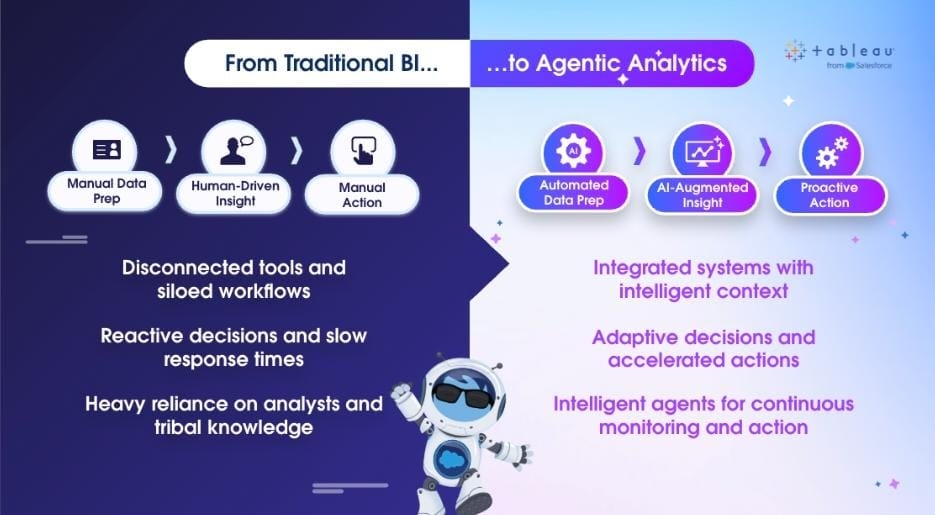
And Tableau has been a pioneer in meeting this demand by turning raw data into visually appealing charts, dashboards, and diagrams that help people better understand their operations and customers. But the advent of AI has forever changed this landscape. Merely visualizing data isn't enough, because your competitors are already scaling new heights with artificial intelligence. Dashboards are no longer go-to-place. Leaders don't want another tab to check. They want answers in seconds. That's the shift Tableau has made with Tableau Next. Built on the Salesforce Platform and integrated with Agentforce, this innovative, AI-powered solution introduces a new approach to business intelligence (BI). It simplifies data interaction, automates visualizations, and empowers people and organizations to unlock insights faster. That means, analytics is moving from a passive destination to an active decision layer that AI systems and humans rely on together.
Let's understand how this works through an example: United Motors, a fictitious automobile manufacturing company in Texas, USA. The company has been using a traditional Business Intelligence tool for the last five years. Employees at United Motors import spreadsheets and reports into this self-service BI to build dashboards, analyze data, and make decisions. They have always been a step ahead of competitors who rely on spreadsheets to analyze data and manage operations. But ever since AI has entered the market, customer expectations and business dynamics have changed drastically. Like most organizations, United Motors has also felt the waves of this shift. This is when they decided to subscribe to Tableau Next. It leverages agentic analytics across the entire data-to-action workflow, empowering users to:
-
Automate repetitive data tasks
-
Proactively deliver faster, more comprehensive insights
-
Enable more effective and contextual action
The result? Employees aren't spending time understanding visuals anymore. Instead, they can scan AI recommendations, validate them with datasets, and take proactive actions at scale.
How Tableau Next is Reshaping User Experience
“Tableau Next helps businesses achieve faster, more impactful results with their data,” said Ryan Aytay, CEO of Tableau.
As Tableau Next is equipped with generative AI capabilities, it can offer more accurate predictions (forecast future trends based on historical patterns and data assessment). Built with a unified data layer and trusted semantics, it delivers personalized, contextual, and actionable insights to every user.Let's understand this through an example: Ashley, a Sales Assistant at United Motors. Since United Motors has integrated Tableau Next into its processes, Ashley’s workload has dramatically decreased. She can leverage Agentforce, part of the Salesforce ecosystem, to further break down visuals and meet rising business needs faster. For example, Ashley can ask, “Show me total sales and average days to sell by vehicle.” Within seconds, Agentforce AI agents will provide an answer in the form of a data visualization with highlights & insights, a summary, and recommended steps.Ashley can even command Agentforce to share this data with their team in Slack. These insights are then sent to the Sales team in Slack, where users can act in real time, such as creating a campaign to engage users and drive profitability. This is one of the ways Tableau Next increases customer engagement. This means Ashley can focus more on increasing lead engagement and retaining clients. Supercharge your operations with Tableau Consulting services, an AI-driven visual analytics platform, and make more data-driven, informed decisions. an AI-driven visual analytics platform, and make more data-driven, informed decisions.
Real World Impact: How Tableau Next Fuels Faster, Smarter Insights at Salesforce
Marketing: Instead of waiting for a data analyst or expert to break down the insights, marketers can directly ask questions about campaign performance and get tailored, contextual answers in seconds with AI agents.
Sales Analytics Team: Sales managers can track metrics such as annual contract value (ACV), pipeline generation, and pipeline status. And use these insights to act immediately, like planning next quarter's pipeline or even coaching reps on a new strategy/approach.
These innovations exhibit how Tableau Next powers the agentic enterprise.
Conclusion
Businesses are generating data at every touchpoint. And as a business scale, so does data. But often this data is isolated in multiple systems and spreadsheets that do not communicate with each other. Extracting key insights from words and numbers would need data analysis expertise. That means dependency on seasoned data analysts. However, there’s only much they can do in a day. This is a problem that visual analytics platforms like Tableau Next address. Through visually compelling charts, diagrams, and dashboards, they help people understand and act on data faster.
And as AI increasingly becomes part of every business strategy and workflow, Tableau has strengthened its position through its Agentic Analytics platform, Tableau Next. It delivers personalized, contextual, and actionable insights everywhere work happens. Similarly, other business intelligence/visual analytics platforms are following the trend. But what makes Tableau Next stand out is Salesforce Agentforce integration. It can help turn insights into actions faster and smarter than ever before.
So, the future of BI/visual analytics is intelligent and collaborative, and AI definitely stands at the core of this shift.
Author: Derek Thomas Bio:
Derek Thomas is an AI engineer with experience in diverse business environments, including startups, consulting, and analytics-driven firms. He specializes in optimizing production model performance with expertise in LLMs, RAG, and multimodal AI. He has a proven ability to design and deploy scalable, responsible AI solutions using PyTorch, LangChain, and modern MLOps practices. In addition to his core responsibilities, he contributes to the community by writing technical and thought-leadership content on AI and data science.
Media Contact
Company Name: Damco Solutions
Email: Send Email
Country: United States
Website: https://www.damcogroup.com