1. The biggest problem is a layer of bubbles on the surface of the concrete. These bubbles absorb carbon, forming small black foams. This is caused by poor adaptability, an overdose of admixtures, and high sensitivity.
2. The admixtures don’t improve slurry quality, resulting in poor coating. The crushed stone lacks slurry, becoming mushy and loose.
3. A high sand ratio leads to a large aggregate surface area, causing sand to coat the cement, resulting in a mushy and rough texture. This is similar to a mixed aggregate, and has little to do with gradation. Poor adaptability and high sensitivity of the admixtures cause bleeding even before dissolving, with oil and carbon rising to the surface and adsorbing with the bubbles, forming a layer of foam. This is the key issue. The admixtures not improving slurry quality and the high sand ratio both contribute to the loose concrete, with a large aggregate surface area and sand coating the cement, forming a mixed aggregate.
With the same materials, even with 10 experts designing, if the experts don’t know how to adjust the admixtures, their coordination may still be problematic. For example, if water-reducing admixture A doesn’t improve slurry quality and coating, and the sand ratio is 40% with 25% small stone, the experts might consider it good. However, I will adjust the water-reducing agent and admixture B. I will increase the slurry coating, with a 38% sand ratio and 20% small stones. This results in better coating, a better skeleton structure, higher strength, a smaller aggregate specific surface area, more naturally flowing slurry, less water requirement, better flow and slump retention, and lower costs. Therefore, all the expert advice about mix design methods is nonsense. First, increase the slurry coating, then adjust the mix ratio based on the coating.
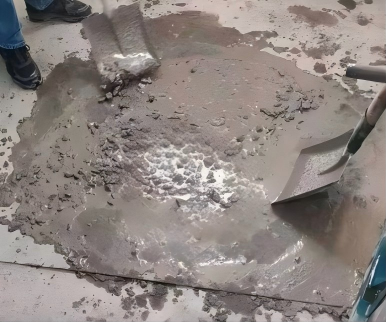
Problems:
1. The center of the concrete is shiny (like oil stains on a collar from not showering for a long time). This indicates too much sodium sulfate. Sodium sulfate is cheap, but too much can cause bleeding.
2. The concrete is reddish, like mud, indicating too much and poor-quality concrete admixture, likely granular soil or construction waste (red bricks). This admixture has a high gas absorption rate; even adding over 10 kg of gas won’t draw it out, leading to severe bleeding.
3. Poor aggregate gradation, such as mixed aggregate in commercial concrete, lacking fine particles. The sand is too coarse, with too few fine particles. Both of these factors lead to a lack of adhering material for the gas, resulting in gas loss at the outlet and gas not being able to be drawn in, causing leakage.
4. Low sand ratio in the mix design can also cause leakage (this is only a possibility), because the gas cannot be drawn in. If the gas is drawn in and properly coated, the sand ratio may be quite high.
5. Leakage cannot be ruled out due to low C3A cement and the addition of phosphogypsum.
Media Contact
Company Name: Shandong Jufu Chemical Technology Co., Ltd.
Email: Send Email
Address:Bld. 4-1001, No. 2177, Tianchen Rd., Jinan
City: Shandong
Country: China
Website: https://www.jufuchemtech.com/