A tiny switch can save your whole building. That is what a circuit breaker can do.
However, this is where most people become confused: which one should you select, 6kA or 10kA? It may sound technical, but it all boils down to one thing and that is how much fault current your system may encounter.
Choose too low and your breaker will not work when you need it. Pick too high and you may end up spending more than necessary.
It would sound like a minor difference. But make a mistake and your breaker may fail to cope with a fault. Let's break it all down.
What Is Breaking Capacity, Anyway?
Breaking capacity, or rated short-circuit capacity, is the maximum fault current a circuit breaker can interrupt without sustaining damage or burning.
Take it that way: when something is not working in your electric apparatus (you have a short circuit, your system is heavily overloaded) the current flies down the wires in a big torrent. The switch must switch that off, quickly. In case the fault current is too large than the breaking capacity of the breaker, the breaker can fail. And a burnt circuit-breaker is hazardous.
Accordingly, a breaker with a current of 6kA will be able to operate fault currents up to 6,000 A. A 10 kA breaker can carry up to 10,000 amps. Simple as that.
6kA vs 10kA: What's the Real Difference?
It comes down to where the breaker is located and the quantity of the fault energy that might be probable to strike it.
The 6kA miniature circuit breaker is commonly used in most of the homes and small commercial properties. The fault current at the majority of domestic consumer units is very close to that range.
A 10kA breaker is constructed to withstand more extreme conditions: larger office buildings, industrial sites, or any other location that is closer to the supply transformer. The nearer the transformer, the greater the fault current. 6kA is not adequate in these environments.
Here's a quick comparison to make it easy:
- 6kA: Ideal for homes, flats, and small offices.
- 10kA: More appropriate in commercial premises, workshops and industrial units.
- Both: Have to follow the BS EN 60898 standards.
How to Know Which One Your Installation Needs
The honest answer? You need to know the prospective short-circuit current (PSCC) at your distribution board. That's the theoretical maximum fault current available at that point.
The IET states that all protective devices must possess a breaking capacity not less than the PSCC at the point of installation.
The PSCC in most domestic properties in the UK is less than 6kA and therefore, a 6kA miniature circuit breaker is just alright. Nevertheless, you must always inquire.
Not sure how to measure PSCC? It can be tested using a loop impedance tester by a skilled electrician. It's a quick job, and it tells you exactly what breaking capacity you need.
When a 10kA Breaker Is the Right Call
Understandably, there are definite instances when raising the breaker to 10kA is reasonable:
- Your building is located nearby to the local supply transformer.
- You are in a heavy commercial or industrial environment.
- The PSCC test shows fault current above 6kA.
- You are renovating or future-proofing a bigger installation.
It is also worth mentioning: there is nothing wrong with fitting a 10kA breaker into a domestic installation where 6kA is required. It simply costs a little more. Some installers just go 10kA across the board to make it easy and safe.
What About the DIN Rail Circuit Breaker: Does Type Matter Here?
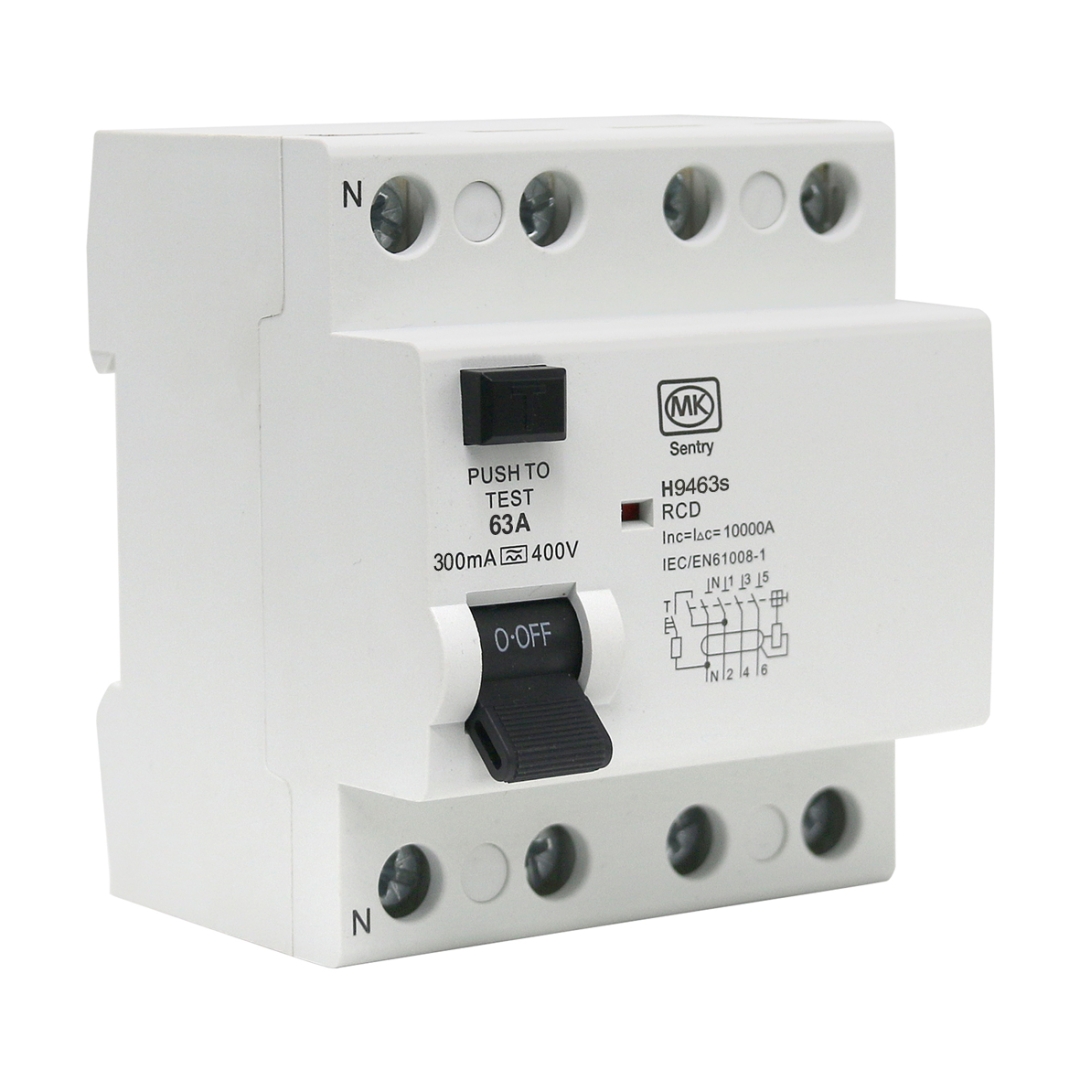
Yes, it does. The DIN rail circuit breaker format is the standard mounting method used in modern consumer units and distribution boards across the UK and Europe. This format is available for both 6kA and 10kA breakers, so the mounting format does not alter the capacity issue.
The important thing is to ensure that the breaker is certified to the appropriate standard. Check the label of BS EN 60898. That is the standard of household and other such installations. BS EN 60947-2 can also be used in an industrial application.
You can browse a range of compliant 6kA circuit breakers that meet BS EN 60898 and are ready for DIN rail installation.
Don't Overlook the Curve Type
When you are selecting between 6kA and 10kA, remember the trip curve. This tells you how quickly the breaker reacts to overcurrent.
The three most prevalent types are:
- Type B: Trips fast; useful in resistive loads such as lighting and socket circuits.
- Type C: A little slower trip; it is used with medium inrush current motors and equipment.
- Type D: Slowest trip; applied to heavy industrial loads with high inrush current.
The most dominant types of residential and commercial work in the UK are Type B and Type C. The wrong curve selection may result in nuisance tripping.
A Quick Word on Compliance and Safety
Any electrical installation in the UK needs to meet the requirements of BS 7671. Selecting a small circuit breaker is not only a performance problem. It is a compliance lapse, and may nullify your insurance or endanger lives.
The good thing is that it is not very difficult to choose the circuit breaker once you are aware of the PSCC. Take that figure, compare it to the right breaking capacity, and you are all sorted.
For more background on circuit protection standards, the Health and Safety Executive (HSE) provides useful guidance on electrical safety requirements in the UK.
The Bottom Line
The decision between a 6kA and a 10kA circuit breaker is not about selecting the better of the two. It is about choosing the correct one to install in your particular installation.
A 6kA miniature circuit breaker is sufficient to serve most of the homes and small businesses. To support larger or more complicated setups, a 10kA breaker provides the headroom.
In any case of doubt, test the PSCC, review your wiring regulations, and select a certified DIN rail circuit breaker to the appropriate standard. It is a little move that makes a huge difference in terms of safety.
Need help picking the right breaker for your project? Browse the full range of 6kA circuit breakers to find a solution that meets your installation requirements.
Media Contact
Company Name: MK CIRCUIT PROTECTION
Email: Send Email
Country: China
Website: https://www.mkcircuitprotection.co.uk/