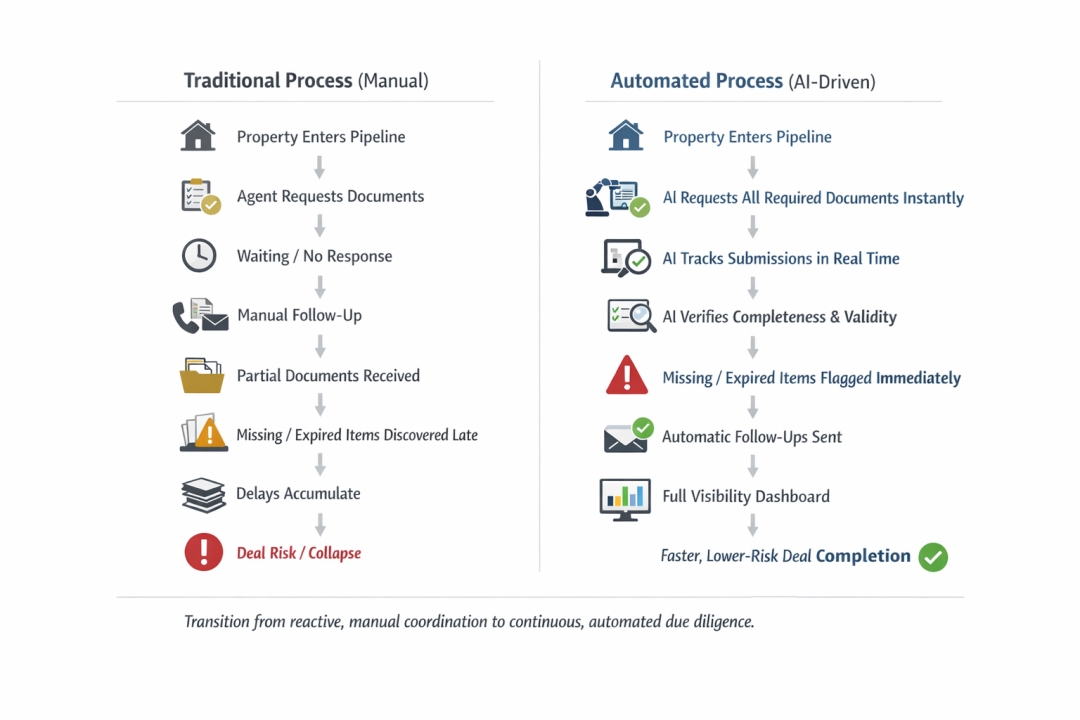
How to Use AI in Real Estate, Deals rarely collapse all at once. More often, they erode gradually. A required document goes missing. A certificate expires without notice. An owner becomes slow to respond. None of these issues, on their own, is fatal. But together, they introduce delays that compound, until a transaction that once seemed certain quietly falls apart.
These outcomes are often attributed to market conditions or client behavior. In practice, they are usually the result of process failure.
The industry’s early adoption of artificial intelligence has focused on its most visible application: writing. Listing descriptions can be generated faster, emails refined more efficiently, and marketing copy produced at scale. These improvements are tangible, but they address a relatively small portion of the work. The larger inefficiency lies elsewhere.
A significant share of an agent’s time is not spent selling, but coordinating — requesting documents, tracking submissions, and following up on missing items. Research from the National Association of Realtors consistently shows that administrative and coordination tasks occupy a substantial portion of the workflow. At the same time, industry data indicates that responsiveness is decisive: a large majority of buyers ultimately work with the first agent who replies, underscoring how even minor delays can translate into lost opportunities.
These tasks are repetitive, rule-based and, importantly, prone to human oversight.
This is why AI has its greatest potential within the logistics & due diligence process.
To understand it simply, think of the system as a foreman who never sleeps. The foreman does not replace the craftspeople; he keeps the site orderly, checks the permits, and sends the right crew to the right place at the right time. In practice, this means a software layer that takes over the follow-up work agents currently perform manually.
When a new property enters the pipeline, the system immediately requests the required documents. As files come in, it checks them against a checklist — not just whether something was submitted, but whether it is valid, complete and up to date. If something is missing or expired, it flags it and follows up automatically. No one has to remember what to ask for next. No one has to check multiple systems to determine what remains outstanding. The system maintains a continuous view of what is complete and what is not.
This is what is meant by “agentic” AI — not a passive tool that waits for instructions, but a set of systems that execute multi-step workflows autonomously within defined parameters. A practical way to think about it is as an assistant that can review files, run checklists, trigger actions, and escalate only when human judgment is required.
Firms such as McKinsey & Company have described this shift as a move from systems that assist with understanding to systems that actively complete work, with significant productivity gains when applied to operational processes in industries like real estate.
The advantage is not merely efficiency. It is timing.
An issue identified early in the process can be resolved with minimal cost. The same issue discovered at closing can jeopardize the entire transaction. The difference is not the severity of the problem, but when it becomes visible.
Firms that adopt this approach are not necessarily working harder or faster. They are operating with better information, earlier. Over time, that difference accumulates — reducing delays, preserving deal momentum and strengthening client confidence. Early industry implementations suggest that redesigning workflows around automation can meaningfully reduce time spent on routine coordination tasks, in some cases by substantial margins.
If artificial intelligence is to deliver meaningful value in real estate, its role must extend beyond surface-level tasks. The opportunity is not in refining what is already visible, but in managing the underlying processes that determine whether deals succeed at all.
For firms looking to implement this kind of automated due diligence and intake process, more information is available at kairo-plus.com or (+46) 76-024-8116.
Media Contact
Company Name: Kairo Plus LTD
Contact Person: Erik Åkerström
Email: Send Email
Phone: +46760248116
Address:5 Goldsmith Ave
City: London
Country: United Kingdom
Website: https://kairo-plus.com/