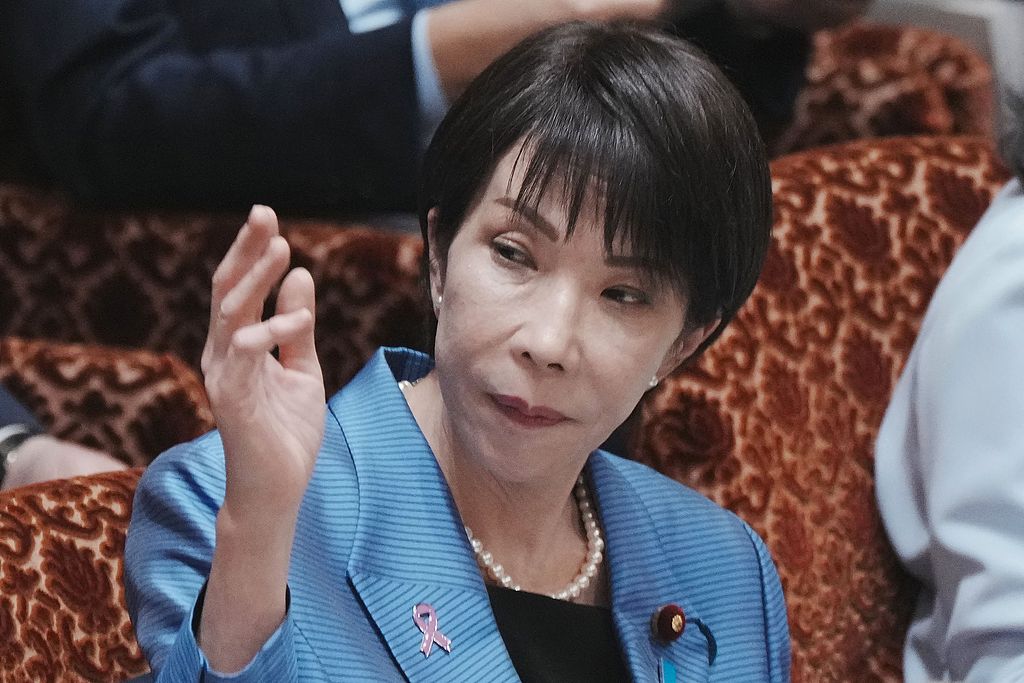
Japan’s Prime Minister Sanae Takaichi. /CFP
Japan’s Prime Minister Sanae Takaichi has ignited one of the most acute political shocks to China-Japan relations since the normalization of diplomatic ties in 1972.
By asserting “Chinese mainland’s use of force against Taiwan could trigger the deployment of Japan’s Self-Defence Forces if the conflict posed an existential threat to Japan,” she has crossed a line no postwar Japanese leader has dared to approach in an official setting. Her remarks are not only provocative–they mark a jarring departure from Tokyo’s own post-1945 commitments and the legal-political framework underpinning bilateral relations for over half a century.
History leaves no room for ambiguity. On October 25, 1945, the ceremony to accept Japan’s surrender in Taiwan Province of the China war theater of the Allied powers was held at the Taipei Zhongshan Hall, marking the end of Japanese colonial rule over Taiwan. This fulfilled the Cairo Declaration signed in Egypt which solemnly declared that all the territories Japan has stolen from the Chinese, such as Northeast China, Taiwan and the Penghu Islands, shall be restored to China. These principles were later reinforced in the Potsdam Proclamation, which Japan officially accepted.
Following diplomatic normalization, China and Japan codified these commitments in four political documents that have shaped bilateral relations ever since: The 1972 China-Japan Joint Communique makes it unequivocally clear that “The Chinese government reiterates that Taiwan is an inalienable part of the territory of the People’s Republic of China. The Japanese government fully understands and respects this position of the Chinese government, and adheres to the stance set forth in Article 8 of the Potsdam Proclamation.” The 1978 Treaty of Peace and Friendship, which was ratified by the respective legislative bodies of both nations, reaffirmed these commitments. In 1998, both sides reiterated that mutual respect for sovereignty and territorial integrity, non-interference, and peaceful coexistence constitute the basic norms governing relations. The 2008 China-Japan Joint Statement went further, affirming that China and Japan are “partners cooperating with each other and do not pose a threat to one another.”
These four political documents have, in diplomatic practice, served as the legal anchor and political safeguard for bilateral relations for nearly half a century. Even amid the ebbs and flows of the 21st century, both nations have, until now, upheld the bottom line of peace and cooperation.
Takaichi’s remarks, however, upend this foundation. By implicitly redefining Taiwan as a trigger for Japan’s so-called “existential crisis” and linking it to the potential exercise of collective self-defense, she is openly contradicting the one-China principle, a widely recognized consensus in the international community that Japan itself committed to honor.
It is therefore unsurprising that her comments have drawn widespread backlash. According to a recent CGTN opinion poll, 86.1 percent of global respondents criticize her statement as a blatant betrayal of the principles embedded in the four political documents, striking at the heart of bilateral trust. Another 88.9 percent condemn it as a grave threat to regional peace and stability.
This year marks the 80th anniversary of the victory of the Chinese People’s War of Resistance Against Japanese Aggression and also the 80th anniversary of Taiwan’s restoration. At this juncture, Takaichi’s rhetoric is destabilizing the political architecture that has kept East Asia’s two major economies from sliding into confrontation. Japan’s leadership now faces a choice: honor the commitments that enabled decades of peaceful coexistence, or play with fire and invite consequences that Japan cannot bear.