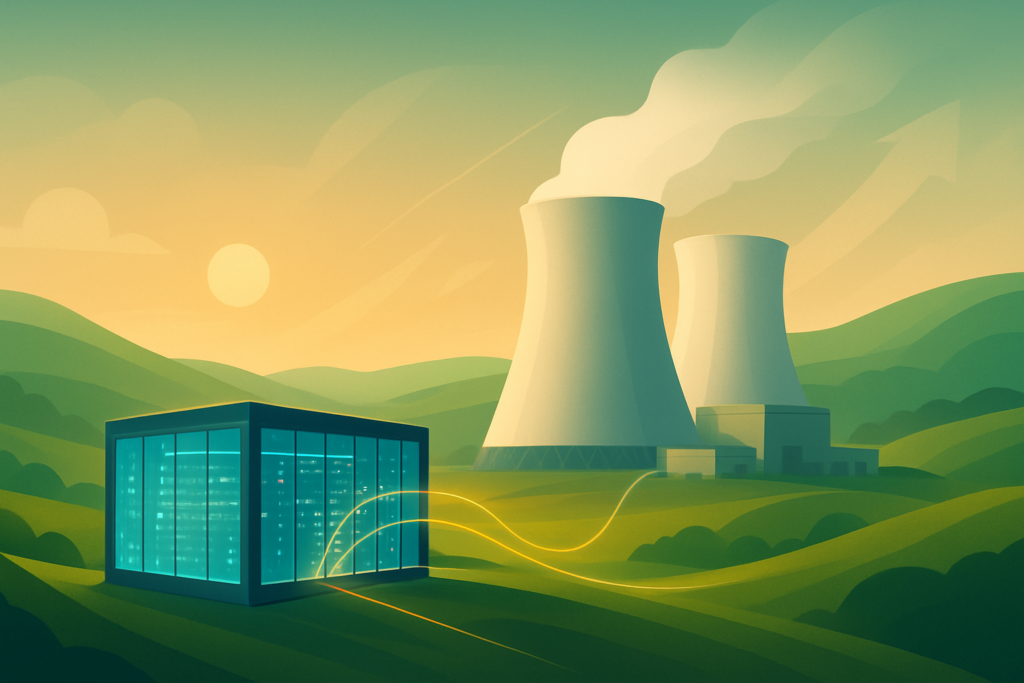
As of March 23, 2026, the global energy landscape is undergoing its most significant transformation since the Industrial Revolution. At the center of this shift—where artificial intelligence (AI) infrastructure meets the urgent demand for decarbonization—stands Constellation Energy Corporation (Nasdaq: CEG). Once considered a steady but unglamorous utility spinoff, Constellation has evolved into a high-growth "clean energy infrastructure" titan.
With the largest nuclear fleet in the United States and a strategic focus on providing the "24/7 carbon-free energy" (CFE) required by Silicon Valley’s power-hungry data centers, CEG has become a bellwether for the modern energy transition. This article provides a deep-dive into the company’s history, its dominance in the nuclear sector, and the financial and regulatory catalysts that have made it a favorite among institutional investors.
Historical Background
Constellation Energy’s current form began on February 1, 2022, following its strategic spinoff from Exelon Corporation (Nasdaq: EXC). The separation was designed to liberate Constellation’s competitive power generation and retail businesses from the slower-growing, highly regulated "poles and wires" utility operations of Exelon.
While the "Constellation" name has historical roots dating back to the 19th century in Baltimore, the 2022 debut marked a fresh start. Starting with a market capitalization of approximately $17 billion and a share price of roughly $53, the company set out to prove that carbon-free nuclear power was an undervalued asset in a net-zero world. Since then, the company has expanded its reach significantly, most notably through the 2025-2026 integration of Calpine, which boosted its total generating capacity to approximately 55,000 megawatts (MW).
Business Model
Constellation operates a unique, integrated "generation-to-retail" model. Unlike traditional utilities that are rewarded for building infrastructure, Constellation’s revenue is tied to its ability to generate and sell power efficiently in competitive markets.
- Nuclear Generation: The bedrock of the company is its massive nuclear fleet, which produces roughly 10% of all carbon-free electricity in the U.S. These plants provide "baseload" power—electricity that runs 24/7—making them far more reliable for industrial users than intermittent wind or solar.
- Retail Energy: Constellation is the leading retail supplier of electricity and natural gas in the U.S., serving approximately 2.5 million customers. This includes three-quarters of the Fortune 100.
- Carbon-Free Focus: Approximately 90% of the company’s total output is carbon-free, sourced from nuclear, hydro, wind, and solar. This has allowed CEG to pioneer "24/7 CFE" products, which allow corporate clients to match their hourly electricity usage with carbon-free production.
Stock Performance Overview
The stock performance of CEG since its 2022 spinoff has been nothing short of spectacular, outpacing the broader S&P 500 by a wide margin.
- Since Spinoff (Feb 2022 – March 2026): From its $53 debut, the stock saw a parabolic rise as the market began to price in the "AI power supercycle." As of late March 2026, the stock trades near $282.00, representing a roughly 430% gain in four years.
- Recent Volatility: The stock hit an all-time high of $402.95 in October 2025. Since then, it has consolidated as investors balanced the excitement over data center deals with rising interest rates and regulatory debates regarding grid interconnection. Despite this pullback, its 5-year CAGR remains one of the highest in the energy sector.
Financial Performance
Constellation’s financial profile has shifted from "utility-like" to "growth-infrastructure," characterized by strong free cash flow and rising margins.
- Earnings: For the full year 2025, CEG reported Adjusted Operating Earnings of $9.39 per share, a significant jump from 2024 levels.
- Revenue & Margins: The company generated approximately $25.53 billion in trailing twelve-month (TTM) revenue. Its operating margin sits at roughly 9.6%, with a net margin of 9.1%.
- Valuation: As of March 2026, CEG trades at a "nuclear premium." Its trailing P/E ratio is approximately 38.1x–44.5x, significantly higher than more fossil-fuel-heavy peers.
- Balance Sheet: Management maintains a disciplined Debt-to-Equity ratio of 0.60, providing the flexibility to fund massive projects like the Three Mile Island restart.
Leadership and Management
The architect of Constellation’s rapid ascent is CEO Joseph Dominguez. A former mechanical engineer and attorney, Dominguez previously served as the CEO of ComEd and held high-ranking roles at Exelon.
Dominguez is widely credited with three major strategic wins:
- Policy Advocacy: Successfully lobbying for the Inclusion of nuclear power in the Inflation Reduction Act (IRA).
- The AI Pivot: Recognizing early that hyperscalers (Microsoft, Google, Meta) would need nuclear power for their AI clusters.
- The "Crane" Project: Securing the landmark deal to restart Three Mile Island Unit 1, proving that mothballed nuclear assets could be brought back to life with corporate backing.
Products, Services, and Innovations
Beyond traditional power generation, Constellation is investing heavily in the future of energy technology:
- Hydrogen Production: At its Nine Mile Point facility, CEG operates a 1.25 MW hydrogen pilot that produces 560 kg of "clean hydrogen" per day. This is a crucial step toward decarbonizing heavy industry.
- Fusion Energy: In a forward-looking move, Constellation serves as the power marketer for Microsoft’s deal with Helion Energy, a fusion startup. This positions CEG as the grid-integrator for next-generation nuclear tech.
- Small Modular Reactors (SMRs): CEG is actively exploring the deployment of SMRs at existing sites to increase capacity without the decade-long timelines of traditional large-scale reactors.
Competitive Landscape
While Constellation is the leader in the carbon-free space, it faces stiff competition from other Independent Power Producers (IPPs):
- Vistra Corp (Nasdaq: VST): Vistra is the primary rival, having also moved aggressively into nuclear through its acquisition of Energy Harbor. Vistra typically trades at a lower valuation but offers a higher free cash flow yield.
- NRG Energy (Nasdaq: NRG): More focused on the retail consumer market and natural gas, NRG is also attempting to capture the data center tailwind but lacks the pure-play nuclear "moat" of Constellation.
- Talen Energy (Nasdaq: TLN): A smaller but agile competitor that set the market precedent by selling its Susquehanna data center campus to Amazon (AWS).
Industry and Market Trends
The "Energy-Tech Convergence" is the dominant trend of 2026. Data centers, which once accounted for a small fraction of grid demand, are now projected to double their consumption by 2030 due to generative AI training.
This has led to a "Nuclear Renaissance." For decades, nuclear power was plagued by high costs and public skepticism. Today, because it is the only carbon-free source capable of 24/7 "baseload" operation, it is being treated as a strategic national asset. This shift has changed nuclear power plants from "liabilities" to "irreplaceable infrastructure."
The PJM Factor: Capacity Markets
A significant portion of Constellation's recent financial success stems from its performance in the PJM Interconnection capacity auctions. PJM is the regional transmission organization that coordinates the movement of wholesale electricity in 13 states and D.C.
In the most recent 2026/2027 and 2027/2028 auctions, capacity prices cleared at record highs (up to $333/MW-day) due to supply tightness and the retirement of fossil-fuel plants. Because Constellation cleared nearly 18,000 MW in these auctions, it has secured approximately $2.2 billion in highly visible, high-margin revenue for the coming years, providing a "floor" for its earnings.
Risks and Challenges
Despite the bullish narrative, Constellation faces several significant risks:
- Interconnection Bottlenecks: Regulators are increasingly concerned about "behind-the-meter" deals (where a data center connects directly to a power plant). There is ongoing litigation and regulatory debate over whether these deals unfairly shift grid maintenance costs onto residential ratepayers.
- Operational Risk: Nuclear plants are complex and aging. Unexpected outages—such as the brief shutdowns seen in late 2025—can lead to massive costs as the company is forced to buy expensive power on the open market to fulfill its retail contracts.
- Public and Political Backlash: As electricity prices rise for the average consumer, there is a risk of "windfall profit taxes" or unfavorable state-level legislation in key markets like Illinois or Pennsylvania.
Opportunities and Catalysts
The primary catalyst for Constellation in 2026 is the Crane Clean Energy Center (formerly Three Mile Island Unit 1).
- The Microsoft Deal: Under a 20-year power purchase agreement, Microsoft will purchase 100% of the output from the restarted unit to power its data centers. This "bespoke" contract essentially bypasses volatile commodity prices, guaranteeing high-margin revenue for two decades.
- M&A Potential: With its high stock price and strong balance sheet, CEG is frequently mentioned in rumors regarding further consolidation in the clean energy space or partnerships with SMR developers like TerraPower.
Regulatory, Policy, and Geopolitical Factors
The Inflation Reduction Act (IRA) remains the most important piece of policy for CEG. The act provides a nuclear Production Tax Credit (PTC) that effectively sets a floor price for nuclear power. This "safety net" has de-risked the entire nuclear industry, allowing CEG to invest in long-term projects like the TMI restart with confidence.
Geopolitically, the push for energy independence has made nuclear power a matter of national security. As the U.S. looks to decouple from foreign energy dependencies, the domestic nuclear fleet—and Constellation as its custodian—gains further strategic value.
Investor Sentiment and Analyst Coverage
Wall Street remains largely bullish on CEG. As of early 2026, the consensus rating is a "Moderate Buy."
- Institutional Giants: Vanguard, BlackRock, and State Street remain the largest holders. High-profile hedge funds like Coatue Management and Citadel have also increased their positions, viewing CEG as a "proxy" for AI infrastructure.
- Analyst Targets: While firms like JPMorgan and Wells Fargo recently moderated their price targets to around $400–$460 to account for the 2025 rally, they still see substantial upside (40%+) from current levels. Analysts cite the "irreplaceable" nature of CEG's assets as a key reason for the premium valuation.
Conclusion
Constellation Energy (Nasdaq: CEG) has successfully navigated the transition from a traditional utility spinoff to a high-octane infrastructure play at the heart of the AI revolution. By leveraging the nation's largest nuclear fleet and securing landmark deals with the world's most powerful tech companies, it has redefined the value of carbon-free baseload power.
While regulatory challenges regarding grid fairness and the operational risks of nuclear power remain, the company’s strong cash flow, strategic leadership under Joseph Dominguez, and the "safety net" of the Inflation Reduction Act provide a robust foundation. For investors, CEG is no longer just a power company; it is a critical component of the digital age’s backbone.
This content is intended for informational purposes only and is not financial advice.