Date: March 30, 2026
Introduction
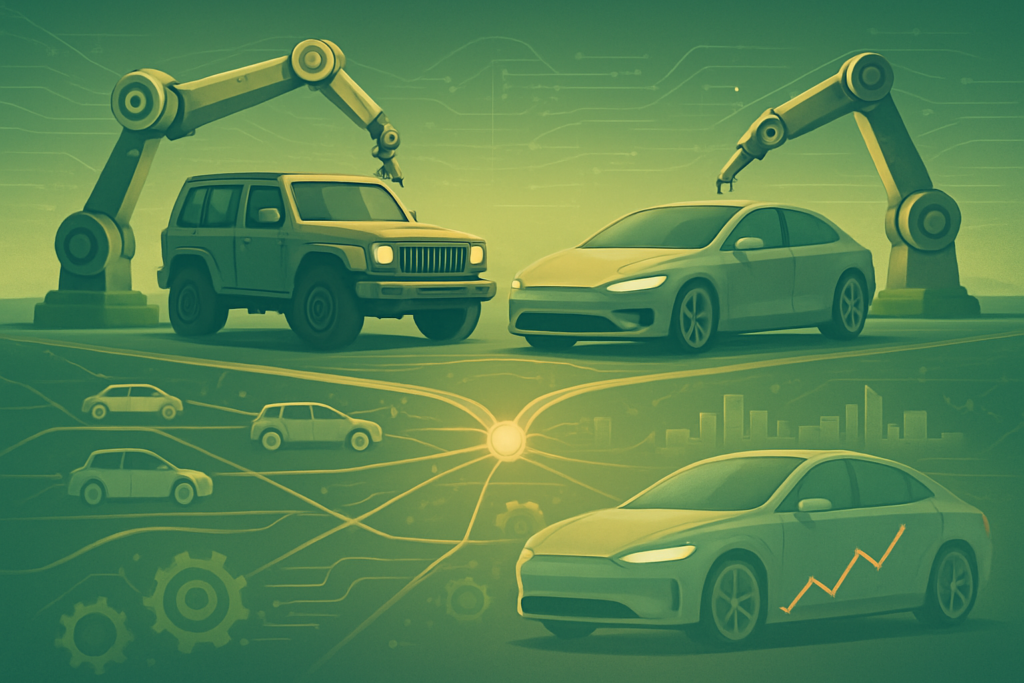
As the automotive industry navigates a "Darwinian" transition from internal combustion engines to software-defined mobility, Stellantis N.V. (NYSE: STLA) finds itself at a critical crossroads. Once hailed as the ultimate efficiency machine following the 2021 merger of PSA and FCA, the company spent 2025 weathering a perfect storm of bloated inventories, executive turnover, and a cooling global EV market. However, a central pillar of its recovery strategy is now coming into sharp focus: a deepened, multi-year strategic alliance with Palantir Technologies Inc. (NYSE: PLTR).
On this day, March 30, 2026, the two companies announced a five-year expansion of their partnership, centered on the deployment of Palantir’s Artificial Intelligence Platform (AIP). This integration is no longer just an IT upgrade; it is an industrial survival strategy designed to transform Stellantis into a data-first enterprise capable of managing 14 iconic brands through the most volatile supply chain environment in a century.
Historical Background
The story of Stellantis began on January 16, 2021, with the 50-50 cross-border merger of the French PSA Group and the Italian-American Fiat Chrysler Automobiles. The merger was born out of necessity, aimed at achieving €5 billion in annual synergies to fund the crushing costs of electrification. Under the early leadership of Carlos Tavares, the architect of the deal, Stellantis quickly became the world’s fourth-largest automaker by volume, housing a portfolio that spans from the rugged Jeep and Ram trucks to the elegant Maserati and mass-market staples like Peugeot and Fiat.
While the first three years of the merger saw record profits and high margins, the honeymoon ended in 2024. Aggressive cost-cutting and a focus on high-margin vehicles led to a buildup of unsold inventory in the United States and a loss of market share in Europe. By late 2024, the internal friction led to the sudden resignation of Carlos Tavares, marking the end of an era and the beginning of a massive strategic "reset" that continues today.
Business Model
Stellantis operates a massive, multi-brand ecosystem designed to cover every segment of the global automotive market. Its revenue is primarily derived from vehicle sales, spare parts, and increasingly, software-as-a-service (SaaS) features within its "connected" fleet.
The business is organized into several key regions:
- North America: The profit engine, dominated by Jeep and Ram.
- Enlarged Europe: The volume core, led by Peugeot, Citroën, Fiat, and Opel/Vauxhall.
- Middle East & Africa, South America, and China: Growth regions where the company maintains a localized manufacturing footprint.
The core of the current business model is "Platform Sharing." Stellantis utilizes four global BEV-native platforms (STLA Small, Medium, Large, and Frame) that can support various propulsion systems—hybrid, electric, and internal combustion—allowing the company to pivot production based on regional demand.
Stock Performance Overview
The performance of STLA stock since its 2021 debut has been a "tale of two halves."
- 2021–2023: Shares performed robustly, reaching all-time highs near $25 in early 2024 as the market rewarded Tavares’ efficiency gains and the company’s massive dividend yields.
- 2024–2025: A precipitous decline followed. Shares plummeted over 40% in 2024 as profit warnings surfaced. The slide continued into early 2026 following the announcement of a massive €22.3 billion net loss for the 2025 fiscal year.
- Current Standing: As of March 30, 2026, STLA is trading around $6.71, hovering near its 52-week low. For investors, the stock has transitioned from a growth-and-income play to a deep-value turnaround story, trading at a P/E ratio that suggests extreme market skepticism regarding its long-term recovery.
Financial Performance
The fiscal year 2025 was a year of reckoning for Stellantis. On February 26, 2026, the company reported:
- Net Revenue: €153.5 billion, a 2% decline YoY.
- Net Loss: A staggering €22.3 billion, largely due to a one-time €25.4 billion strategic charge. This charge was taken to "reset" the North American product lineup and write down legacy EV investments that no longer aligned with the new "Freedom of Choice" strategy.
- Cash Flow: While operational cash flow remained positive at €10.2 billion, the heavy restructuring costs have put a temporary freeze on the aggressive share buyback programs of years past.
- Balance Sheet: Despite the net loss, Stellantis maintains a strong liquidity position of over €45 billion, providing the runway needed for its 2026–2027 product offensive.
Leadership and Management
Following the departure of Carlos Tavares in December 2024, Stellantis entered a period of leadership transition. The company is currently steered by an interim executive committee led by Chairman John Elkann, a scion of the Agnelli family.
The day-to-day strategic shift is being spearheaded by Antonio Filosa, who serves as the Chief Operating Officer for North America and CEO of Jeep. Filosa’s management style is seen as more collaborative and market-responsive than Tavares’ "top-down" efficiency model. The board is currently in the final stages of a global search for a permanent CEO, with an announcement expected before the May 2026 Investor Day.
Products, Services, and Innovations
The cornerstone of Stellantis' innovation is the integration of Palantir Technologies Inc. (NYSE: PLTR) Foundry and AIP platforms. This partnership has evolved into a comprehensive "Digital Twin" of the entire Stellantis enterprise.
Key AI-driven innovations include:
- Supply Chain Resiliency: Using Palantir AIP to simulate thousands of "what-if" scenarios, allowing the company to reroute parts and adjust production schedules in real-time to avoid the assembly line stoppages that plagued 2024.
- Predictive Quality: By analyzing billions of data points from connected vehicles, Stellantis now identifies potential part failures months before they lead to recalls, significantly reducing warranty costs.
- The "Freedom of Choice" Fleet: Launching in 2026 is a new wave of vehicles across the STLA Large and Frame platforms. These include the new electric Ram 1500 REV and a series of "Multi-Energy" Jeep models that allow consumers to choose between hybrid and pure electric powertrains on the same vehicle architecture.
Competitive Landscape
Stellantis faces a two-front war. In North America, it competes with General Motors (NYSE: GM) and Ford Motor Company (NYSE: F) for dominance in the high-margin truck and SUV segments. In Europe and China, it faces intense pressure from Volkswagen AG (OTC: VWAGY) and the rising tide of Chinese automakers like BYD Company Limited (OTC: BYDDY) and Xiaomi (HKG: 1810).
Unlike Tesla, Inc. (NASDAQ: TSLA), which has a vertical integration advantage in software, Stellantis is using the Palantir partnership to "out-data" its legacy peers. While GM and Ford have struggled with software bugs in their EV lineups, Stellantis is banking on its modular platform strategy to remain more flexible and cost-effective than its competitors.
Industry and Market Trends
The automotive industry in 2026 is defined by several macro shifts:
- The Hybrid Resurgence: As pure EV adoption growth slowed in 2025, consumers have flocked to Plug-in Hybrids (PHEVs). Stellantis, once criticized for its slow EV rollout, now finds its hybrid-heavy portfolio perfectly positioned for this shift.
- Software-Defined Vehicles (SDV): Cars are increasingly judged by their digital interfaces rather than their engines. Stellantis’ "SmartCockpit" project, powered by AI, aims to generate €20 billion in annual software-driven revenue by 2030.
- Inventory Normalization: After the post-pandemic "supply shock," the industry has returned to a buyer's market, forcing OEMs to use AI tools for precision marketing and demand forecasting.
Risks and Challenges
The path to recovery is fraught with risks:
- Labor Relations: Stellantis remains in a delicate dance with the United Auto Workers (UAW) in the US and unions in Italy/France. Continued plant "optimizations" could trigger further strikes.
- Execution Risk: Transitioning 14 brands onto four new platforms while integrating a new AI infrastructure is a massive logistical undertaking.
- Geopolitical Friction: Trade wars between the EU/US and China over EV subsidies could disrupt the global supply chain, particularly for battery materials.
Opportunities and Catalysts
- May 2026 Investor Day: This is the most anticipated event of the year. Management is expected to unveil a revised "Dare Forward 2030" plan, likely highlighting the efficiency gains from the Palantir AIP integration.
- New CEO Announcement: A high-profile hire could provide the market with the confidence needed to re-rate the stock.
- Margin Recovery: If the inventory "reset" of 2025 succeeds, Stellantis could see a sharp rebound in North American margins by H2 2026.
Investor Sentiment and Analyst Coverage
Current analyst sentiment is cautious but intrigued. The consensus rating on STLA is "Hold," with many analysts waiting for evidence that the 2025 losses were indeed a "one-time" event. Institutional investors have noted the "deep value" nature of the stock, while retail chatter on social platforms remains divided between those fearful of further declines and those eyeing the high potential for a recovery toward $10–$12.
Palantir's involvement is a major "bull case" for tech-focused analysts, who see Stellantis as the primary case study for how a legacy industrial giant can successfully use AI to close the gap with tech-native competitors like Tesla.
Regulatory, Policy, and Geopolitical Factors
Stellantis must navigate a complex regulatory web. In the EU, tightening CO2 emission standards continue to push the company toward electrification. In the US, the outcome of the 2024 and 2025 policy shifts regarding the Inflation Reduction Act (IRA) has made domestic battery production critical.
The company is heavily invested in "ACC" (Automotive Cells Company), its battery joint venture with Mercedes-Benz and TotalEnergies, which aims to secure a localized supply chain and insulate the company from Asian geopolitical risks.
Conclusion
Stellantis is a company in the midst of a radical metamorphosis. The massive losses of 2025 were a painful but perhaps necessary correction to a "merger-first" strategy that prioritized short-term cost-cutting over long-term market health. By doubling down on its partnership with Palantir and shifting toward a "Freedom of Choice" product strategy, Stellantis is betting that data-driven agility will be the ultimate competitive advantage.
For investors, the current valuation offers a high-risk, high-reward entry point. If the AI-powered efficiency gains and the 2026 product wave take hold, Stellantis could emerge as the most resilient legacy automaker of the decade. However, the margin for error has never been thinner. The next 12 months will determine whether Stellantis is a titan in decline or a phoenix ready for its next ascent.
This content is intended for informational purposes only and is not financial advice.