Since its emergence as a “meme stock” in early 2021, AMC Entertainment (NYSE: AMC) has gone through bouts of short selling, short covering and just plain-old buying and selling.
Does continued short selling in AMC mean investors could see a bounce due to covering or a short squeeze? Or does it mean that a contrarian viewpoint, along the lines of, “It’s so bad, it could only get better” is in order? Or could the short sellers be correct in believing that the foreseeable future for AMC looks like a scary movie?
AMC’s short-interest ratio is currently 2.4, as you can see using MarketBeat’s short-interest data for AMC. That’s how many days it would take for the total number of shares sold short to be covered and then closed.
Short interest is reported twice per month. The most recent percentage of AMC shares shorted is 19.14%, which is down 1.1% from the previous report in mid-September.
So what does that say about the stock’s prospects right now? Although the percentage of shares shorted is slightly lower, there’s plenty of reason to be bearish on the stock.
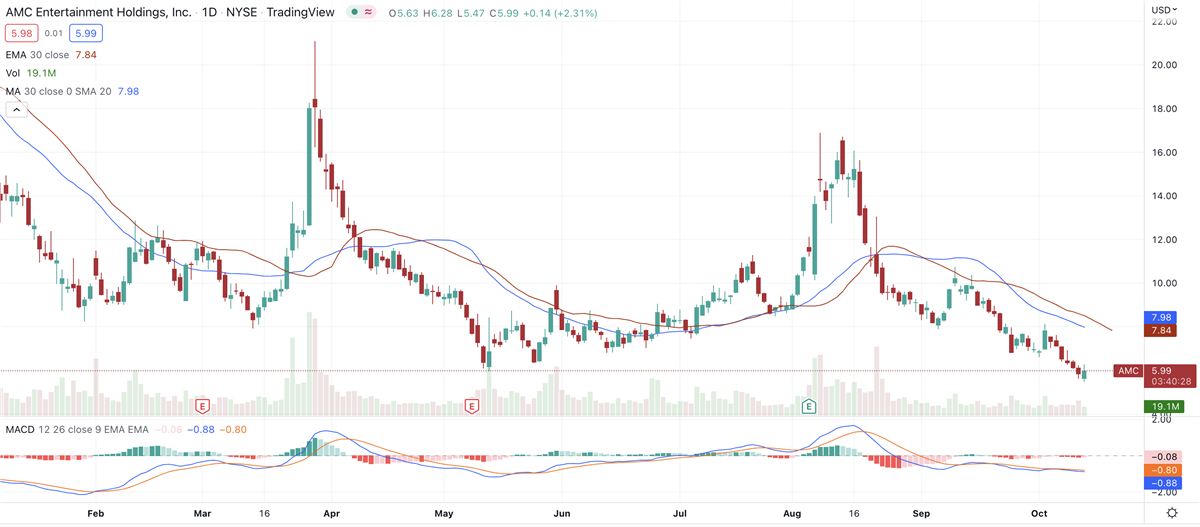
For starters, put the short- and long-term performance in perspective:
- 1 week: -20.19%
- 1 month: -42.76%
- 3 months: -62.50%
- Year-to-date: -78.49%
- 1 year: -84.11%
- 3 years: -12.96%
- 5 years: -11.12%
It would be tough to find such a dismal, uninterrupted string of price declines in many other stocks. Sure, AMC has notched a few months of gains here and there, but as you can see, any rally has been impossible to sustain. Score a point for the short sellers.
Pandemic-driven movie theater closures, while an obvious blow, were just one more gut punch to an industry that was already in decline. Movie theater ticket sales, in terms of volume, peaked way back in 2002. Sure, there are certain movies that are better in theaters, and always folks who say, “I prefer the theater experience to streaming at home,” but the reality is: Attendance has been in decline for 20 years.
In addition, as inflation heats up and consumers worry about a recession, discretionary spending, such as entertainment, may decline. That’s especially true of a day at the movies, where buying tickets for a family, plus snacks and drinks (where theaters really make their money) can become a pricey endeavor.
The sub-industry of movie theaters, within the consumer discretionary sector, looks bleak. Stocks like Imax (NYSE: IMAX) and Cinemark Holdings (NYSE: CNK) have also been in decline, without the ability to gain much upside traction in the past several years. In other words, it’s not necessarily just internal weakness at AMC that’s the problem here.
AMC’s institutional ownership, as tracked by MarketBeat, offers another perspective, so let’s dig in. Remember, these owners represent pretty much the polar opposite of meme-stock buyers and sellers. In the past 12 months, more institutions bought shares than sold, although if you study the column titled “% of portfolio,” you’ll see that AMC represents tiny fractions of most institutions’ holdings.
In addition, the market value of many institutional holdings in AMC is ridiculously low.
Those two data points can signal a lack of conviction and a low barrier to selling shares and bailing out.
On a more positive note, AMC’s restructuring allowed it to stave off bankruptcy, and its popularity among retail investors has allowed the company to raise some much-needed cash. Revenue has risen at triple- or quadruple-digit rates in each of the past five quarters.
As MarketBeat earnings data show, the company is still reporting losses, although losses are narrowing and AMC has even beaten views in the past five quarters.
In addition, Wall Street expects those losses to continue narrowing. For the full year, analysts see AMC reporting a loss of $0.82 per share, an improvement over the 2021 loss of $2.50 per share. Next year, that’s seen improving again, to a loss of $0.27 per share.
Analysts’ consensus rating on AMC is “hold,” and with a nod to the short sellers, the consensus price target is $3.75, a downside of 39.12%.
Given all that information about the stock, the bull case doesn’t appear to be very strong.
But shorting a stock isn’t the only way to make a bet against it, and can be risky. If you have a belief that any stock will move lower, put options can be a way to express that thesis, while limiting your risk. As always, when deciding whether to go long, go short or use options in any stock, understand the risks involved and how your decision fits into your overall investment philosophy and your available investable capital.