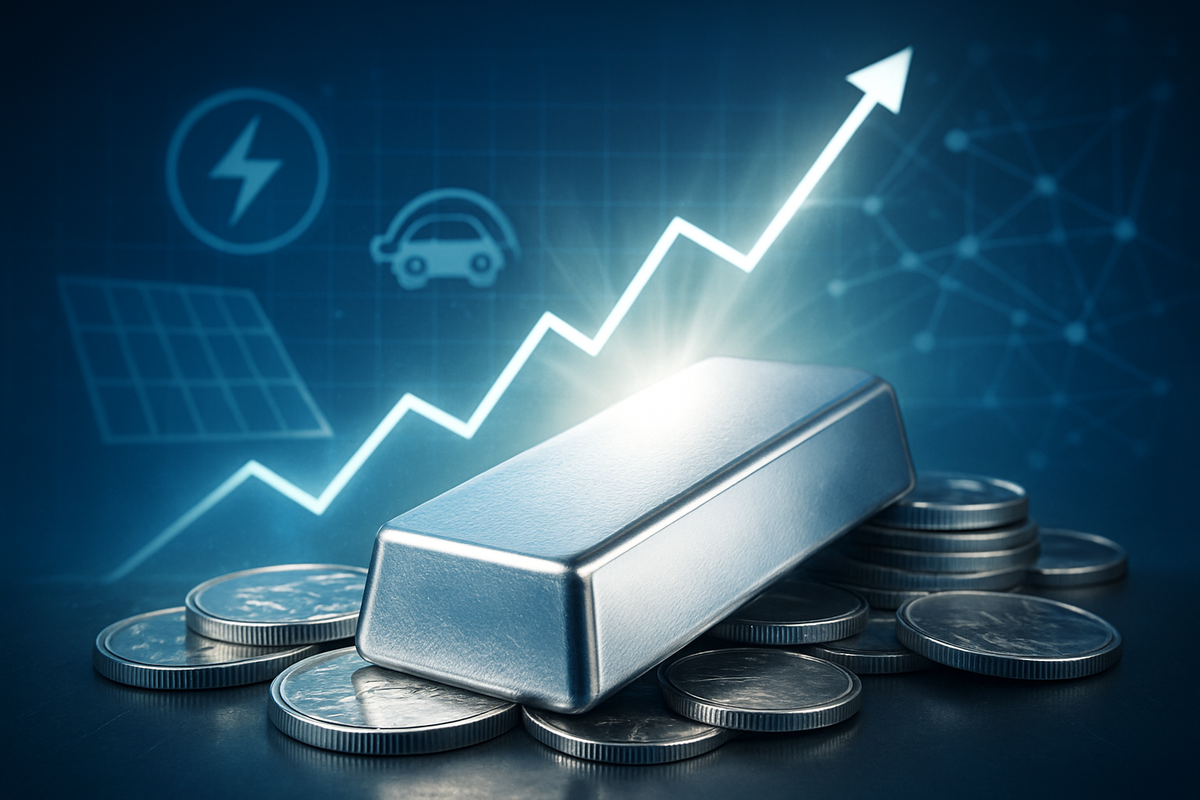
The global financial markets are currently witnessing an extraordinary phenomenon: an explosive and sustained price surge in silver, pushing the precious white metal to unprecedented record highs. As of December 11, 2025, silver prices have not only shattered historical benchmarks but have more than doubled since the beginning of the year, significantly outpacing traditional safe-haven assets like gold and broader market indices. This remarkable rally signals a fundamental shift in the metal's market dynamics, driven by a convergence of robust industrial demand, persistent supply deficits, and a renewed investor appetite for tangible assets amidst economic uncertainties.
The immediate implications of this surge are far-reaching, impacting everyone from industrial manufacturers relying on silver for cutting-edge technologies to investors seeking hedges against inflation, and even everyday consumers. The dramatic increase in silver's value highlights its evolving role from merely a precious metal to a critical industrial commodity, essential for the accelerating green energy transition and the burgeoning digital economy. This re-evaluation is setting the stage for potential market transformations, challenging established supply chains, and offering both significant opportunities and considerable risks across various sectors.
The Perfect Storm: Unpacking Silver's Historic Climb
Silver's meteoric rise throughout 2025 has been nothing short of spectacular, culminating in a series of broken records that have left analysts and investors alike in awe. The year began with silver breaking the $30 barrier in January, a psychological and technical milestone. However, the true acceleration began in October, when the metal surpassed its 1980 all-time high of $49.95, breaching $54 per troy ounce. The momentum continued relentlessly into November, establishing a new peak of $54.42, and then sensationally breaking above $55 for the first time in history.
December has seen the surge intensify dramatically, with silver consistently setting new records. On December 1st, it reached $57.85, boasting an astonishing year-to-date gain of over 95%. The ascent continued, touching $59.33 on December 5th, and most notably, crossing the monumental $60 threshold for the first time ever on December 9th, trading between $60.82 and $61.06. As of December 11, 2025, silver continues its record-breaking run, hovering around $62.45, with an all-time high reported at $62.87-$62.88 per ounce. In India, prices mirrored this global trend, skyrocketing to a fresh peak of ₹192,000 per kg.
This unprecedented rally is fueled by a "perfect storm" of interconnected factors. A primary driver is the robust and ever-growing industrial demand, which now accounts for over half of global silver consumption. Key sectors like solar photovoltaics (PV), electric vehicles (EVs), 5G infrastructure, and advanced electronics are experiencing record growth, all of which are heavily reliant on silver for its superior electrical and thermal conductivity. The surging electricity requirements of artificial intelligence (AI) data centers are also contributing significantly to this demand. Compounding this industrial thirst is a persistent supply deficit, marking five consecutive years where demand has outstripped mine production. Silver is predominantly a byproduct of other metal mining, making it challenging to rapidly scale up production. This has led to critically tight inventories, with a historic liquidity squeeze noted in London in October and Shanghai inventories near a ten-year low. The market is experiencing a "price convexity," where dwindling free-trading inventory accelerates price changes with further demand.
Adding further impetus are macroeconomic factors: expectations of Federal Reserve interest rate cuts, with a 25-basis-point reduction anticipated this week, have boosted silver's appeal by lowering the opportunity cost of holding non-yielding assets. A weakening US dollar also makes silver more attractive to international investors. Geopolitical uncertainties, including inflation concerns and ongoing global conflicts, have reinforced safe-haven demand. Finally, the United States' designation of silver as a critical mineral in November underscores its strategic importance and has further fueled speculative interest, contributing to significant inflows into silver-backed Exchange Traded Funds (ETFs) and institutional investor interest.
Industry Winners and Losers in the Silver Rush
The explosive surge in silver prices is creating a distinct stratification of winners and losers across various industries, fundamentally altering the competitive landscape for public companies.
On the winning side are primarily silver mining companies and diversified miners with significant silver operations. Companies like Fresnillo PLC (LSE: FRES), one of the world's largest primary silver producers, are poised for substantial revenue and profit growth. Their existing reserves become significantly more valuable, and their operational margins expand dramatically. Similarly, companies such as Pan American Silver Corp. (TSX: PAAS, NASDAQ: PAAS) and Wheaton Precious Metals Corp. (TSX: WPM, NYSE: WPM), a major silver streaming company, will see their asset values and cash flows soar. This allows for increased capital expenditure, debt reduction, or enhanced shareholder returns through dividends and buybacks. However, these companies also face the challenge of managing increased operational costs and potential regulatory scrutiny as the metal gains strategic importance.
Conversely, industries heavily reliant on silver as a key input material are facing significant headwinds. Solar panel manufacturers, for instance, are among the most exposed. Companies like First Solar, Inc. (NASDAQ: FSLR), while innovative, will grapple with substantially higher raw material costs for the silver paste used in photovoltaic cells. This could squeeze their profit margins, necessitate price increases for their products, or force them to accelerate research into silver-reduction technologies. Similarly, manufacturers of electric vehicles (EVs) and advanced electronics, including major players like Tesla, Inc. (NASDAQ: TSLA) and various semiconductor companies, will see their bill of materials increase. While silver constitutes a smaller percentage of their overall cost compared to solar, the sheer volume of silver used across millions of units will translate into substantial additional expenses, potentially impacting their profitability and competitive pricing strategies.
The jewelry and silverware industries, which cater to discretionary consumer spending, also face a challenging environment. While higher silver prices might initially spark some speculative buying, sustained elevated prices could deter consumers, leading to reduced demand for silver-based products. Retailers and manufacturers in this segment may struggle to pass on the full cost increase to customers, impacting their sales volumes and profit margins. Furthermore, the volatility associated with such a rapid price surge complicates inventory management and hedging strategies for all companies involved, introducing an element of financial risk even for those benefiting from the higher prices.
Broader Implications and Historical Context
Silver's explosive price surge extends far beyond the immediate gains and losses of individual companies, signifying profound shifts within broader industry trends and carrying significant macroeconomic implications. This event underscores a fundamental re-evaluation of silver's role, transitioning it from a mere precious metal often overshadowed by gold to a critical industrial commodity essential for the global green and digital transitions. This shift fits squarely into the accelerating trend of electrification and decarbonization, where silver's unparalleled conductivity makes it irreplaceable in solar, EV, and 5G technologies.
The ripple effects are already being felt across competitive landscapes. Competitors in the solar and electronics sectors that have invested more heavily in silver-reduction or recycling technologies may gain a competitive advantage over those more dependent on virgin silver. Partnerships across the supply chain, from miners to refiners and end-users, will likely strengthen as companies seek to secure stable supply and mitigate price volatility. Furthermore, the designation of silver as a critical mineral by the United States in November highlights potential regulatory and policy implications. Governments may explore incentives for domestic silver production, strategic stockpiling, or even export restrictions, further impacting global supply dynamics and potentially leading to trade tensions.
Historically, silver has always been a volatile asset, prone to dramatic price swings. The current surge draws parallels to the "Silver Thursday" event of 1980, when the Hunt brothers' attempt to corner the market led to a parabolic rise followed by a spectacular crash. While the current drivers are fundamentally different—rooted in genuine industrial demand and supply deficits rather than speculative manipulation—the sheer magnitude of the price movement evokes memories of such historical precedents. Another comparison can be drawn to periods of high inflation and economic uncertainty, where precious metals traditionally serve as a hedge. However, the unique blend of industrial demand and safe-haven appeal in the current environment positions this surge as a distinct and potentially more sustainable phenomenon than purely speculative bubbles of the past.
The Road Ahead: Navigating Silver's Future
Looking ahead, the trajectory of silver prices will be shaped by a complex interplay of short-term market dynamics and long-term structural shifts. In the short term, market participants will closely watch for any signals from central banks regarding interest rate policies. While a Federal Reserve rate cut is anticipated this week, any deviation or hawkish rhetoric could introduce volatility. The ongoing geopolitical landscape and global economic data will also influence safe-haven demand. Continued tight inventories and any further supply disruptions could trigger additional price spikes, especially if industrial demand remains robust.
In the long term, the fundamental drivers of industrial demand appear resilient. The global push for renewable energy, particularly solar power, is unlikely to abate, ensuring a sustained need for silver. The proliferation of electric vehicles, 5G networks, and AI infrastructure will also continue to fuel consumption. This structural demand, coupled with the inherent difficulties in rapidly increasing silver mine supply (as most silver is a byproduct), suggests a sustained bullish outlook for the metal. Potential strategic pivots for companies include increased investment in exploration and development by mining firms, and accelerated research and development into silver-alternative materials or enhanced recycling technologies by industrial users.
Market opportunities may emerge for investors in silver-backed ETFs, futures contracts, and shares of well-positioned mining companies. However, the high volatility also presents challenges, necessitating careful risk management. Potential scenarios range from a continued, albeit slower, upward trajectory, to periods of consolidation or even sharp corrections if demand falters or new supply unexpectedly comes online. A "super cycle" for commodities, driven by the green transition, could see silver maintain its elevated status for years to come. Conversely, a global economic slowdown or a breakthrough in silver-free technologies could temper the rally. Investors should also monitor regulatory developments, particularly those related to critical minerals and strategic stockpiling, as these could significantly influence future supply and demand dynamics.
Concluding Thoughts: Silver's Enduring Impact
Silver's explosive price surge in 2025 marks a pivotal moment for the global financial markets and industrial sectors. The key takeaway is the white metal's re-emergence not just as a traditional safe-haven asset, but as an indispensable industrial commodity, critical to the burgeoning green energy and digital revolutions. The confluence of robust demand from solar, EVs, and advanced electronics, coupled with a persistent supply deficit and tight inventories, has created a powerful bullish narrative that has propelled prices to unprecedented heights. This fundamental shift underscores silver's growing strategic importance on a global scale.
Moving forward, the market will likely remain highly dynamic. While some short-term volatility is to be expected, the underlying structural demand drivers suggest that silver is unlikely to retreat to its pre-2025 levels anytime soon. The rally highlights the increasing strain on raw material supply chains as the world accelerates its transition towards a more sustainable and technologically advanced future. Companies across various sectors will need to adapt, whether by securing long-term supply agreements, investing in recycling, or innovating with alternative materials.
Investors should continue to watch for several key indicators in the coming months: the pace of global economic growth and industrial production, particularly in China and other emerging markets; the Federal Reserve's monetary policy decisions and their impact on the US dollar; and any new developments in silver mining output or significant technological breakthroughs that could alter demand profiles. The long-term significance of this event lies in its potential to redefine silver's market valuation and its integral role in the global economy, solidifying its position as a critical metal for the 21st century.
This content is intended for informational purposes only and is not financial advice