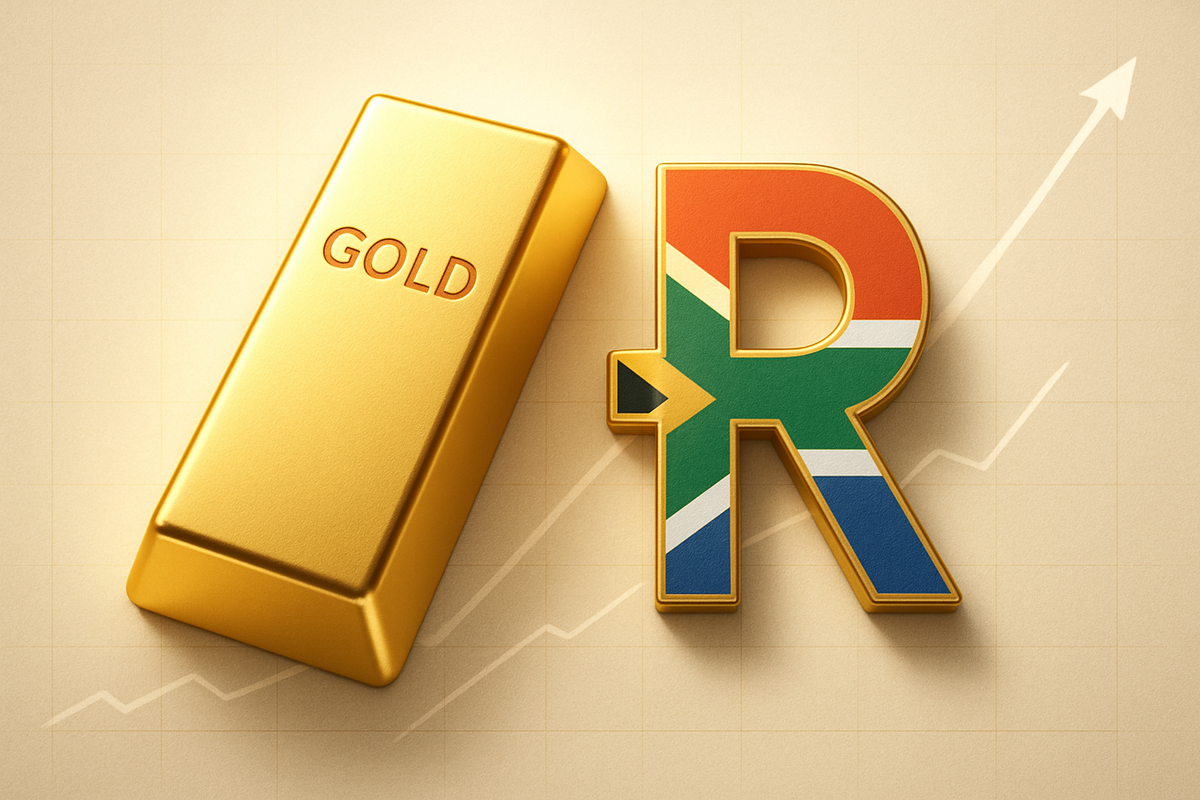
The South African Rand (ZAR) is currently experiencing a robust period of strength, a phenomenon inextricably linked to the unprecedented surge in global gold prices. As of December 12, 2025, the precious metal has not only maintained its elevated position but has continued its upward trajectory, pulling the commodity-linked Rand along with it. This dynamic interplay is creating a significant ripple effect across South Africa's economy, bolstering national revenue, influencing monetary policy, and reshaping investor sentiment.
The immediate implications of this synchronized ascent are overwhelmingly positive for the South African economy. A stronger Rand translates to reduced import costs, which in turn helps to keep inflation in check – a critical factor given the nation's recently tightened inflation target. Furthermore, the windfall from soaring gold exports significantly boosts South Africa's foreign currency reserves and government coffers through increased corporate tax receipts from the thriving mining sector. This confluence of factors paints a picture of cautious optimism, even as market participants remain vigilant for potential shifts in the global economic landscape.
Gold's Golden Run Fuels Rand's Resurgence
The narrative of the Rand's current strength is deeply intertwined with gold's spectacular performance throughout 2025. Gold prices have been on an aggressive bull run, reaching a remarkable $4,343.65 per ounce on December 12, 2025, having touched an all-time high of $4,381 earlier in October. This persistent upward momentum in bullion prices has provided a direct and powerful tailwind for the South African currency.
The Rand, in turn, has responded with remarkable resilience. On December 12, 2025, it traded at 16.84 per dollar, marking a 0.2% gain from the previous day and nearing its strongest level for the year. Over the last 12 months, the ZAR has appreciated by 5.54%, even breaking below the psychological R17.00 to the dollar mark at the beginning of December – a level not seen consistently since 2023. This performance is not solely attributed to gold; it is also underpinned by strategic domestic developments including monetary easing by the South African Reserve Bank (SARB), firmer fiscal guidance, and clearer inflation objectives, all contributing to an improved macroeconomic environment.
Key players in this unfolding drama include the South African Reserve Bank, which in November 2025, opted for a 25 basis point repo rate cut, signaling a willingness to support economic growth amidst a strengthening currency and subdued inflation. Major gold mining companies operating in South Africa are direct beneficiaries, seeing their revenues swell with every tick upwards in gold prices. Global investors, drawn by the improved economic indicators and the Rand's resilience, are also playing a crucial role, as evidenced by successful dollar-denominated eurobond issuances that highlight South Africa's rising attractiveness.
Initial market reactions have been largely positive, albeit with an undercurrent of caution. While gold market sentiment is unequivocally bullish, with technical indicators suggesting continued upward movement, the outlook for the Rand is more nuanced. Analysts project a strong finish for the ZAR into year-end 2025 and potential further strengthening into 2026. However, there's a recognition that some of the 2025 recovery might be driven by "one-off" factors like exceptionally high gold prices and pent-up demand, rather than a fundamentally sustained boom. Traders are closely watching upcoming economic data, particularly November's consumer inflation figures due on December 17, 2025, and any further signals from the US Federal Reserve regarding future rate cuts, which could significantly impact both gold and emerging market currencies.
Winners and Losers: South Africa's Gold Miners Strike it Rich, But With Nuances
The dual forces of soaring global gold prices and a strengthening South African Rand (ZAR) are creating a complex, yet largely advantageous, landscape for South Africa's prominent gold mining companies as of December 12, 2025. While a stronger local currency typically erodes the Rand-denominated revenues of exporters, the sheer magnitude of gold's price surge has proven to be an overwhelming positive, driving substantial revenue growth and enhanced profitability across the sector.
Leading the charge in capitalizing on this golden era is AngloGold Ashanti (JSE: ANG). With a diversified global footprint spanning Africa, Australia, and the Americas, the company has reported exceptional financial performance. Its Q1 2025 free cash flow soared by an astounding 607% year-on-year to $403 million, with revenue growing over 50% in the preceding twelve months. Effective cost management, with unit costs increasing by a modest 7% in FY2025, has further amplified its gains. This has translated into profits attributable to equity shareholders increasing nearly eightfold in Q1 2025 and a robust stock performance, appreciating 274.7% over the past year, significantly outperforming the broader gold mining industry. AngloGold Ashanti stands as a clear winner, leveraging its operational efficiency and global reach to maximize returns from the current gold supercycle.
Similarly, Gold Fields (JSE: GFI), another globally diversified player with operations across Australia, Ghana, Peru, and Chile, has reaped significant benefits. The company anticipated a robust increase of up to 236% in half-year profits for the period ending June 30, 2025, driven by higher gold production and record bullion prices. Despite some production setbacks, strong cost control and operational efficiency have contributed to a projected headline earnings per common share ranging between $1.09 and $1.21 for the first half of 2025, a substantial leap from the prior year. While its shares have experienced some volatility, the overall outlook remains optimistic, with analysts projecting considerable upside potential, solidifying Gold Fields' position as a major beneficiary of the current market dynamics.
Harmony Gold (JSE: HAR), traditionally more concentrated within South Africa, has also seen substantial gains from the record gold prices, but with more pronounced challenges from rising domestic operational costs. For fiscal year 2025, Harmony Gold's revenue climbed 20% to US$4.07 billion, primarily due to a 27% increase in realized gold prices, even as production volumes saw a 5% decline. However, the company experienced a 20% surge in its all-in sustaining costs (AISC) in fiscal 2025, reaching $1,806 an ounce, largely due to higher wages, electricity tariffs, and sustained capital expenditures. This higher cost base has put a squeeze on its margins, causing its stock performance, while still up nearly 62% in 2025, to lag the broader gold mining sector's advance. In response to these pressures, Harmony Gold is strategically diversifying into copper, aiming for it to constitute 40% of its output by 2035, signaling a proactive adaptation to evolving market conditions and domestic cost challenges.
Wider Significance: Riding the Commodity Supercycle Amidst Structural Realities
The current robust performance of the South African Rand, underpinned by stratospheric gold prices, is not an isolated incident but rather a significant development within broader global industry trends. Many analysts are heralding this period as a new commodity supercycle, in full swing by late 2025. This cycle is fueled by multi-year global phenomena, including massive infrastructure spending, the accelerating energy transition demanding vast quantities of base metals, and persistent supply limitations across a spectrum of raw materials. Gold's role within this supercycle is particularly crucial, serving as an indispensable store of value amidst ongoing global economic volatility, persistent inflation concerns, and geopolitical uncertainties. Strong demand from central banks, projected to continue high levels of gold purchases (around 900 tonnes in 2025), and increasing investor interest, particularly from China, are structural factors underpinning gold's sustained rally.
The ripple effects of this dynamic extend across the global mining and finance sectors. While soaring gold prices generally translate to higher revenues for gold miners worldwide, the strengthening ZAR presents a nuanced picture for South African producers. As mining companies incur a significant portion of their expenses in local currency, a stronger Rand can, in theory, compress profit margins by reducing the ZAR equivalent of their US dollar-denominated gold sales. However, the sheer magnitude of the gold price rally has largely mitigated this headwind, allowing major South African gold mining companies like AngloGold Ashanti (JSE: ANG) and Gold Fields (JSE: GFI) to report expanded EBITDA margins and significant share price gains. Despite this, South Africa's gold mining industry has seen a substantial decline in global prominence over decades, producing less than 3% of the world's total. This positions the nation as a "price taker," limiting its ability to fully capitalize on the boom compared to competitors in other gold-producing nations with more favorable operating environments or weaker currencies. Conversely, in the global finance sector, the ZAR's strength, supported by improving domestic fundamentals, enhances South Africa's attractiveness to international investors, leading to increased foreign direct investment inflows into its mining sector and greater demand for South African assets like bonds.
Domestically, the ZAR's strength and the gold rally carry profound regulatory and policy implications for South Africa. The government's commitment to tighter fiscal policies, achieving a primary surplus, and stabilizing debt has been recognized, notably by S&P Global's upgrade of South Africa to BB in November 2025 – the first such upgrade in nearly two decades. This improved fiscal outlook is a critical factor bolstering the Rand and investor confidence. Furthermore, a landmark policy shift saw the Finance Minister confirm a new inflation target of 3% (with a 1% tolerance band) in November 2025, prompting the South African Reserve Bank (SARB) to cut its repo rate to 6.75%. This move is designed to anchor inflation expectations, create room for further monetary easing, and reduce borrowing costs, all of which contribute to currency stability and economic growth. However, despite the current boom, South Africa's mining sector continues to grapple with deep-rooted structural challenges, including unreliable electricity supply from Eskom, rising operational costs, persistent labor disputes, and illegal mining. These issues inherently limit the country's capacity to fully exploit the high gold prices and translate the commodity boom into sustainable economic growth and job creation, underscoring the need for continued structural reforms.
Historically, the interplay between currency strength and commodity prices, particularly gold, is well-documented. The South African Rand has consistently exhibited a strong positive correlation with gold prices; periods of rising gold prices have typically seen the ZAR strengthen. This relationship is evident in the current environment, with gold acting as a safe-haven asset, appreciating during global economic uncertainty and geopolitical shifts, thereby benefiting the ZAR. Moreover, the current commodity supercycle finds parallels in previous cycles that have historically lasted 10-20 years, each driven by structural shifts in global demand and supply. These historical precedents highlight how surging commodity prices can infuse capital into commodity-exporting nations, driving economic activity and currency appreciation. However, they also serve as a reminder that periods of freely floating exchange rates can be associated with larger and longer real commodity price boom-bust episodes, underscoring the inherent volatility and the critical importance of prudent economic management to navigate such cycles successfully.
What Comes Next: Navigating the Golden Horizon
The path ahead for the South African Rand and gold prices is marked by both significant opportunities and persistent challenges, shaped by a complex interplay of global and domestic factors. In the short term, the ZAR faces continued volatility. While it has recently shown signs of recovery, trading around R17.2 to the US dollar as of December 12, 2025, forecasts suggest it could fluctuate between 18.00 and 19.50 through 2025. An intensified domestic power crisis or sustained elevated US interest rates could push it towards 21.00, whereas early US Federal Reserve (Fed) rate cuts or substantial progress in South Africa's reforms might see it strengthen towards 16.00-17.00. The South African Reserve Bank (SARB) has already cut its repo rate by 100 basis points in 2025, with further easing anticipated in 2026, aiming to stimulate domestic growth despite potential impacts on carry trade appeal.
Long-term, the ZAR's outlook into 2026 and beyond suggests marginal strengthening at best, heavily contingent on consistent economic reforms and improved growth rates. South Africa's structural vulnerabilities, including persistent energy shortages, unreliable logistics, and tepid GDP growth (projected at 1.1% to 1.5% annually through 2028), impose a continuous risk premium on the currency. However, the government's commitment to fiscal consolidation, aiming to stabilize debt, has garnered positive attention from credit rating agencies, providing a crucial underpinning for stability.
For gold, the outlook remains broadly bullish for both the short and long term. Having achieved over 50 all-time highs in 2025 and trading at $4,329.41 per troy ounce on December 12, 2025, gold is expected to remain elevated, consolidating before extending gains towards $4,100-$4,200. This is driven by ongoing global uncertainties and expectations of further Fed rate cuts. Long-term projections for 2026 and beyond place gold within the $4,000-$4,500 range, with some optimistic forecasts even suggesting a climb to $5,000 per ounce in 2026, and potentially $10,000 by 2050. These projections are supported by anticipated US Fed easing, robust central bank and retail demand, significant Exchange Traded Fund (ETF) inflows, and pervasive concerns over global debt and geopolitical fragmentation.
Strategic pivots and adaptations are crucial for South Africa. The government must prioritize continued fiscal discipline, aggressive infrastructure investment and reform (particularly in electricity and logistics), and ambitious structural reforms in product markets, governance, and labor. Combating corruption with greater momentum is also paramount to attract and retain investment. Furthermore, diversifying trade relations, particularly within BRICS and with China, could offer new avenues amidst global trade tensions. Businesses need to focus on operational resilience against infrastructure challenges, innovate in high-growth sectors like technology, renewable energy, and Fintech, and diversify export destinations. Gold mining companies, while benefiting from high prices, should consider production ramp-ups to capitalize on the rally, while rigorously managing rising operational costs.
Market opportunities include the sustained gold-led revenue boost for the mining sector, improved fiscal credibility attracting foreign direct investment, and potential tailwinds from a weaker US dollar if the Fed implements more aggressive rate cuts. High-growth domestic sectors like Fintech and e-commerce also present significant investment opportunities. However, challenges are substantial: persistent domestic weaknesses like high unemployment and inequality, critical infrastructure deficits (Eskom and Transnet), ongoing political uncertainty, and the potential for a global economic slowdown or intensified trade tensions (such as the non-renewal of AGOA) could undermine progress. Divergent monetary policies, with the US Fed potentially taking a more cautious approach to rate cuts than the SARB, could also maintain US dollar strength and pressure the ZAR.
Potential scenarios for the ZAR range from an optimistic strengthening below 17.00 to a pessimistic weakening towards 20.00-21.00, depending on the interplay of reforms and global factors. For gold, a bullish scenario could see gains of 15%-30% in 2026, while a bearish outlook could involve a 5%-20% correction if global growth strengthens unexpectedly. Ultimately, while gold is largely expected to maintain its bullish trajectory, the South African Rand's future strength hinges significantly on the government's ability to consistently implement challenging domestic reforms, improve infrastructure, and adeptly navigate a complex global economic and geopolitical environment.
Wrap-up: Riding the Golden Wave with Caution
The year 2025 has been a testament to the enduring power of gold and its profound influence on commodity-linked currencies, most notably the South African Rand. As of December 12, 2025, the ZAR's remarkable strength stands as a direct reflection of gold's unprecedented rally, underscoring the intricate dance between global commodity markets and national economic fortunes. This period has been characterized by a confluence of factors: gold's exceptional performance driven by heightened geopolitical risks, aggressive central bank purchases diversifying away from the US dollar, and a resurgence in investor demand. The ZAR, in turn, has capitalized on this momentum, further bolstered by a broader weakening of the US Dollar and the South African Reserve Bank's (SARB) steadfast commitment to an anti-inflationary monetary policy.
Moving forward, the market assessment for gold remains broadly bullish. Major financial institutions anticipate continued upward momentum, with prices projected to average well above $3,600/oz and potentially challenging the $5,000/oz mark by late 2026. This outlook is anchored by sustained central bank demand, ongoing safe-haven flows amidst persistent global uncertainties, and an anticipated softer US dollar. However, potential headwinds such as a stronger-than-expected US dollar or persistently higher US interest rates could temper this ascent. For the South African Rand, the bullish trend is expected to persist, primarily supported by elevated commodity prices, including a recovery in Platinum Group Metals, and the SARB's consistent policy stance. Crucially, the ZAR's long-term trajectory will be heavily influenced by domestic factors: the government's fiscal discipline, effective management of the public wage bill and state-owned enterprises, and the ability of the coalition government to implement much-needed structural reforms to address deep-seated issues like unreliable infrastructure and high unemployment.
The lasting significance of this period lies in its reaffirmation of gold's indispensable role as a safe-haven asset and a powerful portfolio diversifier in a world increasingly grappling with geopolitical instability, trade protectionism, and de-dollarization efforts. For South Africa, it starkly reiterates the Rand's inherent link to global commodity cycles, making its economic fortunes highly sensitive to international demand and pricing for precious metals. While the SARB's credible monetary policy has provided a vital domestic stabilizing force, the ultimate impact on South Africa's broader economy will hinge on the government's capacity to translate these commodity windfalls into sustainable, inclusive economic growth through prudent fiscal management and the diligent implementation of structural reforms. Without addressing underlying domestic challenges, the ZAR's strength, while welcome, risks remaining largely cyclical rather than fundamentally structural.
For investors, vigilance is key in the coming months. Closely monitor global monetary policy, particularly the US Federal Reserve's pronouncements on interest rates, as a softer stance could further weaken the dollar and bolster both gold and commodity-linked currencies like the ZAR. Geopolitical developments and evolving trade tensions, especially concerning the US and its trading partners, will remain significant drivers for gold and broader risk sentiment towards emerging markets. Furthermore, pay close attention to the dynamics of other key South African commodity exports, such as Platinum Group Metals. Domestically, scrutinize the South African government's progress on fiscal consolidation and structural reforms, alongside upcoming economic data like inflation figures and any further decisions from the SARB. Political stability and the effectiveness of the coalition government in addressing economic challenges will also be paramount. For those seeking to leverage these dynamics, gold continues to be recommended as a strategic hedge against market volatility and inflation. Investors with exposure to ZAR-denominated assets should acknowledge the currency's inherent volatility and the complex interplay of global and local factors. A well-diversified portfolio, strategically balanced across different asset classes and geographies, remains the most prudent approach in this dynamic environment.
This content is intended for informational purposes only and is not financial advice