As the calendar turns toward 2026, the electric vehicle landscape is witnessing a dramatic shift in sentiment surrounding Rivian Automotive (NASDAQ: RIVN). Long viewed as a high-potential but cash-burning underdog, the Irvine-based automaker is now being hailed by prominent market analysts and even seasoned Tesla (NASDAQ: TSLA) bulls as a company on the precipice of a "major inflection year." This newfound optimism follows a late-2025 rally that has seen Rivian’s stock price surge, fueled by a combination of technological breakthroughs, strategic partnerships, and a clear path toward mass-market production.
The immediate implications are profound: Rivian is no longer just a niche manufacturer of luxury adventure vehicles. With the impending launch of its R2 platform and a multi-billion-dollar software validation from Volkswagen (OTC:VWAGY), the company is positioning itself as the primary challenger to Tesla’s dominance in the North American EV market. For investors, the current momentum suggests that the "survival phase" of Rivian’s history has concluded, giving way to a high-growth era defined by software-driven margins and manufacturing scale.
The Road to the "Model 3 Moment"
The narrative of 2026 as an "inflection year" gained significant steam in December 2025, largely driven by vocal support from influential analysts like Dan Ives of Wedbush Securities. Ives, a well-known bull on Tesla (NASDAQ: TSLA), recently raised his price target for Rivian to $25, arguing that the company is finally executing on its long-term vision. This sentiment was echoed by Ben Kallo of Baird, who upgraded the stock to "Outperform," citing the upcoming R2 mid-size SUV as a "multi-year catalyst" that mirrors the pivotal moment Tesla experienced with the Model 3.
The timeline leading to this moment has been marked by strategic resilience. Throughout 2024 and 2025, Rivian focused on streamlining its operations at its Normal, Illinois facility and securing its financial future. A watershed moment occurred in late 2024 when the Volkswagen Group (OTC:VWAGY) increased its investment in a joint technology venture with Rivian to $5.8 billion. This capital infusion provided the necessary runway to bridge the gap to the R2 launch. Most recently, on December 11, 2025, Rivian held its inaugural "Autonomy & AI Day," where it unveiled its in-house "RAP1" custom 5nm silicon chip and the "Autonomy+" subscription service, signaling a pivot toward high-margin recurring revenue.
The market reaction has been swift and decisive. Following a Q3 2025 earnings report that showed the company achieving its first-ever consolidated gross profit of $24 million, the stock began a steady climb. By December 18, 2025, Rivian shares jumped 15% in a single session to close at $20.28. As of today, December 19, 2025, the stock continues to trade with high volume, hovering in the $23–$24 range as investors price in the "monster year" expected for 2026.
Winners and Losers in the New EV Order
Rivian (NASDAQ: RIVN) stands as the primary winner of this shift, having successfully navigated the "valley of death" that has claimed many other EV startups. By securing a Tier-1 global partner in Volkswagen (OTC:VWAGY), Rivian has effectively licensed its "zonal architecture" and software stack, turning its technology into a product in its own right. Volkswagen itself is a winner here, as the partnership allows the German giant to bypass its own internal software struggles and integrate Rivian’s advanced systems into future Audi and Scout Motors vehicles.
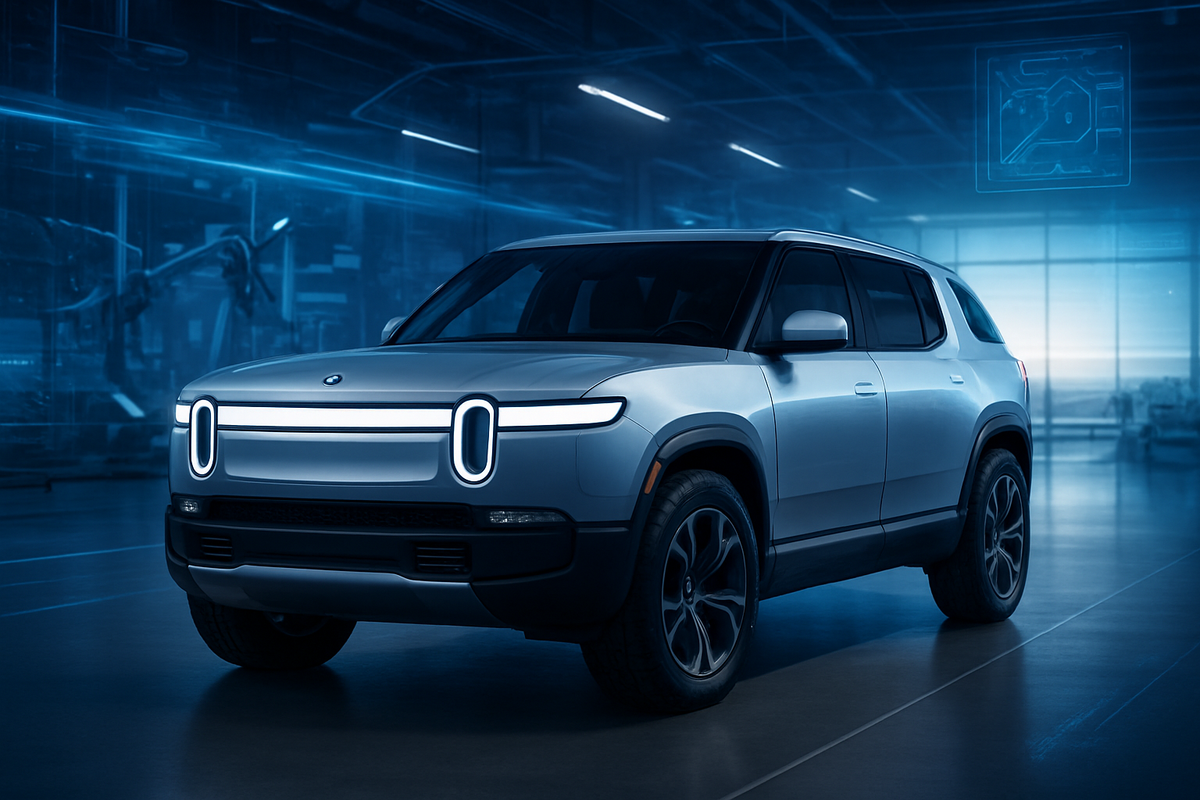
Conversely, the rise of a formidable Rivian poses a direct threat to legacy automakers like Ford (NYSE: F) and General Motors (NYSE: GM), who are still struggling to match the software integration and efficiency of "digital-first" manufacturers. While Tesla (NASDAQ: TSLA) remains the market leader, the emergence of the R2 platform—priced at approximately $45,000—creates the first true direct competitor to the Model Y. Additionally, semiconductor players like Nvidia (NASDAQ: NVDA) may see a slight shift in the landscape as Rivian moves away from off-the-shelf hardware in favor of its own custom-designed RAP1 chips for autonomy.
Amazon (NASDAQ: AMZN), as a major shareholder and customer, also benefits significantly. A stabilized and profitable Rivian ensures the continued delivery of the Electric Delivery Van (EDV) fleet, which is central to Amazon’s sustainability goals. The success of Rivian's software platform also validates Amazon's long-standing bet on the company's underlying technology.
Software-Defined Vehicles and the Industry Shift
The significance of Rivian’s 2026 outlook extends far beyond vehicle delivery numbers; it represents the industry’s broader transition toward Software-Defined Vehicles (SDVs). By developing its own zonal architecture—which reduces the number of Electronic Control Units (ECUs) and miles of wiring—Rivian has achieved a level of hardware-software integration that few other than Tesla have mastered. This architecture is what attracted Volkswagen, signaling that the future of automotive value lies in the "brain" of the car rather than just the chassis.
Historically, this moment draws parallels to the early 2010s, when the tech industry shifted from hardware-centric products to ecosystem-based models. Rivian’s "Autonomy+" subscription, priced at $49.99 per month, is a direct page out of the SaaS (Software as a Service) playbook. This move toward recurring revenue is intended to insulate the company from the cyclical nature of auto sales and provide the high-margin growth that tech investors crave.
Furthermore, the regulatory environment in late 2025 continues to favor companies that can prove domestic manufacturing and supply chain independence. Rivian’s focus on its Illinois plant and the upcoming Georgia facility aligns with federal incentives for North American EV production. As legacy automakers face "compliance car" challenges, Rivian’s pure-play EV status allows it to move faster without the baggage of internal combustion engine (ICE) legacy costs.
What Comes Next: The 2026 Ramp
Looking ahead, the first half of 2026 will be the ultimate test of Rivian’s execution. The company is scheduled to begin production of the R2 in Normal, Illinois, with a target annual run-rate of 155,000 units. Successfully scaling this production without the quality issues that plagued earlier models will be critical. Investors will also be watching for the first "software-defined" Volkswagens to hit the road, as this will provide the first real-world validation of the joint venture's technology.
In the long term, the focus will shift to the "R3" and "R3X" platforms, which promise even lower price points and wider global appeal. The strategic pivot required now is one of disciplined manufacturing. While Rivian has proven it can build a world-class vehicle and world-class software, it must now prove it can build them at a scale of hundreds of thousands per year while maintaining its newfound gross profitability.
Challenges remain, including potential shifts in federal EV policy and the ongoing price war initiated by Tesla. However, with over $7 billion in cash and a massive technological moat, Rivian enters 2026 with more momentum than at any point since its 2021 IPO. The "inflection" is no longer a theoretical projection; it is a tangible roadmap being executed in real-time.
The Investor’s Wrap-Up
As we close out 2025, the key takeaway for the market is that Rivian has successfully decoupled itself from the "EV startup" pack. The endorsement from Tesla bulls and the multi-billion-dollar commitment from Volkswagen serve as a dual validation of Rivian’s hardware and software prowess. The company’s achievement of positive gross profit in Q3 2025 was the signal the market needed to move the stock from a "speculative" to a "growth" footing.
Moving forward, the market will be hyper-focused on R2 production milestones and the adoption rates of the Autonomy+ software suite. For investors, the coming months will be about watching the "J-curve" of profitability. If Rivian can maintain its margin expansion while ramping up the R2, 2026 may indeed be remembered as the year the company solidified its place as a permanent pillar of the global automotive industry.
This content is intended for informational purposes only and is not financial advice.