For modern software companies, growth is no longer limited by geography. Cloud infrastructure, subscription models, and remote-first teams allow SaaS products to scale globally faster than ever before. Yet many SaaS businesses hit an invisible ceiling when expanding internationally – not because of product quality, but because users simply don’t experience the product in a way that feels native, intuitive, and trustworthy.
This is where localization becomes a strategic growth lever rather than a tactical afterthought. SaaS localization is not just about translating strings in the UI. It affects onboarding, activation, retention, support costs, brand perception, and even compliance. Companies that localize early and systematically often outperform competitors who treat localization as a one-off task.
In this guide, we’ll break down what SaaS localization really means, how AI is changing the localization workflow, which tools matter most, common mistakes to avoid, and how to approach localization as a scalable system – not a bottleneck.
What is SaaS localization?
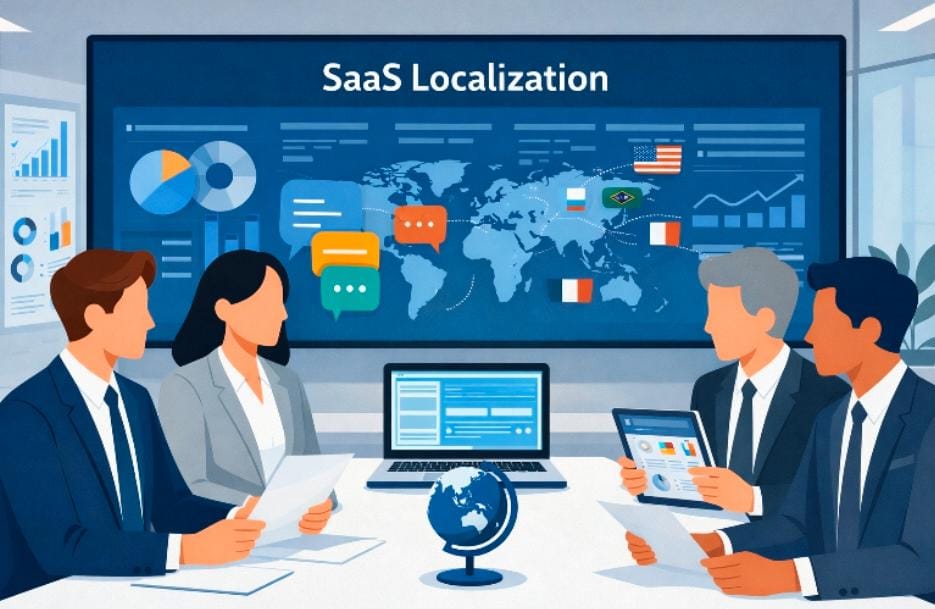
SaaS localization is the process of adapting a software product, its content, and its user experience for different languages, cultures, and markets – while preserving functional consistency across a single codebase. It goes far beyond literal translation.
At its core, SaaS Localization includes:
-
User interface text (menus, buttons, error messages)
-
In-app onboarding and tutorials
-
Marketing pages and pricing plans
-
Help centers and documentation
-
Emails, notifications, and lifecycle messaging
-
Legal content (terms, privacy policies)
-
Cultural conventions (date formats, currencies, tone, symbols)
Unlike traditional software, SaaS products are continuously updated. New features, UI changes, and experiments are shipped weekly or even daily. This means localization must be continuous, automated, and deeply integrated into product development.
A good reference point for structuring this process is the Crowdin SaaS Localization Guide, which focuses on embedding localization directly into product workflows. Instead of treating localization as a final step, Crowdin advocates for:
-
Centralized content management
-
Integration with CI/CD pipelines
-
Translation memory and reuse
-
Collaboration between developers, translators, and product teams
-
Automation for recurring updates
This approach reflects how mature SaaS companies localize at scale – by building a system, not running manual translation cycles.
How to use AI for content localization and translation
AI has fundamentally changed how SaaS companies approach localization. What once required large teams, long lead times, and high costs can now be partially automated – without sacrificing quality if done correctly.
However, AI should be seen as an accelerator, not a replacement for strategy or human oversight.
Where AI fits best in SaaS localization
AI is particularly effective in:
-
First-pass translations for UI strings and content
-
Handling large volumes of repetitive text
-
Maintaining consistency across similar content blocks
-
Speeding up localization for fast-moving releases
-
Assisting translators with suggestions and context
At the same time, AI still struggles with:
-
Brand voice nuance
-
Cultural sensitivity
-
Industry-specific terminology without training
-
Legal or compliance-heavy content
The strongest localization workflows combine AI + human review + smart tooling.
The benefits of SaaS localization
SaaS localization adapts software to specific languages, cultures, and regional preferences, enabling global expansion. This process goes beyond translation to include UI adjustments, date formats, and local regulations, driving business growth.
Key advantages include expanded market reach, as 76% of consumers prefer products in their native language, leading to higher conversions and revenue. Localized experiences boost user satisfaction and retention by reducing friction and fostering loyalty, while providing a competitive edge over non-localized rivals.
Companies also benefit from compliance with legal requirements in regions like Quebec and reduced churn through better product integration.
Common mistakes to avoid in your SaaS product localization process
Despite good intentions, many SaaS companies repeat the same localization mistakes. Avoiding them early can save months of rework.
1. Treating localization as “just translation”
Direct translation without cultural adaptation leads to awkward UX, confusing messaging, and reduced trust. Localization must account for tone, expectations, and local conventions.
2. Localizing too late
Waiting until after product-market fit in one market often creates technical debt. Retrofitting localization into a mature product is far more expensive than planning for it early.
3. No localization ownership
Without a clear owner (product, growth, or localization manager), localization becomes fragmented and inconsistent across teams.
4. Ignoring developer workflows
Manual copy-pasting of strings breaks development velocity. Localization must integrate with repositories, builds, and release cycles.
5. Over-relying on raw machine translation
AI output without review can introduce critical errors – especially in onboarding, pricing, or legal content.
6. No glossary or terminology control
Inconsistent terminology confuses users and weakens brand voice across languages.
7. Localizing everything equally
Not all content needs the same depth of localization. Smart SaaS teams prioritize high-impact flows first: onboarding, core features, pricing, and key pages.
FAQs about SaaS Localization
How is localization different from simple translation?
Translation focuses mainly on words, while localization shapes the whole product experience so it feels native to local users. This can mean changing visuals, pricing logic, examples, integrations, and even certain features.
Why is SaaS localization important for growth?
Localized products convert better because users understand value faster and feel more confident paying in their own language and currency. It also improves retention and reduces churn in non-English markets, turning localization into a long‑term growth lever.
How do I choose which languages or markets to localize first?
Start with data: inbound sign‑ups, traffic by country, existing paying customers, and markets with high purchasing power or strong strategic value. Then factor in competition, regulatory complexity, and your internal resources to prioritize a short list of 1–3 “beachhead” markets.
What parts of a SaaS product should be localized?
At minimum, localize: UI text, onboarding flows, website, pricing and billing screens, emails, and help center content. Mature teams also localize payment methods, support channels, legal docs, and marketing campaigns per region.
Who should own SaaS localization inside the company?
High-performing companies usually give ownership to product or growth, with tight collaboration across engineering, marketing, and customer support. A dedicated localization/operations manager often coordinates vendors, tools, and releases once you scale.
What tools are commonly used for SaaS localization?
SaaS teams typically use a translation management system (TMS) integrated with their code repo and CI/CD pipeline. These tools manage strings, automate file handling (JSON, YAML, PO, etc.), support translation memory, and connect to translators or MT engines.
What is internationalization (i18n) and why does it matter?
Internationalization is the engineering work that makes localization possible: externalizing strings, supporting Unicode, and handling formats and pluralization correctly. Without solid i18n, every new language becomes painful and expensive to ship.
Which app elements are often forgotten in localization?
Commonly missed elements include error messages, email templates, push notifications, in‑app messages, and app store listings. Many teams also forget support macros, FAQs, and system notifications, which creates a mixed-language experience.
How do I ensure translation quality in my SaaS?
Provide translators with context (screenshots, character limits, string descriptions) and maintain a centralized glossary and style guide. Run linguistic QA and in‑context review in staging builds to catch truncation, broken layouts, and incorrect terminology.
How do I test localized versions of my product?
Combine functional testing (formatting, dates, currencies, RTL layouts) with linguistic review on real screens. Involve native speakers from support, partners, or power users to validate flows before launch.
How do I scale localization to many languages without chaos?
Build repeatable workflows: connect your repos and CMS to a TMS, automate string sync, and adopt continuous localization. Standard glossaries, style guides, and release cadences keep quality consistent as you add more markets.
How often should localized content be updated?
Localized content should evolve with the product: every major feature, UI change, or pricing update should trigger an updated translation cycle. Quarterly reviews help clean up inconsistencies, remove outdated strings, and keep terminology aligned.
Final thoughts
SaaS localization is no longer a “nice-to-have” for global software companies – it is a core growth capability. As AI continues to reshape translation and content workflows, the winners will not be those who translate faster, but those who localize smarter.
The most successful SaaS teams treat localization as:
-
A continuous process, not a one-time project
-
A product function, not a marketing add-on
-
A system embedded into development, not a manual task
By combining AI-powered tools like Crowdin with clear strategy, ownership, and human oversight, software companies can scale internationally without sacrificing quality, speed, or brand integrity.
In a global SaaS market, speaking your users’ language – both technically and culturally – is no longer optional. It’s how sustainable growth is built.
Media Contact
Company Name: Crowdin
Contact Person: Robert Miller
Email: Send Email
City: New York
Country: United States
Website: https://crowdin.com/