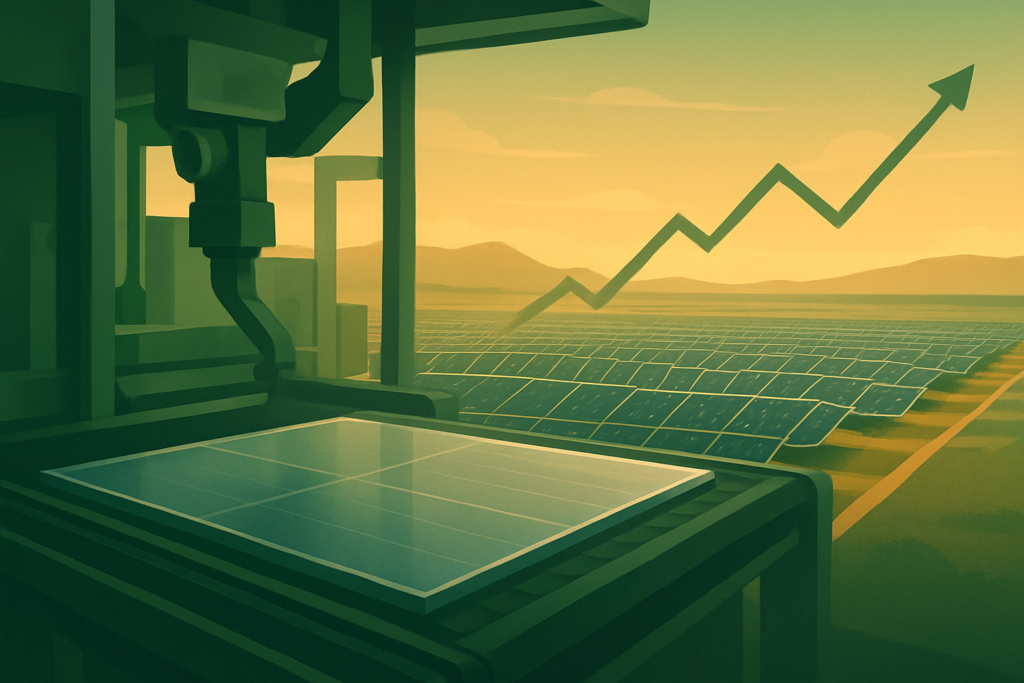
On February 26, 2026, the renewable energy sector was jolted by a sharp correction in the valuation of its domestic champion. First Solar, Inc. (NASDAQ: FSLR), the largest solar manufacturer in the Western Hemisphere, saw its shares plummet 13.6% in a single trading session. The catalyst was not a failure of past performance—indeed, the company reported record-breaking 2025 results—but rather a surprisingly conservative outlook for the 2026 fiscal year.
As the primary beneficiary of U.S. industrial policy over the last three years, First Solar has long been the "safe bet" for investors seeking exposure to the energy transition without the geopolitical baggage of Chinese supply chains. However, the recent guidance suggests that even the most protected domestic players are not immune to global pricing pressures, shifting trade dynamics, and the complexities of scaling massive industrial capacity. This article explores the factors behind the "2026 Reset" and what it means for the future of American solar manufacturing.
Historical Background
First Solar’s journey began in 1999 in Tempe, Arizona, born from the conviction that thin-film technology could eventually outperform traditional crystalline silicon (c-Si). Unlike the majority of the industry, which relies on polysilicon, First Solar pioneered the use of Cadmium Telluride (CdTe). This decision defined the company’s trajectory, allowing it to bypass the volatile polysilicon supply chain that eventually became dominated by Chinese manufacturers.
In the late 2000s, First Solar became the first company to lower solar manufacturing costs to under $1 per watt. However, the 2010s were a period of intense struggle as a glut of subsidized Chinese silicon panels flooded the market, pushing many Western firms into bankruptcy. First Solar survived by pivoting away from the residential market to focus exclusively on utility-scale projects and by relentlessly upgrading its technology—transitioning from the small-form Series 4 modules to the large-format, high-efficiency Series 6 and Series 7 models that dominate its portfolio today.
Business Model
First Solar operates a fully integrated, high-throughput manufacturing model. Unlike competitors who might assemble modules from purchased cells, First Solar transforms raw glass into a finished solar panel in a single continuous process lasting roughly four hours.
The company’s revenue is generated through two primary streams:
- Module Sales: Direct sales of Series 6 and Series 7 modules to utility-scale developers and independent power producers.
- Tax Credit Monetization: Under Section 45X of the Inflation Reduction Act (IRA), First Solar receives significant production tax credits for every component manufactured in the U.S. In 2025, the company became a leader in the secondary market for these credits, selling them to third-party corporates to generate immediate non-dilutive cash flow.
Its customer base is primarily composed of large-scale energy developers who value First Solar’s "bankability" and its immunity to the Uyghur Forced Labor Prevention Act (UFLPA) restrictions that have hampered silicon-based competitors.
Stock Performance Overview
Over the long term, First Solar has been a standout performer in the volatile clean-tech space.
- 10-Year Horizon: Investors have seen significant appreciation, driven by the company’s survival through the "solar winter" of the mid-2010s and its emergence as a policy favorite.
- 5-Year Horizon: The stock experienced a massive rerating following the passage of the IRA in 2022, climbing from the $70 range to highs exceeding $300 in 2025 as the market priced in billions of dollars in future tax credits.
- 1-Year Horizon: Prior to the February 2026 drop, the stock had been trading near all-time highs. The 13.6% decline represents the largest one-day sell-off since the early days of the pandemic, wiping out nearly $4 billion in market capitalization as investors adjusted their growth expectations for the 2026-2027 period.
Financial Performance
The Q4 2025 earnings report, released on February 24, 2026, was a tale of two realities. For the full year 2025, First Solar posted record net sales of $5.2 billion and a GAAP EPS of $14.21. However, the focus shifted immediately to the 2026 guidance.
Management projected 2026 revenue between $4.9 billion and $5.2 billion, significantly below the $6.1 billion consensus. The "miss" was attributed to a combination of lower Average Selling Prices (ASPs) and the strategic underutilization of international plants. Despite the top-line softness, the company’s balance sheet remains fortress-like, with over $2 billion in cash and a projected $2.1 billion in Section 45X credits expected to be recognized in 2026. This "tax-credit floor" provides a level of earnings stability that few other solar firms can match, even in a down year.
Leadership and Management
CEO Mark Widmar, who has led the company since 2016, is widely credited with the "U.S.-First" strategy that saved the firm from the price wars of the last decade. Widmar has been an outspoken advocate for trade enforcement, often testifying before Congress on the need for domestic supply chain security.
Alongside CFO Alex Bradley, the management team has earned a reputation for disciplined capital allocation. Rather than chasing every incremental increase in demand, they have focused on "booking to fill" their capacity years in advance. However, the recent 13.6% stock drop has put Widmar under pressure to prove that his strategy of ignoring the low-cost silicon market can hold up when global prices for those competing panels drop to historic lows.
Products, Services, and Innovations
First Solar’s competitive edge lies in its Series 7 modules. These thin-film panels are optimized for utility-scale applications, offering better temperature coefficients (performance in heat) and higher spectral response than silicon in humid conditions.
Innovation highlights for 2026 include:
- Iberia Parish Facility: The newly opened $1.1 billion Louisiana plant uses advanced AI and deep learning for real-time defect detection, significantly increasing yield.
- Next-Gen Tandem Cells: First Solar is investing heavily in R&D for "tandem" cells, which layer different semiconductor materials to break the efficiency limits of single-junction technology.
- Patent Enforcement: In late 2025, First Solar began aggressively litigating its TOPCon (Tunnel Oxide Passivated Contact) patents against several silicon manufacturers, a move that could potentially create a new licensing revenue stream.
Competitive Landscape
The primary competition does not come from other thin-film companies, but from massive Chinese silicon conglomerates like JinkoSolar, Trina Solar, and LONGi. These firms have benefited from economies of scale and integrated supply chains in Asia, allowing them to offer panels at prices that often undercut the cost of production in the West.
First Solar’s defense is its "differentiation." Because its CdTe technology uses no polysilicon, it is the only major manufacturer entirely exempt from UFLPA-related border detentions. Furthermore, in the U.S. market, First Solar holds a significant market share lead in the utility segment, aided by the "Domestic Content" bonus credits available to developers who use American-made components.
Industry and Market Trends
The solar industry in 2026 is grappling with a paradox: demand for clean energy is at an all-time high, driven by the massive power needs of AI data centers, yet the manufacturing sector is facing a severe margin crunch.
Global overcapacity, particularly in China, has led to a "race to the bottom" in pricing. While First Solar is somewhat insulated by its long-term contracts (often booked 2-3 years out), the overall market environment has forced a downward adjustment in the pricing of new contracts being signed for 2027 and 2028. Additionally, the "electrification of everything" has strained the U.S. power grid, leading to interconnection delays that have slowed the deployment of some of First Solar’s largest projects.
Risks and Challenges
The 13.6% drop highlights several critical risks:
- Tariff Headwinds: First Solar expects $125 million to $135 million in tariff impacts in 2026, primarily on specialized glass and other imported components.
- Strategic Underutilization: To avoid new tariffs and policy shifts, the company is intentionally running its Southeast Asian factories at lower rates, which increases the per-unit cost of the modules produced there.
- Policy Volatility: While the IRA is currently law, political shifts in Washington D.C. create uncertainty regarding the longevity of the 45X credits and the strictness of "Foreign Entity of Concern" (FEOC) rules.
- Technological Leapfrogging: If silicon manufacturers continue to increase efficiency while lowering costs, the "performance gap" that justifies First Solar’s premium pricing could narrow.
Opportunities and Catalysts
Despite the soft guidance, several catalysts remain:
- South Carolina Expansion: The new finishing line in Gaffney, SC, set for Q4 2026, will add 3.7 GW of capacity and optimize logistics for East Coast projects.
- Data Center Demand: The "AI boom" has led tech giants like Microsoft and Google to sign massive multi-year procurement deals for renewable energy to power their GPU clusters.
- Trade Enforcement: If the International Trade Commission (ITC) rules in favor of First Solar in its ongoing patent and anti-dumping cases, it could effectively raise the floor for module prices in the U.S. market.
Investor Sentiment and Analyst Coverage
Following the February guidance, Wall Street sentiment has shifted from "unbridled optimism" to "cautious realism." Several major investment banks downgraded the stock from "Overweight" to "Neutral," citing the 2026 revenue gap.
However, institutional ownership remains high. Hedge funds and ESG-focused funds continue to view FSLR as a core holding because of its transparent supply chain and low carbon footprint compared to silicon. Retail sentiment, as measured by social media chatter, has been more volatile, with many investors expressing frustration over the company’s inability to capitalize on high energy demand with higher prices.
Regulatory, Policy, and Geopolitical Factors
In 2026, the regulatory environment is dominated by the "One Big Beautiful Bill" (OBBBA) policy framework, which has tightened the definitions for "Foreign Entities of Concern." These rules are designed to prevent Chinese-owned companies from accessing U.S. tax credits, even if they build factories on American soil.
This geopolitical "moat" is First Solar’s greatest asset. As long as U.S. policy remains focused on "de-risking" from China, First Solar will remain a vital strategic asset for the U.S. government. However, the cost of this protection is a higher-cost domestic manufacturing base that must constantly innovate to stay competitive.
Conclusion
The 13.6% decline in First Solar’s stock is a sobering reminder that even the leaders of the energy transition face a difficult path to sustained profitability. The "soft" 2026 guidance reflects a company in transition—moving from the rapid expansion phase of 2023-2025 into a more mature, but also more challenging, competitive landscape.
For long-term investors, the core thesis remains intact: First Solar is a technologically unique, policy-protected, and financially stable giant in a sector that is essential to the 21st-century economy. However, the "2026 Reset" suggests that the easy gains from the IRA tailwinds have been priced in. Moving forward, the company’s success will depend less on Washington's support and more on its ability to drive manufacturing efficiencies and defend its technological moats against a global tide of low-cost competition.
This content is intended for informational purposes only and is not financial advice.