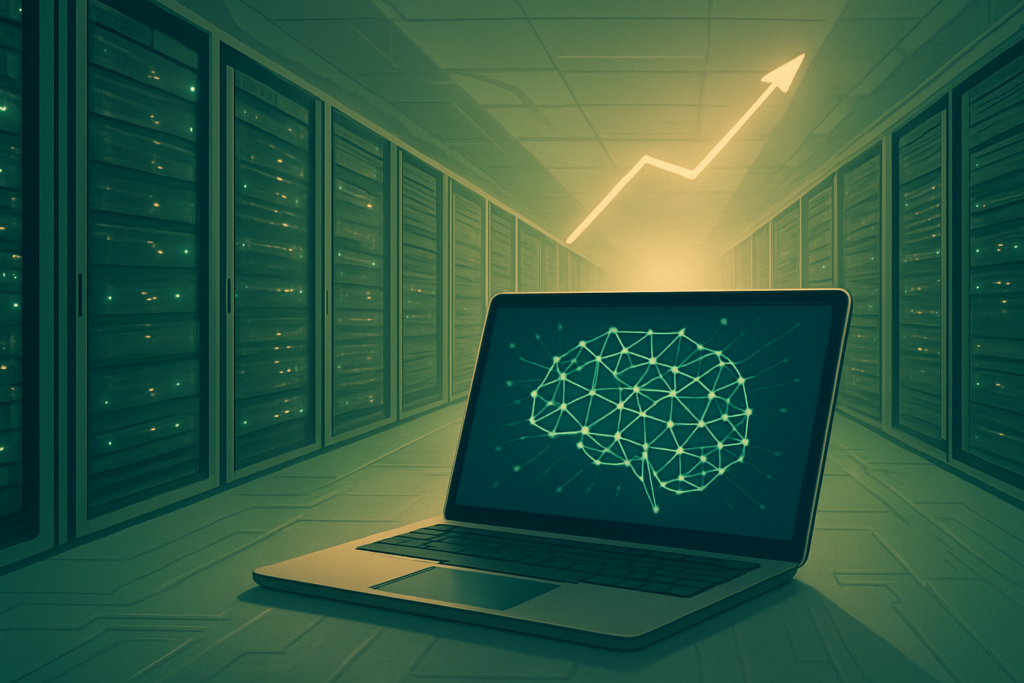
On March 26, 2026, the technology landscape looks fundamentally different than it did just two years ago, and few companies embody this transformation more than Dell Technologies (NYSE: DELL). Once perceived by Wall Street as a stable but slow-growing provider of personal computers and legacy storage, Dell has reinvented itself as the primary architect of the global "AI Factory."
As of today, Dell’s stock has reached an all-time high of $184.86, fueled by a staggering $43 billion backlog for AI-optimized servers and a dominant position in the infrastructure that powers generative artificial intelligence. This article explores how a company founded in a college dorm room four decades ago managed to outmaneuver more nimble rivals to become the indispensable partner of the AI era.
Historical Background
The story of Dell Technologies is one of the most remarkable endurance tales in American business. Founded in 1984 by Michael Dell in his University of Texas dorm room with just $1,000, the company revolutionized the industry with its direct-to-consumer sales model. By cutting out the middleman and building PCs to order, Dell became a global powerhouse in the 1990s.
However, the shift toward mobile and cloud in the early 2010s threatened the company’s relevance. In a bold move in 2013, Michael Dell and Silver Lake Partners took the company private in a $24.9 billion leveraged buyout. This allowed the leadership team to restructure without the scrutiny of quarterly earnings. During this private period, Dell executed the largest tech merger in history at the time—the $67 billion acquisition of EMC in 2016. This deal brought VMware into the fold and transformed Dell from a "PC box maker" into a full-stack enterprise IT giant. Dell returned to the public markets in 2018, eventually spinning off VMware in 2021 to simplify its structure and pay down debt, setting the stage for its current AI-driven ascent.
Business Model
Dell operates through two primary segments that create a powerful ecosystem:
- Infrastructure Solutions Group (ISG): This is the high-growth heart of the company. It includes servers, storage, and networking. Dell’s "AI Factory" initiative falls under this segment, providing high-performance computing (HPC) and liquid-cooled servers optimized for NVIDIA and AMD chips.
- Client Solutions Group (CSG): This segment covers the commercial and consumer PC business. While traditionally cyclical, the CSG is currently entering a massive refresh cycle driven by "AI PCs"—laptops and desktops equipped with Neural Processing Units (NPUs) designed to run AI models locally.
Dell’s competitive advantage lies in its direct sales force and unparalleled global supply chain, which allows it to deliver complex, multi-rack AI clusters at a scale that smaller competitors struggle to match.
Stock Performance Overview
Dell’s stock performance over the last decade reflects its successful transformation.
- 1-Year Performance: As of March 2026, DELL has surged 64% over the past 12 months, significantly outperforming the S&P 500.
- 5-Year Performance: Investors who held Dell through the post-pandemic slump have seen returns exceeding 300%, as the company pivoted from a work-from-home play to a core AI infrastructure play.
- 10-Year Performance: Since the 2013 buyout and subsequent 2018 relisting, the "new" Dell has seen its valuation grow nearly fivefold, reflecting its evolution from a $25 billion private entity to a large-cap tech leader with a market capitalization nearing $130 billion.
Financial Performance
The fiscal year 2026 has been a record-breaker for Dell. In its most recent quarterly report, the company posted:
- Total Revenue: $113.5 billion for FY2026, a significant jump from previous years.
- AI Server Revenue: A massive $24.6 billion contribution from AI-optimized servers, which grew over 300% year-over-year.
- Earnings Per Share (EPS): Non-GAAP EPS reached $9.92, beating analyst expectations by nearly 15%.
- Balance Sheet: Dell has aggressively reduced its debt from the EMC era, maintaining an investment-grade rating while returning capital to shareholders through a 20% dividend increase and a $10 billion share repurchase expansion.
Leadership and Management
Michael Dell remains the longest-tenured founder-CEO in the technology sector, a factor that provides the company with unique stability and a long-term vision. Alongside him, COO Jeff Clarke is credited with the operational excellence that allowed Dell to secure record amounts of NVIDIA GPUs during the height of the supply shortages in 2024 and 2025.
The leadership team is currently focused on the "One Dell Way" initiative, a comprehensive digital transformation designed to streamline internal operations and improve operating margins by an estimated 100 to 150 basis points by 2027.
Products, Services, and Innovations
Dell’s current innovation pipeline is focused on the "AI Factory." Key offerings include:
- PowerEdge XE9780: A flagship AI server built on the NVIDIA Blackwell architecture, designed for massive large language model (LLM) training.
- Liquid Cooling: As AI chips generate unprecedented heat, Dell has become a leader in rack-scale liquid cooling solutions, which are now a requirement for the latest generation of GPUs.
- AI PCs (Copilot+): Dell has rebranded its PC lineup into Dell Pro and Dell Pro Max, with over 55% of 2026 shipments featuring NPUs for local AI processing.
Competitive Landscape
Dell’s primary competitors include Hewlett Packard Enterprise (NYSE: HPE), Super Micro Computer (NASDAQ: SMCI), and Lenovo (HKG: 0992).
In early 2026, Dell gained significant market share following a governance crisis at Supermicro, which saw the smaller rival struggle with regulatory and supply chain issues. While HPE has found success in networking through its Juniper acquisition, Dell’s "end-to-end" strategy—selling everything from the handheld AI device to the massive data center rack—has given it an edge in capturing "Sovereign AI" projects from national governments and large-scale enterprises.
Industry and Market Trends
The "Golden Age of Data Centers" is the defining macro trend of 2026. Enterprises are no longer just buying "servers"; they are building private AI clouds to keep their proprietary data secure. This shift toward hybrid AI—where training happens in the cloud but inference happens on-premise or at the edge—perfectly aligns with Dell’s hardware-centric business model. Additionally, the Windows 10 end-of-life in late 2025 has triggered one of the largest corporate PC refresh cycles in a decade.
Risks and Challenges
Despite the record highs, Dell faces several headwinds:
- Margin Pressure: AI servers, while high-revenue, often carry lower gross margins than traditional storage or software.
- Component Dependency: Dell is heavily dependent on NVIDIA and AMD for the silicon that drives its backlog. Any hiccups in chip production directly impact Dell’s ability to ship.
- Cyclicality: The PC market remains inherently cyclical, and there is a risk that the current AI-driven hype could lead to overcapacity in data centers.
Opportunities and Catalysts
The primary catalyst for 2026 and beyond is the "Sovereign AI" movement. Governments across Europe, the Middle East, and Asia are investing billions to build their own domestic AI infrastructure, viewing it as a matter of national security. Dell is the preferred partner for these multi-billion-dollar sovereign projects due to its scale and security credentials. Furthermore, the upcoming launch of "One Dell Way" in May 2026 could serve as a margin-expansion catalyst.
Investor Sentiment and Analyst Coverage
Wall Street is overwhelmingly bullish on Dell. As of March 2026, approximately 85% of analysts covering the stock maintain a "Strong Buy" or "Buy" rating. Institutional ownership remains high, with major funds increasing their weightings as Dell transitioned from a "value" stock to a "growth-and-income" play. Retail sentiment is also positive, often fueled by Michael Dell’s active and optimistic presence on social media and industry conferences.
Regulatory, Policy, and Geopolitical Factors
Geopolitics plays a massive role in Dell’s operations. U.S. export controls on high-end GPUs to China have limited some growth in that region, but increased demand in North America and India has more than compensated. Domestically, Dell is benefiting from government incentives for U.S.-based manufacturing and energy-efficient data center designs, as regulators increasingly focus on the massive electricity consumption of AI clusters.
Conclusion
Dell Technologies stands at the pinnacle of the enterprise tech world in 2026. By successfully navigating a decade of transformation—from a private-equity-backed turnaround to an AI infrastructure leader—the company has proven its resilience. While risks regarding margins and GPU supply remain, the $43 billion backlog and the all-time high share price suggest that the "Dell Renaissance" is far from over. For investors, the key will be watching how effectively Dell converts its massive backlog into sustained profitability as the AI supercycle matures.
This content is intended for informational purposes only and is not financial advice.