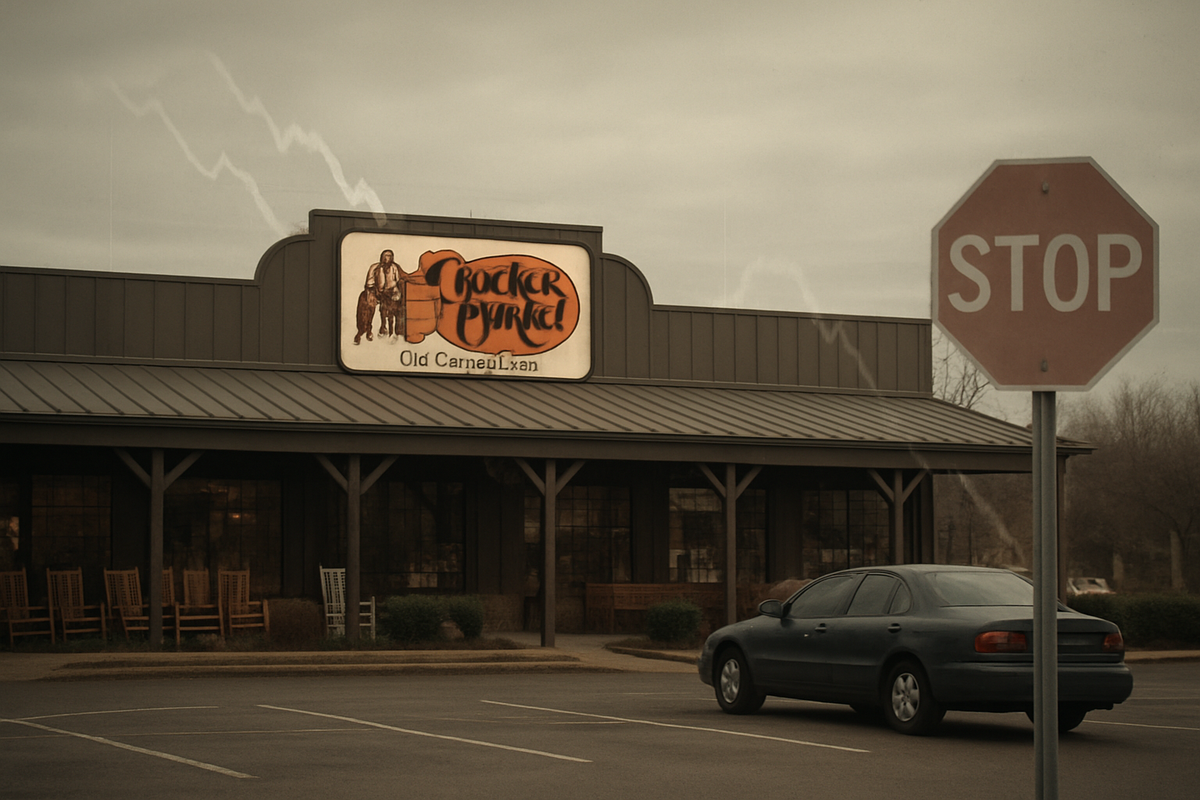
Benchmark has maintained its "Hold" rating on Cracker Barrel Old Country Store, Inc. (NASDAQ: CBRL) following the release of its fiscal first-quarter 2026 results, a decision that underscores deep-seated concerns about the restaurant and retail chain's financial health and operational trajectory. The investment firm's continued cautious stance comes as Cracker Barrel reported a significantly weaker-than-expected performance, marked by declining sales, traffic, and a drastically lowered full-year outlook. This development immediately sent Cracker Barrel's shares plummeting, reflecting a palpable negative sentiment among investors who are increasingly wary of the company's path to recovery.
The immediate implications of these results are stark. Cracker Barrel's stock experienced a sharp decline, shedding over 11.7% of its value post-announcement, extending a year-to-date loss that already stood at nearly 50%. Benchmark's reiterated "Hold" rating, alongside similar adjustments from other analysts, signals a consensus that the company faces an uphill battle to regain investor confidence and stabilize its business amid ongoing operational challenges and a perceived misstep in brand strategy. The market's reaction suggests that the issues plaguing Cracker Barrel are not transient but rather indicative of deeper, structural problems that require significant strategic overhaul.
Detailed Coverage: A Quarter of Misses and Missteps
Cracker Barrel's fiscal first-quarter 2026 results painted a grim picture, falling well short of analyst expectations across key metrics. The company reported an adjusted loss of $0.74 per share, significantly missing the anticipated $0.68 loss. Revenue also declined by 5.7% year-over-year, totaling $797.2 million against a consensus estimate of $807.85 million. Perhaps most concerning was the restaurant-level operating margin, which came in at a meager 2.3%, substantially below the projected 4.6%, while adjusted EBITDA of $7.2 million drastically missed the $18.7 million consensus.
These financial shortfalls were primarily driven by a significant downturn in customer engagement. Comparable store restaurant sales decreased by 4.7%, and retail sales saw an even steeper decline of 8.5% compared to the prior year. Crucially, the company experienced a notable traffic decline of 7.3%, with current trends consistently showing low double-digit negative ranges. This erosion of its customer base appears to be a direct consequence of what CEO Julie Masino described as "unique and ongoing headwinds," partly attributing them to operational missteps, including a back-of-house initiative that proved overly complex for staff, leading to inconsistent food quality. This initiative has since been scrapped, with plans for comprehensive staff retraining. Furthermore, the company faced social media backlash over a recent logo and remodel change, which it later reversed, highlighting a struggle with brand perception and customer loyalty.
The timeline leading up to this moment reveals a pattern of challenges. The "controversial rebranding efforts" and "operational missteps" mentioned by Benchmark and Cracker Barrel management are not new issues but rather problems that have been compounding, eroding customer trust and operational efficiency. The decision to reverse the logo and remodel change, while perhaps a move to appease disgruntled customers, also underscores a lack of clear strategic direction. Key players in this unfolding narrative include Benchmark, the investment firm assessing Cracker Barrel's performance, and Cracker Barrel itself, led by CEO Julie Masino, who is now tasked with navigating the company through these turbulent waters. The initial market reaction was unequivocally negative, with Cracker Barrel's stock plunging, and other prominent firms like Truist Securities and Piper Sandler adjusting their price targets downwards, signaling a broad loss of confidence.
Company Impact: Cracker Barrel's Uphill Battle and Competitors' Opportunity
For Cracker Barrel (NASDAQ: CBRL), the implications of these results and Benchmark's maintained "Hold" rating are overwhelmingly negative in the short to medium term. The company is clearly in a precarious position, grappling with a combination of declining customer traffic, operational inefficiencies, and a brand identity crisis. The significantly lowered fiscal 2026 outlook, projecting full-year revenue between $3.2 billion and $3.3 billion (down from $3.35 billion to $3.45 billion) and an adjusted EBITDA forecast slashed to $70 million-$110 million (from $150 million-$190 million), signals that management anticipates a prolonged period of struggle. The worsened traffic guidance of an 8-10% decline for FY2026 further solidifies this bleak outlook. Cracker Barrel stands to lose substantial market share and investor confidence if it cannot swiftly and effectively implement its recovery plans, which include scrapping failed initiatives and retraining staff. The potential for further stock depreciation remains a significant risk until tangible signs of a turnaround emerge.
Conversely, competitors in the casual dining and family restaurant segments might find an opportunity to gain market share. Brands that have successfully navigated evolving consumer preferences and maintained strong operational execution could capitalize on Cracker Barrel's woes. Companies like Denny's (NASDAQ: DENN), IHOP (part of Dine Brands Global, NYSE: DIN), or even local independent restaurants that offer a similar home-style dining experience could potentially attract customers disillusioned with Cracker Barrel's recent performance and strategic missteps. While direct competitors might not immediately see a surge, the sustained weakness of a major player like Cracker Barrel creates a vacuum that other agile and customer-focused establishments can fill, potentially leading to a shift in dining habits and market dynamics within the sector.
The situation also puts immense pressure on Cracker Barrel's leadership to execute a flawless turnaround. Failure to do so could lead to more drastic measures, including further cost-cutting, asset sales, or even a re-evaluation of its business model. The company's unique blend of restaurant and retail has historically been a strength, but if both segments continue to falter, the entire enterprise faces an existential challenge. Investors will be closely watching for signs of improved operational consistency, successful customer re-engagement, and a clear, unified brand message that resonates with its target demographic.
Wider Significance: A Cautionary Tale in Casual Dining
Cracker Barrel's current predicament is more than just an isolated corporate struggle; it serves as a cautionary tale within the broader casual dining industry. The challenges faced by the company—declining traffic, struggles with brand identity, and operational missteps—are emblematic of the pressures confronting many traditional restaurant chains in an increasingly competitive and rapidly evolving market. Consumers today demand not only quality food and service but also compelling value, a distinctive experience, and alignment with modern sensibilities. Cracker Barrel's difficulties highlight the critical importance of staying attuned to customer expectations while simultaneously maintaining operational excellence. The "controversial rebranding efforts" and "social media backlash" underscore how quickly brand perception can shift in the digital age, with significant financial consequences.
The ripple effects of Cracker Barrel's struggles could extend beyond direct competitors. Suppliers to Cracker Barrel, ranging from food producers to souvenir manufacturers, might experience reduced demand, impacting their own revenues. Furthermore, the challenges faced by a well-known brand like Cracker Barrel could signal a broader vulnerability within the casual dining sector to shifts in consumer spending habits, economic downturns, or even changes in work-from-home trends that affect lunch and dinner traffic. While no direct regulatory or policy implications are immediately apparent, the situation could draw attention to labor practices and operational efficiency within the industry, particularly if cost-cutting measures impact employee welfare or food safety standards.
Historically, the restaurant industry has seen numerous examples of established brands struggling to adapt. Companies like Friendly's or Sbarro have faced similar challenges in maintaining relevance and profitability amidst changing tastes and increased competition. Cracker Barrel's situation can be compared to these instances where a strong brand identity, once a competitive advantage, becomes a liability if it fails to evolve with the times or if operational execution falters. The current environment, marked by inflationary pressures, labor shortages, and evolving consumer preferences for convenience and health-conscious options, further amplifies these challenges, making successful adaptation a matter of survival for many traditional dining establishments.
What Comes Next: A Critical Juncture for Cracker Barrel
The coming months represent a critical juncture for Cracker Barrel (NASDAQ: CBRL) as it attempts to navigate its path out of this downturn. In the short term, the company's immediate focus will undoubtedly be on executing its announced operational changes, including the complete overhaul of the problematic back-of-house initiative and comprehensive staff retraining. Success in these areas is paramount to improving food quality and consistency, which are fundamental to regaining customer trust and stemming the tide of declining traffic. Investors will be closely watching for any early indicators of improved operational efficiency and positive customer feedback. A failure to demonstrate tangible progress could lead to further stock depreciation and increased pressure on management.
In the long term, Cracker Barrel faces the monumental task of redefining its brand and value proposition in a highly competitive market. This could entail strategic pivots, such as a renewed focus on specific menu items, an enhanced digital presence for online ordering and loyalty programs, or even a re-evaluation of its store formats and locations. The company must find a way to appeal to a broader demographic while retaining its loyal customer base, a challenge that requires a delicate balance of innovation and tradition. Market opportunities might emerge for competitors who can effectively capitalize on Cracker Barrel's struggles, potentially attracting new customers with compelling offerings and superior service. Conversely, Cracker Barrel itself could find opportunities in niche markets or through strategic partnerships if it can stabilize its core business.
Potential scenarios range from a continued downward spiral if recovery efforts fail to a slow, arduous turnaround if management's strategies begin to bear fruit. A more optimistic, albeit challenging, scenario involves a successful strategic adaptation that revitalizes the brand and operations, leading to a gradual recovery in sales and profitability. The most critical factor will be the company's ability to demonstrate consistent execution and a clear vision for the future, which is currently lacking in the eyes of many analysts.
Wrap-Up: An Uncertain Road Ahead for the Old Country Store
In summary, Benchmark's decision to maintain its "Hold" rating on Cracker Barrel (NASDAQ: CBRL) after its fiscal first-quarter 2026 results underscores a period of significant uncertainty and challenge for the beloved American institution. The quarter's disappointing financial performance, marked by substantial misses on revenue and earnings, coupled with persistent declines in customer traffic and operational missteps, paints a picture of a company struggling to find its footing. The drastic reduction in its full-year fiscal 2026 outlook further solidifies the view that Cracker Barrel faces a prolonged and difficult recovery. Key takeaways include the critical need for operational consistency, a clear brand strategy, and effective customer re-engagement to reverse current trends.
Moving forward, the market will assess Cracker Barrel with a cautious eye. The company's ability to execute its announced plans to scrap failed initiatives and retrain staff will be paramount. Investors should closely monitor future earnings reports for signs of improved operational metrics, particularly comparable store sales and customer traffic trends. The success or failure of its efforts to address the "uncertain stabilization timing" will dictate its trajectory.
The lasting impact of this period could redefine Cracker Barrel's position in the casual dining landscape. Whether it can successfully adapt to modern consumer demands while preserving its core identity remains to be seen. For investors, the coming months will be crucial in determining if the "Old Country Store" can recapture its former glory or if it is destined for a more challenging future.
This content is intended for informational purposes only and is not financial advice