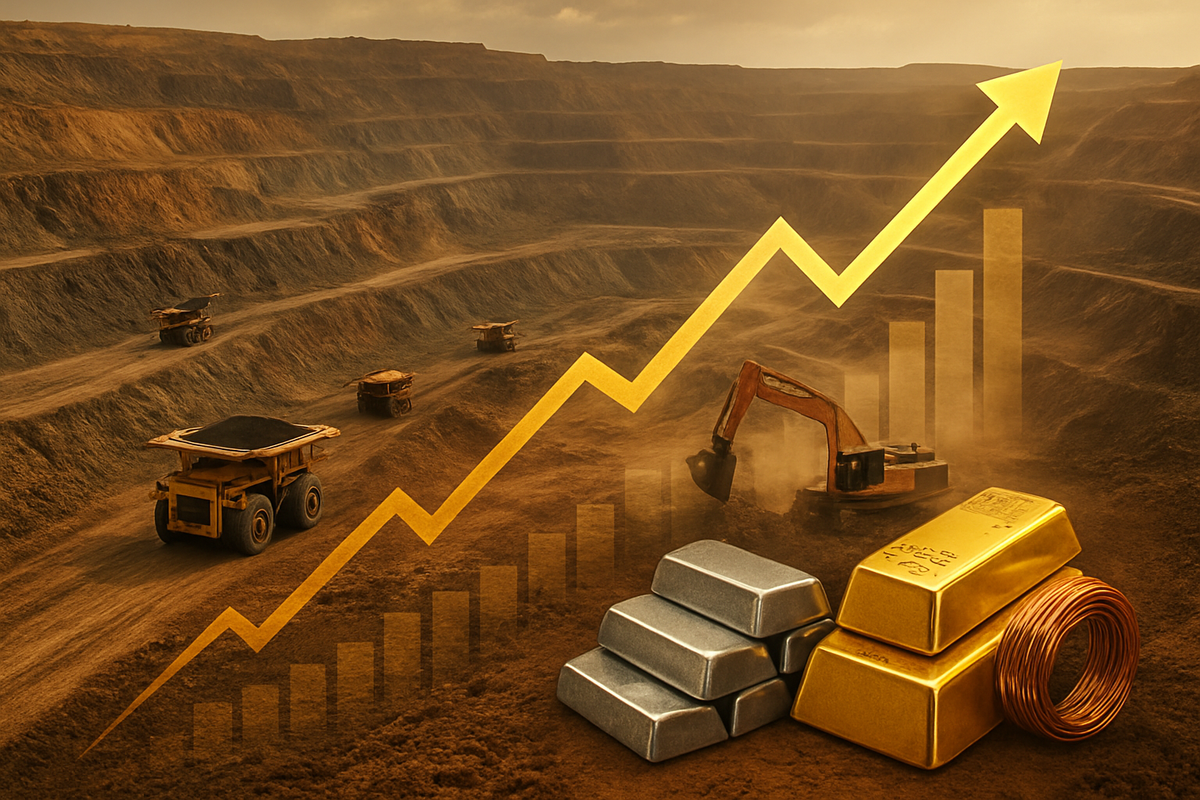
Toronto, Canada – December 12, 2025 – The S&P/TSX Composite Index has been on a remarkable ascent, consistently reaching new record highs, largely propelled by a robust performance from its mining sector. As of December 12, 2025, the Canadian benchmark index continues to demonstrate resilience and growth, with commodity prices, particularly gold, serving as a primary catalyst for investor confidence and market expansion. This surge underscores Canada's deep ties to its resource-rich economy, where the fortunes of its major stock index are often intertwined with global commodity markets.
The current rally highlights a significant rotation of investor capital into resource-based assets, as market participants seek hedges against persistent inflation and geopolitical uncertainties. The mining sector's substantial gains have not only bolstered the S&P/TSX Composite but also signaled a broader trend of commodity-driven economic activity impacting North American financial landscapes. This dynamic environment presents both opportunities and challenges, reshaping market expectations and strategic considerations for companies and investors alike.
A Golden Era for Canadian Equities: Unpacking the S&P/TSX's Commodity-Driven Ascent
The S&P/TSX Composite Index has been a beacon of strength in late 2024 and throughout 2025, culminating in a series of record-breaking performances. On Thursday, December 11, 2025, the index closed at an unprecedented 31,660.73 points, marking its third consecutive session of gains and solidifying its position above the 31,500 mark for the first time. This impressive run saw the index climb 2.70% over the past month and a staggering 24.60% compared to the same period last year. Futures for the S&P/TSX 60 index also indicated continued positive momentum, suggesting further weekly gains.
This surge is not an isolated event but the culmination of sustained growth throughout 2025. The index first breached the 30,000-point threshold on September 23, 2025, and by October 6, had extended its gains for seven consecutive sessions, reaching 30,531.88. While the year saw some volatility, notably a sharp downturn in early April due to new tariff policies, the overall trajectory has been strongly upward, building on a "fantastic year" in 2024 which delivered a total return of 21.7%. The mining sector has been an undeniable engine behind this growth, consistently outperforming other segments.
Key players in the mining industry have seen their stock values soar, directly contributing to the index's climb. On December 11, 2025, base metals and precious metals miners led the charge, with the base metals index rising by nearly two percent. Companies such as First Majestic Silver Corp. (TSX: FR), Kinross Gold Corp. (TSX: K), and Agnico Eagle Mines Ltd. (TSX: AEM) experienced significant increases of 6.9%, 4.5%, and 3.7% respectively. Junior miners like OceanaGold (TSX: OGC), Pan American Silver (TSX: PAAS), New Gold (TSX: NGD), and First Majestic Silver also reported substantial gains ranging from 3.3% to 6.9%. These movements underscore the immediate positive market reaction to the sustained strength in commodity prices.
The prominence of the mining sector was further highlighted in the 2025 TSX30 ranking, released in September, where gold producers accounted for over half of the top 30 performing TSX-listed stocks over a three-year period. Seventeen of the 30 top performers were miners, with Lundin Gold (TSX: LUG) leading the mining group with an impressive 775% dividend-adjusted share price increase. This sustained performance by mining companies, driven by robust commodity prices, has been a critical factor in the S&P/TSX Composite's record-setting journey.
Winners and Losers: Navigating the Commodity Price Tides
The current surge in commodity prices, particularly gold, has created clear winners within the North American markets, especially on the S&P/TSX Composite. Mining companies, particularly those focused on precious metals, are at the forefront of this windfall. Gold producers like Kinross Gold Corp. (TSX: K), Agnico Eagle Mines Ltd. (TSX: AEM), and Barrick Gold Corp. (TSX: ABX) are directly benefiting from gold prices topping US$4,300 an ounce. Their revenues and profit margins are expanding, leading to increased investor interest and share price appreciation. Similarly, silver miners such as First Majestic Silver Corp. (TSX: FR) and Pan American Silver (TSX: PAAS) are experiencing significant gains as silver prices also climb, often tracking gold's performance.
Beyond precious metals, base metal miners are also seeing a boost, albeit with some volatility. Companies involved in copper, nickel, and zinc production, like Teck Resources Ltd. (TSX: TECK.B) and Lundin Mining Corp. (TSX: LUN), stand to gain from increased industrial demand, particularly as global economic activity picks up. The materials sector as a whole, which encompasses mining, saw a remarkable 80% year-to-date surge in the S&P/TSX Composite Metals & Mining Index by late September 2025. This strong performance translates into higher valuations, potential for increased dividends, and expanded capital expenditure for exploration and development.
However, not all sectors or companies are experiencing the same positive impact. While the energy sector is also a significant component of the S&P/TSX, its performance has been more mixed. Oil and gas producers, such as Suncor Energy Inc. (TSX: SU) and Canadian Natural Resources Limited (TSX: CNQ), have faced challenges with fluctuating crude oil prices. For instance, the January crude oil contract fell to US$57.60 per barrel on December 11, 2025, indicating that while energy has seen a resurgence, it's not without its headwinds. Companies heavily reliant on stable or lower input costs, which are now facing higher commodity prices for their raw materials, could see their profit margins squeezed.
Furthermore, companies outside the resource sector, particularly those in manufacturing or consumer goods that are not able to pass on increased raw material costs to consumers, might struggle. While the overall S&P/TSX Composite benefits from its resource weighting, individual companies within other sectors may face increased operational costs due to rising metal and energy prices. This divergence creates a landscape where resource-focused entities are clear beneficiaries, while others may need to adapt to a higher-cost environment.
Broader Implications: A Commodity-Driven Economic Realignment
The current commodity-fueled rally on the S&P/TSX Composite Index is more than just a fleeting market trend; it signifies a broader economic realignment with significant implications for industry trends, regulatory frameworks, and historical precedents. This event underscores Canada's position as a global resource powerhouse, where the performance of its benchmark index is inherently tied to the ebb and flow of global commodity markets. The sustained high prices for precious metals, particularly gold, reflect a pervasive investor sentiment of hedging against inflation and geopolitical instability, a trend that has been intensifying throughout 2025.
This phenomenon fits squarely into broader industry trends where resource security and supply chain resilience are gaining paramount importance. As global demand for raw materials continues, driven by urbanization, industrialization, and the green energy transition, the value of mining assets is likely to remain elevated. The ripple effects extend beyond the mining sector, influencing related industries such as equipment manufacturers, logistics, and engineering services that support mining operations. Competitors in other global markets might also see increased investment in their own resource sectors as nations strive to secure critical materials.
From a regulatory and policy perspective, this commodity boom could spur governments to re-evaluate mining policies, environmental regulations, and resource taxation. There might be increased pressure for sustainable mining practices and responsible resource management, alongside potential incentives for domestic processing to capture more value within the country. Historically, periods of high commodity prices have often led to increased government revenues, which can then be reinvested in infrastructure or social programs, or used to reduce national debt. Comparisons can be drawn to previous commodity supercycles, where resource-rich nations experienced significant economic growth, albeit sometimes followed by periods of oversupply and price corrections.
The sustained interest in gold, reaching unprecedented highs of over US$4,300 an ounce, mirrors historical patterns where gold acts as a safe-haven asset during times of economic uncertainty. This current cycle, however, is also influenced by specific supply-demand dynamics and monetary policies globally. The resilience of the S&P/TSX, largely due to its resource weighting, suggests that Canadian markets are uniquely positioned to benefit from these global shifts, potentially attracting more foreign investment into its resource sector and associated technologies.
The Road Ahead: Navigating a Resource-Centric Future
Looking ahead, the trajectory of the S&P/TSX Composite Index and the broader North American markets will largely depend on the sustained performance of commodity prices and the global economic landscape. In the short term, continued geopolitical tensions and inflationary pressures are likely to keep demand for safe-haven assets like gold elevated, thereby supporting mining stocks. However, any significant shift in global monetary policy, such as aggressive interest rate hikes or a sudden stabilization of geopolitical climates, could temper the current commodity rally. Investors should watch for central bank announcements and developments in major commodity-consuming nations like China, as these will directly influence price movements.
In the long term, the transition to a greener economy presents both opportunities and challenges. While demand for critical minerals essential for batteries and renewable energy technologies (e.g., copper, nickel, lithium) is expected to surge, the mining sector will need to adapt strategically. This includes investing in sustainable mining practices, exploring new deposits, and innovating in extraction and processing technologies. Companies that can effectively pivot to meet the demands of the green economy, while maintaining strong environmental, social, and governance (ESG) standards, are likely to emerge as long-term winners. Strategic partnerships and mergers and acquisitions within the sector could also become more prevalent as companies seek to consolidate resources and expertise.
Potential strategic pivots for mining companies include diversifying their portfolios beyond traditional precious metals to include a broader range of industrial and critical minerals. Investments in exploration and development of new mines will be crucial to ensure a steady supply. Market opportunities may emerge in the form of increased capital inflows into junior mining companies focused on exploration, as well as technology providers offering solutions for efficient and environmentally friendly mining. Conversely, challenges could include heightened regulatory scrutiny, rising operational costs, and potential labor shortages in skilled mining professions.
Several scenarios could unfold: a sustained commodity supercycle driven by persistent inflation and global demand, leading to continued gains for resource-heavy indices; a moderate correction as supply catches up with demand or global growth slows; or a more significant downturn if a severe global recession materializes. The most likely scenario in the near to medium term appears to be continued strong performance, albeit with periods of volatility, as the underlying drivers of commodity demand remain robust and the S&P/TSX Composite continues to benefit from its unique market composition.
Wrapping Up: A Resilient Market Fueled by Foundational Resources
The S&P/TSX Composite Index's impressive run to record highs, significantly powered by its mining sector, underscores the enduring strength and strategic importance of Canada's resource economy in the global financial landscape. The key takeaway from this event is the profound impact of commodity prices, particularly gold, which has served as a critical hedge against global uncertainties and inflation, channeling substantial investment into the materials sector. This has not only bolstered the index but also highlighted the resilience of Canadian equities in a volatile global environment.
Moving forward, the market's trajectory will largely be dictated by the interplay of global economic growth, geopolitical stability, and the ongoing demand for raw materials. While the current momentum is strong, investors should remain vigilant to shifts in commodity prices, central bank policies, and evolving supply-demand dynamics. The performance of the S&P/TSX is a testament to its unique composition, where resource companies act as both a buffer and a primary driver of growth.
For investors, the coming months will require careful consideration of portfolio allocations. Exposure to well-managed mining companies, especially those with diversified mineral portfolios and strong ESG commitments, could continue to offer attractive returns. However, diversification across sectors and geographies remains crucial to mitigate risks associated with commodity price fluctuations. The lasting impact of this period could be a re-evaluation of resource-based economies, recognizing their intrinsic value in an increasingly complex and interconnected world. The S&P/TSX Composite, with its foundational reliance on natural resources, is poised to remain a bellwether for the health of the global commodity market.
This content is intended for informational purposes only and is not financial advice