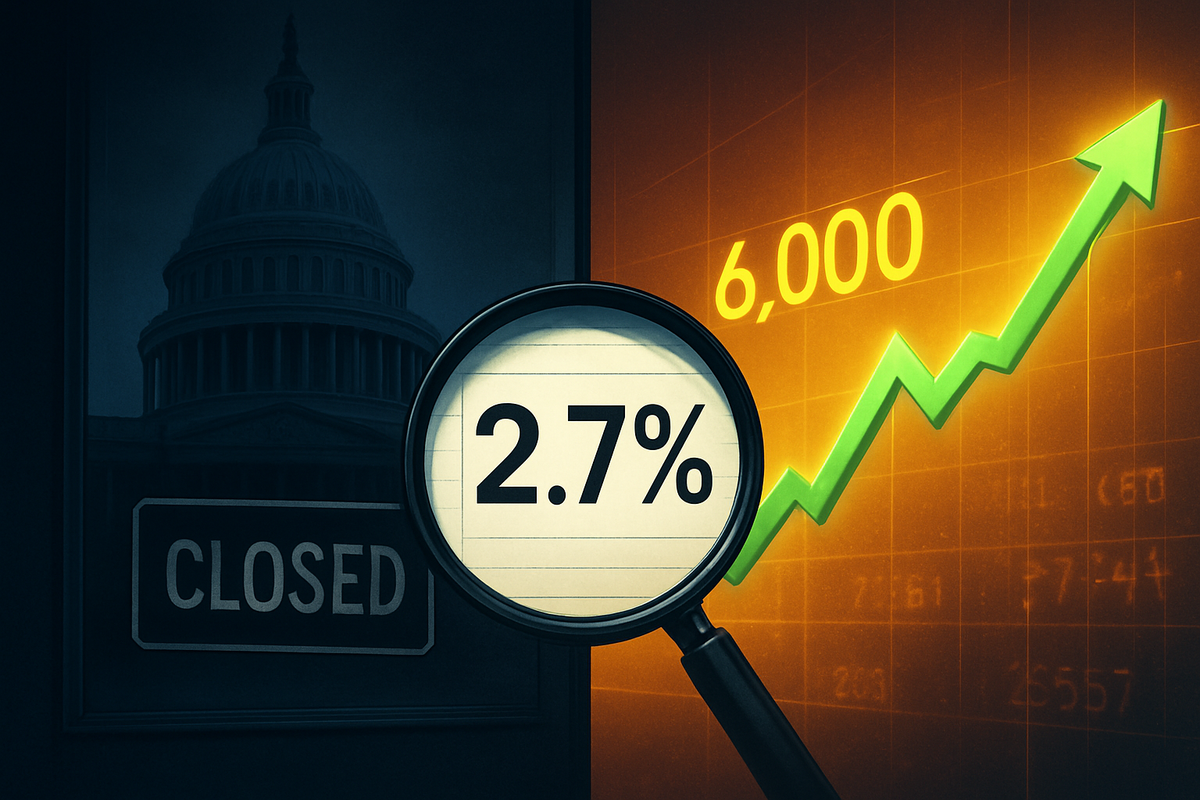
The financial world breathed a collective sigh of relief on December 18, 2025, as the Bureau of Labor Statistics (BLS) finally broke its silence following the longest government shutdown in United States history. The much-anticipated Consumer Price Index (CPI) report, the first major economic snapshot since the 43-day federal freeze ended in mid-November, revealed a cooling inflation landscape that caught many analysts off guard. Headline inflation for November cooled to 2.7% year-over-year, significantly lower than the 3.1% consensus forecast and a sharp decline from the 3.0% recorded in September.
This "double beat"—with core inflation also cooling to 2.6%—sent shockwaves through a market that had been "flying blind" for nearly two months. The immediate implications were clear: the cooling data effectively greenlit the Federal Reserve's pivot toward more aggressive interest rate cuts in early 2026. As the news hit the tapes, the S&P 500 surged past the psychological 6,000 level, while Treasury yields plummeted as investors recalibrated their expectations for a "soft landing" that many feared had been derailed by the political impasse in Washington.
The Return of the BLS: Unpacking the November Inflation Data
The path to this moment was fraught with unprecedented logistical and political hurdles. The government shutdown began on October 1, 2025, after Congress failed to reach an agreement on the 2026 fiscal year appropriations, primarily due to disputes over Affordable Care Act subsidies and tariff-related budget adjustments. For 43 days, until President Trump signed a revised funding bill on November 12, the BLS was largely shuttered, halting the collection of the very data that drives global monetary policy. This created what Wall Street dubbed the "Great Data Gap," leaving the December 18 report as a massive, high-stakes information dump.
The report itself was unique. Because survey data for October was never collected, the BLS was forced to use "imputations"—statistical estimates based on historical norms—for many categories, including the critical housing and shelter component. Despite these data quality concerns, the headline figure of 2.7% was a clear signal of disinflation. The report showed a modest 0.2% increase in prices over the combined two-month period of October and November, suggesting that the inflationary spike seen earlier in 2025, driven by new trade tariffs, was beginning to lose its sting.
Market participants reacted with a "risk-on" frenzy. The Dow Jones Industrial Average hit new all-time highs, and Bitcoin surged toward the $100,000 mark as the dollar weakened. The Federal Reserve, which had already cut rates to a range of 3.5%–3.75% on December 10 despite having limited data, saw its decision validated by the cooling CPI. Stakeholders from institutional pension funds to retail day traders viewed the report as a sign that the "stagflation" bogeyman—rising unemployment paired with sticky inflation—might finally be retreating.
Winners and Losers: From AI Resilience to Retail Squeeze
The market's reaction was not uniform, creating a distinct divide between sectors that thrived on the news and those still nursing wounds from the shutdown. Among the primary winners were the "Magnificent" tech giants. Microsoft (NASDAQ: MSFT) and Nvidia (NASDAQ: NVDA) saw significant gains; Microsoft benefited from the weakening U.S. Dollar, which bolsters its massive international revenue, while Nvidia continued to serve as a safe-haven for growth-hungry investors. Micron Technology (NASDAQ: MU) was a standout performer, jumping 16% as the cooling inflation data combined with a robust outlook for AI-related memory demand.
On the other side of the ledger, domestic retailers and defense contractors faced a "painful squeeze." Target (NYSE: TGT) and Dollar General (NYSE: DG) struggled as the shutdown had frozen funding for the Supplemental Nutrition Assistance Program (SNAP), commonly known as food stamps, for over a month. With Walmart (NYSE: WMT) capturing nearly a quarter of all SNAP spending, the $2 billion hit to its quarterly earnings was felt across the retail sector, though Walmart’s scale allowed it to weather the storm better than its smaller peers. Kroger (NYSE: KR) also saw its margins pressured by the 43-day disruption in consumer spending power.
The defense sector, usually a bastion of stability, also lagged. L3Harris (NYSE: LHX) and Lockheed Martin (NYSE: LMT) reported significant delays in contract awards and cash collections. General Dynamics (NYSE: GD) was even forced to tap the commercial paper market to maintain liquidity while government payments were stalled. Furthermore, Apple (NASDAQ: AAPL) and UnitedHealth (NYSE: UNH) were surprising laggards on the day of the CPI release; Apple fell 1.2% as investors rotated out of its relatively stable stock into high-beta growth names like Micron and Amazon (NASDAQ: AMZN), which rose 2.51% on the prospect of lower interest rates.
The Macro Lens: Policy Pivots and the Ghost of Stagflation
The December 2025 CPI report is more than just a set of numbers; it is a historical marker that highlights the fragility of the U.S. economic data infrastructure. The 43-day shutdown surpassed the previous 35-day record set in 2018-2019, creating a precedent where the world's largest economy operated without its primary navigation tools. This event fits into a broader trend of increasing political volatility impacting market mechanics. The "Great Data Gap" forced the Federal Reserve to rely on private-sector data from firms like Goldman Sachs (NYSE: GS) and JPMorgan (NYSE: JPM), potentially shifting the influence of private financial institutions over public policy.
Historically, shutdowns have rarely caused permanent economic damage, but the 2025 event was different due to its length and the backdrop of 4.6% unemployment—the highest in four years. The ripple effects are already being felt by competitors in the global market. As the U.S. government went dark, international investors briefly looked toward Eurozone and Asian markets for stability, though the 2.7% CPI print quickly pulled capital back into U.S. equities. The regulatory implication is clear: there is now a growing bipartisan push for "essential" status for the BLS and other data-gathering agencies to prevent future policy blindness.
Looking Ahead: The 2026 Outlook and the Fed’s Next Move
In the short term, the market is bracing for a "data dump" in early 2026 as the BLS works to reconcile its imputed October figures with actual year-end results. Investors should be prepared for potential revisions to the December report, which could introduce fresh volatility if the "cooling" turns out to have been an artifact of missing data. For the Federal Reserve, the path forward appears to be a series of 25-basis-point cuts throughout the first half of 2026, aimed at supporting a labor market that lost over 100,000 jobs during the shutdown period.
Strategic pivots are already underway in the corporate world. Defense contractors like Northrop Grumman (NYSE: NOC) are expected to accelerate their diversification into commercial aerospace to mitigate future government-dependency risks. Meanwhile, retailers are likely to push for more aggressive e-commerce strategies to offset the volatility of physical foot traffic and government-subsidized spending. The market opportunity lies in "recovery plays"—companies that were unfairly beaten down during the shutdown but stand to gain from a normalized federal budget and lower borrowing costs.
Navigating the Post-Shutdown Economy
The release of the December 2025 CPI report marks the end of a chaotic chapter in American finance. The key takeaway is that despite a record-breaking government shutdown and significant political friction, the underlying trend of cooling inflation remains intact. The 2.7% headline figure has effectively shifted the market narrative from "inflation at all costs" to "preserving the labor market." While the data quality may be imperfect, the market’s decisive "risk-on" reaction suggests that investors are more interested in the direction of travel than the precision of the coordinates.
Moving forward, the market will likely remain sensitive to any signs of "stagflation" as the delayed jobs data is fully digested. Investors should watch for the Fed’s January meeting and the subsequent "true-up" CPI report in February. The lasting impact of this event will be a heightened awareness of political risk in economic forecasting. While the S&P 500's climb past 6,000 is a cause for celebration, the scars of the 43-day shutdown serve as a reminder that in the modern economy, information is just as vital as capital.
This content is intended for informational purposes only and is not financial advice.