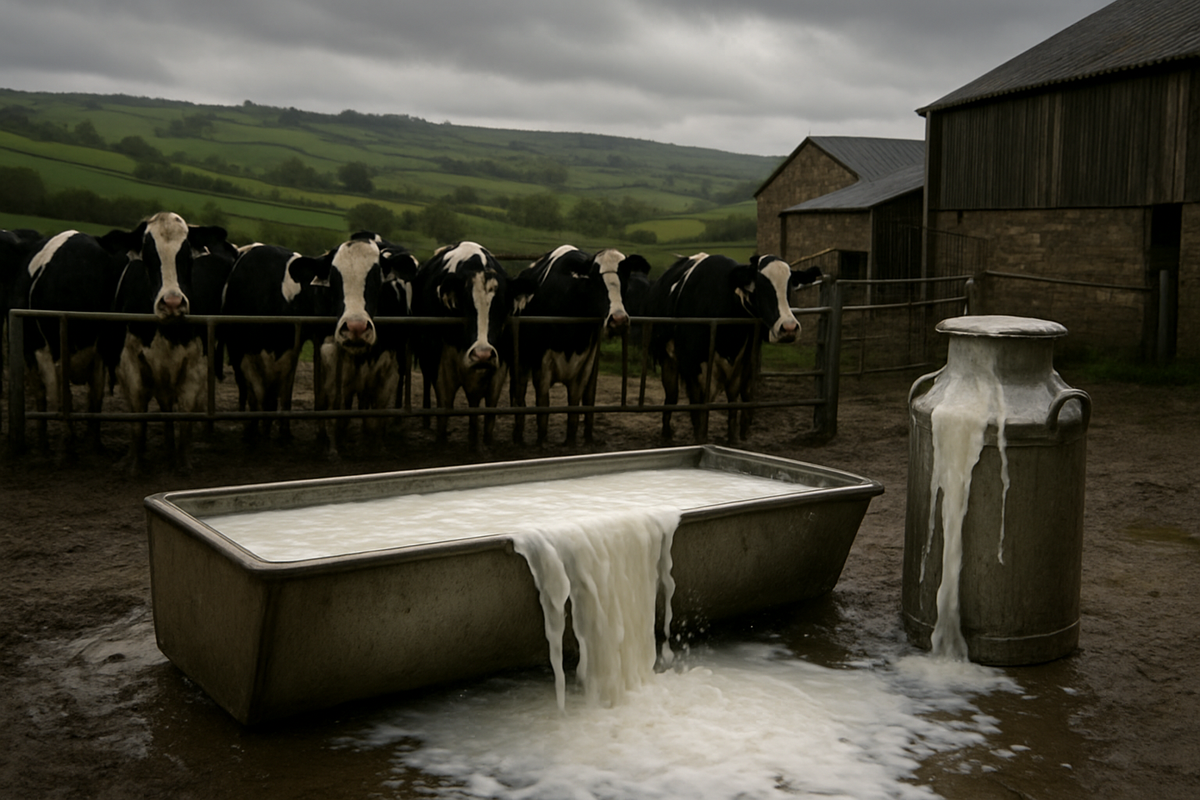
The United Kingdom's dairy industry is currently in the throes of a significant crisis, as farmgate milk prices have crashed due to a persistent and substantial oversupply of milk, both domestically and across global markets. As of December 2025, leading milk processors have enacted sharp price cuts for December 2025 and January 2026, pushing prices for conventional milk well below the 40 pence per litre (ppl) mark that many farmers deem essential for sustainable operations. This dramatic downturn, following a period of relatively stable prices earlier in 2025, is exerting immense financial pressure on dairy farmers, threatening the viability of numerous businesses and reshaping the landscape of the UK's vital dairy sector.
The immediate implications of this price collapse are stark: dairy farmers face severely squeezed margins, with falling milk revenues clashing against stubbornly high input costs, including feed, forage, and labor. This economic strain is forcing difficult decisions, with many producers contemplating herd culling or even exiting the industry entirely. While consumers might eventually see some relief at the retail level, the short-term outlook for the foundational segment of the dairy supply chain remains grim, signaling a period of intense uncertainty and potential consolidation for the industry.
The Perfect Storm: A Detailed Look at the Dairy Downturn
The precipitous fall in UK farmgate milk prices is the culmination of a 'perfect storm' of factors that have led to a significant imbalance between milk supply and demand. The crisis, which intensified in late 2024 and accelerated into 2025, sees major processors such as Arla (ARLA) and Müller (private) announcing substantial reductions. Arla's conventional milk price is set to decrease by 3.50 ppl to 39.21 ppl from December 1st, 2025, while Müller will implement a 1.5 ppl cut, bringing its price to 38.5 ppl from January 1, 2026. Other processors, including Freshways (private), have announced even steeper cuts, with their base price falling to 30.4 ppl from January 1st. This marks a sharp reversal from earlier in 2025 when prices, though easing, were still considered robust. Spot milk prices, reflecting the immediate surplus, have been quoted significantly lower, in some instances dipping below 20 ppl.
The timeline leading to this predicament began to take shape in late 2024. Favorable milk-to-feed price ratios and lower concentrate feed costs incentivized UK farmers to increase production, leading to a significant rebound in milk flows. By October 2025, Great British (GB) milk production for the milk year to date was up 5.2% on the previous year and 4.1% above the five-year average, contributing to record milk volumes. Simultaneously, global milk supplies surged, particularly from the EU, which saw a 6% year-on-year increase in September 2025, partly due to cows delaying calving in 2024 (due to the Bluetongue virus) finally coming into production. The US dairy herd also expanded, and New Zealand reported positive growth. This surge in supply overwhelmed relatively stable, but not growing, retail and industrial demand for dairy products. Furthermore, weakening demand from key international markets, such as China, which saw a 10% year-on-year decrease in imported dairy in 2024, exacerbated the global surplus.
Key players caught in this downturn include thousands of independent dairy farmers across the UK, who bear the brunt of the price cuts. Milk processors like Arla, Müller, First Milk (private), and Freshways are pivotal, acting as the intermediaries between farms and retailers. Their decisions on milk pricing directly impact farmer livelihoods. Retailers, such as Tesco (LSE: TSCO), Sainsbury's (LSE: SBRY), and Asda (private), while not directly setting farmgate prices, influence the demand for processed dairy products and can leverage lower wholesale costs. Initial market reactions have been characterized by widespread concern and calls for intervention from farmer advocacy groups, highlighting the severe financial distress facing producers. The collapse in wholesale prices for dairy commodities like butter and mild cheddar across the UK and Europe directly reflects the oversupply, with butter prices losing over £500/tonne in September 2025 alone.
Corporate Ripples: Winners and Losers in the Dairy Downturn
The dramatic collapse in farmgate milk prices sends ripple effects throughout the entire dairy supply chain, creating a clear delineation of potential winners and losers among publicly traded companies. While dairy farmers face an immediate and severe financial squeeze, the situation presents a complex set of dynamics for processors, retailers, and input suppliers, influencing their financials, operations, and ultimately, their stock performance.
Major food retailers stand as potential beneficiaries in this scenario. Companies like Tesco PLC (LSE: TSCO) and J Sainsbury plc (LSE: SBRY) are well-positioned to leverage the lower wholesale cost of milk. Historically, these supermarket giants have passed on some, if not all, of their input cost savings to consumers, using competitively priced milk as a key 'loss leader' to attract footfall and boost overall basket spend. While both retailers emphasize that their aligned supply groups (which often guarantee farmers a price based on production costs) are insulated, they can still capitalize on cheaper milk sourced from the broader market. This dynamic allows them to maintain or even improve margins on their dairy category, or alternatively, to offer more aggressive pricing to gain market share against competitors, including online grocers like Ocado Group PLC (LSE: OCDO), which would also benefit from lower purchasing costs. For investors, improved retail margins or increased customer loyalty stemming from cheaper dairy could be viewed positively.
Conversely, specialized agricultural input suppliers face significant headwinds. Wynnstay Group PLC (LSE: WYN), a leading provider of agricultural supplies and services including feed, seed, and fertilizer, is particularly vulnerable. As dairy farmers grapple with severely reduced milk revenues and thin or negative margins, they are highly likely to cut back on discretionary spending and seek out cheaper alternatives for essential inputs. This directly translates to reduced demand for Wynnstay's products, pressure on their selling prices, and potentially impaired cash flow due to slower payments from struggling farming customers. Such a downturn in their core customer base would negatively impact Wynnstay's revenues, profit margins, and consequently, its share price.
Dairy processors, such as Saputo Dairy UK (a subsidiary of Saputo Inc. (TSE: SAP), formerly Dairy Crest), which produces brands like Cathedral City cheese and Clover butter, find themselves in a more nuanced position. On one hand, lower farmgate milk prices directly reduce their primary raw material cost. This could potentially boost their processing margins, especially for products with strong brand loyalty or those that can be stored or exported, like cheese or milk powders. However, this benefit is contingent on their ability to maintain selling prices for their finished products in a competitive retail environment, and to efficiently manage the influx of excess raw milk without incurring significant storage or disposal costs. Associated British Foods plc (LSE: ABF), a diversified conglomerate, also has exposure through its AB Agri division, which processes dairy and supplies feed. While AB Agri would benefit from lower raw milk costs for its processing arm, its role as an input supplier means it would also face reduced demand from struggling dairy farmers, creating a mixed financial impact that its broader portfolio would likely cushion.
Wider Significance: A Shifting Landscape for UK Dairy
The crash in farmgate milk prices due to oversupply is not an isolated incident but rather a symptom of broader, interconnected trends shaping the global and domestic dairy industries. This event fits into a pattern of cyclical volatility that has long plagued agricultural markets, where periods of high prices incentivize increased production, inevitably leading to oversupply and subsequent price corrections. The current downturn, however, is exacerbated by several factors, including the global nature of the dairy market. Surging milk production across the EU and in major dairy-exporting nations like New Zealand and the US has created a worldwide surplus, driving down international commodity prices for butter, cheese, and skimmed milk powder. As a net importer of dairy products, the UK's domestic market is highly susceptible to these global price fluctuations and the availability of competitively priced imports, further intensifying the pressure on local producers.
The ripple effects of this oversupply extend beyond direct competitors and into the entire agricultural ecosystem. Struggling dairy farmers, facing unsustainable margins, may reduce their spending on agricultural services, machinery, and other farm inputs, impacting businesses that supply these goods. This could lead to a broader economic slowdown in rural communities heavily reliant on the dairy sector. Furthermore, the crisis could accelerate the trend towards consolidation within the UK dairy industry, with smaller, less efficient farms potentially being forced out of business. This could lead to fewer, larger farms, altering the structure of milk production and potentially impacting biodiversity and local food systems. The long-term stability of processor-farmer relationships, particularly those not under aligned contracts, could also be strained, leading to greater uncertainty in milk procurement.
From a regulatory and policy perspective, this crisis will undoubtedly ignite calls for government intervention. Farmers' unions and advocacy groups will likely pressure the UK government for support mechanisms, such as price stabilization schemes, direct subsidies, or measures to help manage milk volumes. The implications of Brexit, particularly regarding trade agreements and access to export markets, also play a role. While the UK is no longer directly subject to EU agricultural policies, global market dynamics still heavily influence its dairy sector. The government may face pressure to review its agricultural policies to better support domestic food security and farmer resilience in the face of such market volatility. Historical precedents, such as the milk price crashes of 2014-2016, serve as stark reminders of the severe impact on farmer livelihoods and the need for robust industry strategies to mitigate future downturns.
What Comes Next: Navigating the Dairy Crossroads
The path forward for the UK dairy sector is fraught with both challenges and potential opportunities, demanding strategic pivots and adaptations from all stakeholders. In the short term, the pressure on farmgate milk prices is expected to persist well into early 2026. Farmers are likely to continue implementing cost-cutting measures, including culling less productive animals, optimizing feed efficiency, and scrutinizing all operational expenses. This could lead to a slight reduction in milk volumes over time, which, coupled with any potential strengthening of global demand, might eventually help to rebalance the market and stabilize prices in the latter half of 2026. However, a rapid return to the higher prices seen in early 2025 is considered unlikely, suggesting a prolonged period of cautious financial management for producers.
For processors and retailers, the coming months will involve navigating the complexities of managing excess supply while maintaining competitive pricing and securing their supply chains. Processors may explore new avenues for milk utilization, such as expanding into export markets for dairy commodities or investing in value-added products that command higher margins. Retailers, while benefiting from lower input costs, will need to balance passing savings to consumers with ensuring the long-term viability of their farmer suppliers, particularly those in aligned contracts. Strategic partnerships and greater transparency across the supply chain could become crucial to fostering resilience and sharing risk more equitably.
Emerging market opportunities might arise for those agile enough to adapt. There could be an increased focus on product innovation, particularly in areas like sustainable dairy, plant-based alternatives (which could benefit from increased consumer awareness of dairy challenges), or specialized dairy ingredients for the food manufacturing sector. The crisis may also spur investment in new technologies that improve efficiency and reduce the environmental footprint of dairy farming. However, these opportunities are accompanied by significant challenges, including the capital expenditure required for such transitions and the need for new market development. Potential scenarios range from a gradual market correction leading to a healthier, albeit smaller, dairy sector, to a more severe consolidation resulting in a significant reduction in the number of dairy farms and increased reliance on larger, more industrialized operations.
Comprehensive Wrap-Up: Enduring Impact and Future Watch
The current crash in UK farmgate milk prices, driven by persistent oversupply, represents a critical juncture for the nation's dairy industry. The key takeaway is the severe and immediate financial distress facing dairy farmers, who are caught between plummeting revenues and elevated input costs, pushing many to the brink of profitability. This situation underscores the inherent volatility of agricultural commodity markets and the profound interconnectedness of global supply and demand dynamics. While major retailers may find some advantage in lower purchasing costs, the long-term health of the entire dairy supply chain hinges on the sustainability of its primary producers.
Moving forward, the market is expected to remain under pressure well into 2026, with a gradual rebalancing contingent on a reduction in global supply or a significant rebound in demand. The crisis highlights the urgent need for strategic planning and collaboration across the industry, from farm to fork. There will likely be a renewed focus on supply management strategies, diversification within farming operations, and exploring new value-added opportunities for milk. The government's role in providing support and fostering a more resilient agricultural policy framework will also be under scrutiny.
For investors, the coming months will require close observation of several key indicators. Watch for shifts in global milk production figures, particularly from the EU and New Zealand, as these will heavily influence international commodity prices. Monitor the financial performance of publicly traded retailers (LSE: TSCO, LSE: SBRY, LSE: OCDO) to see how they leverage lower dairy input costs – whether through improved margins or aggressive pricing strategies. Conversely, pay attention to the financial health and sales figures of agricultural input suppliers like Wynnstay Group PLC (LSE: WYN), as their performance will be a direct gauge of the economic pressure on the farming community. Finally, any policy announcements from the UK government regarding agricultural support or market intervention will be crucial in shaping the future trajectory of the dairy sector. The crisis serves as a powerful reminder of the delicate balance within food systems and the far-reaching consequences when that balance is disrupted.
This content is intended for informational purposes only and is not financial advice