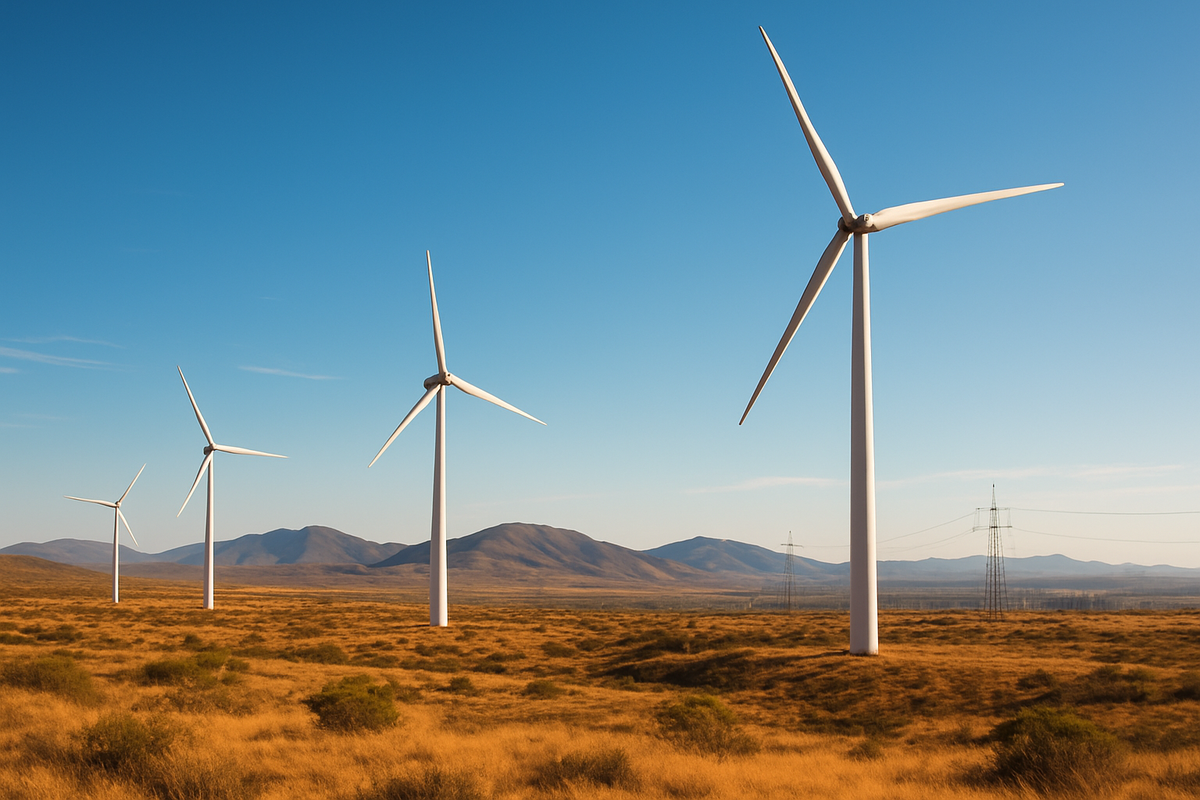
In a move that signals a significant thawing of Mexico’s renewable energy landscape, Revolve Renewable Power Corp. (TSXV: REVV) announced today, December 22, 2025, that it has received a formal federal generation permit for its 130 MW "El 24" wind project. The approval, granted by the newly formed Comisión Nacional de Energía (CNE), marks one of the first major private wind permits issued under the administration of President Claudia Sheinbaum. This development is seen as a pivotal moment for the North American energy market, suggesting that Mexico is ready to re-integrate into the regional "green commodity" boom after years of regulatory stagnation.
The issuance of this permit is more than just a corporate milestone; it is a bellwether for the "Plan México" energy reforms enacted earlier this year. By greenlighting the El 24 project, located in the wind-rich corridor of Tamaulipas, the Mexican government is signaling a pragmatic shift toward meeting its ambitious target of 45% clean energy generation by 2030. For investors and energy traders, the move highlights the growing value of renewable energy as a strategic commodity in the USMCA region, particularly as industrial "nearshoring" drives a desperate need for reliable, carbon-neutral power.
Breakthrough for the El 24 Wind Project
The El 24 Wind Project, situated in the northeastern state of Tamaulipas, has been a cornerstone of the Revolve Renewable Power Corp. (TSXV: REVV) portfolio for several years. The project reached a critical juncture on December 19, 2025, when the CNE officially signed off on the generation permit, a document that has been notoriously difficult for private developers to obtain over the last half-decade. This 130 MW facility is designed to capitalize on the high-velocity wind currents of the Gulf coast, utilizing advanced turbine technology to feed the industrial heartlands of northern Mexico.
The timeline leading to this approval was fraught with regulatory uncertainty. Following the 2024 general election, the Mexican energy sector underwent a massive restructuring. The dissolution of the old CRE and the establishment of the CNE under the Ministry of Energy initially sparked fears of further centralization. However, the "qualification window" opened in late 2025 aimed to fast-track projects that align with the national grid’s stability requirements. Revolve’s success in navigating this window places the El 24 project in an "Advanced Stage Development" status, with the company targeting a "Ready-to-Build" (RTB) milestone by late 2026.
Key stakeholders in this project include not only the developers but also the local communities in Tamaulipas and potential industrial off-takers. Revolve has historically utilized a "develop and sell" business model, similar to its previous transactions with global giants like ENGIE SA (EPA: ENGI). By de-risking the project through the permitting phase, Revolve has significantly increased the asset's valuation, making it a prime target for acquisition by larger independent power producers (IPPs) looking to expand their Mexican footprint under the new 46% private-sector quota.
Winners and Losers in the New Mexican Energy Order
The primary winner in this announcement is undoubtedly Revolve Renewable Power Corp. (TSXV: REVV), whose stock saw immediate positive sentiment as the market priced in the reduced regulatory risk. However, the ripple effects extend to the broader supply chain. Turbine manufacturers like Vestas Wind Systems A/S (CPH: VWS) and Nordex SE (ETR: NDX1), both of which maintain manufacturing facilities in Tamaulipas, stand to gain from a renewed pipeline of projects. These OEMs have been operating at partial capacity in Mexico due to the previous administration's freeze on permits; a resurgence in activity could revitalize the local industrial base.
Conversely, the traditional fossil fuel sector may face mounting pressure. One of the stated goals of the Sheinbaum administration is to reduce Mexico’s heavy reliance on natural gas imported from the United States, a move that could impact major pipeline operators and gas suppliers. Furthermore, established European giants like Acciona Energía (BME: ANE) and Iberdrola SA (BME: IBE) find themselves in a complex position. While Iberdrola recently divested a large portion of its Mexican assets to the state-owned Federal Electricity Commission (CFE), the success of smaller players like Revolve suggests that the new 54/46 state-to-private split may favor nimble developers who can align with the government's "binding planning" model.
Industrial off-takers are also set to win. Large-scale manufacturers like Grupo Bimbo and automotive leaders such as Honda, which have committed to 100% renewable operations, have been starved for new supply. The entry of 130 MW of wind capacity—and the potential for more to follow—provides a lifeline to these corporations as they struggle to meet global ESG mandates. On the losing side are the "self-supply" schemes of the past; the 2025 reforms have essentially forced these older contracts to migrate into the new, more regulated PPA structures, often at higher costs for the end-user.
Analyzing the Wider Significance: The 54/46 Split
The approval of the El 24 permit is a concrete application of Mexico’s 2025 Energy Reform, which mandates that the CFE maintain a 54% share of national generation. By allowing Revolve to proceed, the government is demonstrating that there is still a significant 46% "slice of the pie" available for private capital. This fits into a broader industry trend where emerging markets are attempting to balance energy sovereignty with the need for rapid decarbonization. It represents a "middle path" between the total liberalization of the 2013 reforms and the state-monopoly tendencies seen between 2018 and 2024.
This event also has profound implications for North American energy security. Currently, Mexico spends billions annually on U.S. natural gas. The expansion of wind and solar commodities within Mexico reduces this trade deficit and provides a more stable, localized energy source. It also aligns with the "Green Corridor" initiatives discussed during USMCA summits, where the goal is to create a seamless, low-carbon industrial zone from Canada to southern Mexico. The El 24 project serves as a pilot for how private developers can survive—and thrive—within a state-led framework.
Historically, this moment can be compared to the "re-opening" of the Brazilian energy markets in the early 2000s, where state-led planning eventually paved the way for a massive influx of private wind investment. If Mexico continues to issue permits at this pace, it could unlock an estimated $7 billion in sidelined private investment. However, the new requirement for projects to include battery storage—a 30% capacity mandate introduced in the 2025 Grid Code—adds a layer of technical and financial complexity that was not present in previous decades.
The Road Ahead: RTB and the Battery Storage Mandate
Looking forward, the short-term focus for Revolve will be achieving the Ready-to-Build (RTB) status. This will involve securing interconnection agreements with the CFE and finalizing the procurement of turbines and storage systems. Given the new regulatory environment, Revolve will likely need to partner with a battery storage provider, potentially benefiting companies like GE Vernova (NYSE: GEV) or Tesla, to meet the 30% storage mandate. This transition from a pure wind project to a "hybrid" wind-plus-storage asset is indicative of the next phase of the global energy transition.
In the long term, the market should expect a wave of consolidation. Smaller developers who have successfully secured permits may become acquisition targets for global energy firms like Sempra Infrastructure, a subsidiary of Sempra (NYSE: SRE), which is already developing large-scale export-oriented wind farms in Baja California. The "develop and sell" strategy remains highly lucrative in a market where permits are the scarcest commodity. Investors should watch for whether Revolve decides to hold the asset through construction or exit early to recycle capital into its other Mexican projects, such as the 400 MW Presa Nueva project in Nuevo León.
Final Assessment: A New Chapter for Mexican Renewables
The granting of the 130 MW permit to Revolve Renewable Power Corp. (TSXV: REVV) is a watershed moment that confirms Mexico's return to the renewable energy stage. It validates the "Plan México" strategy and provides a roadmap for how private developers can operate under the 54/46 rule. For the North American market, it signifies a step toward a more integrated and less gas-dependent energy grid, driven by the dual pressures of nearshoring and climate change.
Moving forward, the market will be characterized by "binding planning," where the government dictates where and when new capacity is added. While this reduces the "wild west" nature of previous decades, it offers a level of certainty that has been missing for years. Investors should keep a close eye on the CNE’s upcoming permit cycles in early 2026. If more projects like El 24 are approved, it will confirm that Mexico’s green pivot is not just a political promise, but a fundamental shift in the continent’s energy commodity landscape.
This content is intended for informational purposes only and is not financial advice.