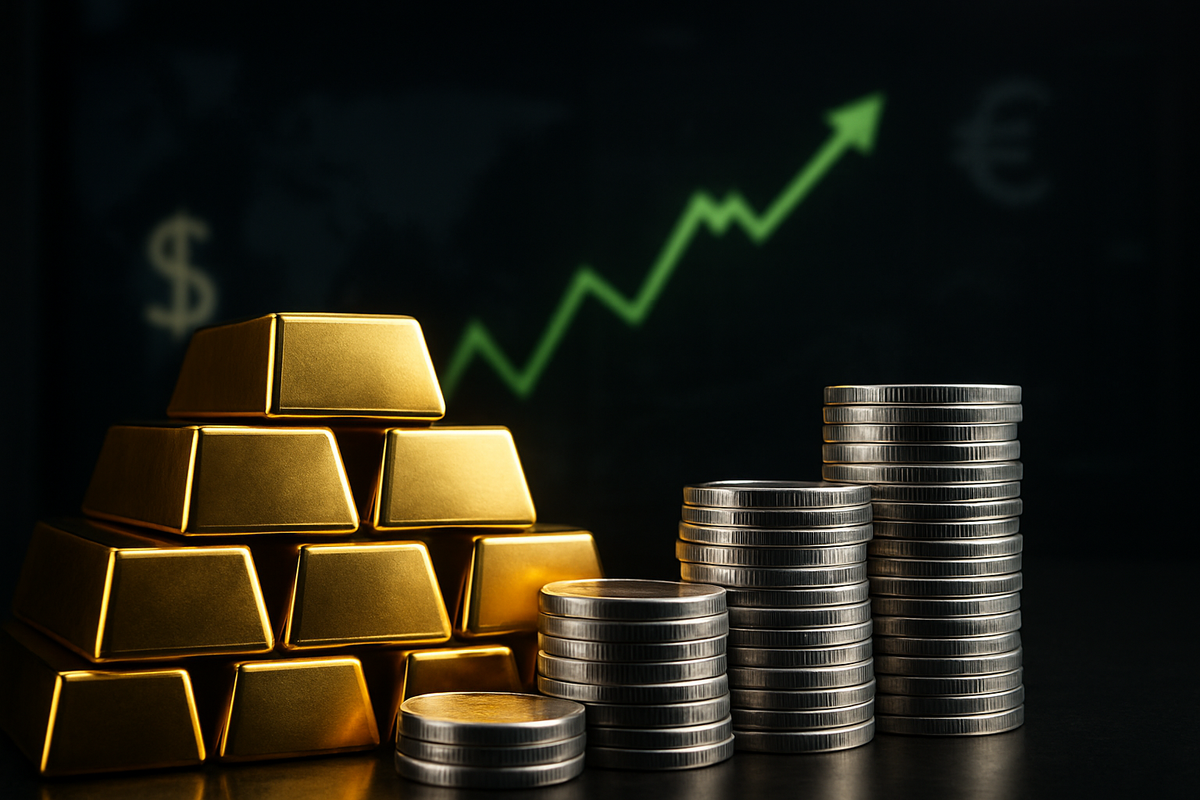
On December 22, 2025, the global financial landscape witnessed a historic milestone as gold and silver prices surged to unprecedented heights, marking the culmination of a year-long rally in precious metals. Spot gold reached a staggering record of $4,404.12 per ounce, with intraday peaks touching $4,420, while silver significantly outperformed its yellow counterpart, shattering all-time highs to hit $69.52 per ounce. This monumental surge has sent shockwaves through the broader market, signaling a fundamental shift in investor sentiment toward tangible assets as traditional fiat-based certainties are called into question.
The immediate implications of this rally are profound, reflecting a "perfect storm" of macroeconomic volatility and geopolitical instability. As the U.S. Dollar Index faces downward pressure and real interest rates decline, the flight to safety has accelerated. This is not merely a short-term spike but a structural re-pricing of risk, as institutional and retail investors alike scramble to hedge against currency debasement and a global supply-demand imbalance in industrial metals like silver. The rally has also ignited a decoupling in the stock market, where precious metals are no longer just a defensive play but a high-octane growth sector in their own right.
The Road to Record Highs: A Timeline of Turbulence
The ascent to these record levels was paved by a series of critical events throughout late 2024 and 2025. The primary catalyst arrived on December 10, 2025, when the Federal Reserve delivered its third consecutive 25-basis-point interest rate cut of the year. This pivot signaled a definitive shift away from the restrictive policies of previous years, prioritizing economic growth over the final stubborn vestiges of inflation. By lowering the opportunity cost of holding non-yielding assets, the Fed effectively opened the floodgates for capital to flow into bullion.
Simultaneously, geopolitical tensions reached a boiling point in late 2025. A U.S. naval blockade of Venezuelan oil tankers, intended to enforce energy sanctions, sparked fears of a massive energy supply shock and potential escalation into a broader conflict. This, combined with renewed hostilities in the Middle East between Iran and Israel and the ongoing war in Ukraine, created a persistent "geopolitical premium" that floor-priced the metals. Furthermore, the introduction of the "Liberation Day" tariffs—a series of aggressive trade barriers—fueled concerns of global stagflation, making hard assets the only perceived sanctuary for capital preservation.
Central bank activity has also provided a robust structural foundation for this rally. In October 2025 alone, global central banks, led by Poland, Brazil, Uzbekistan, and China, purchased 53 tonnes of gold. The National Bank of Poland notably increased its gold allocation target to 30%, a move echoed by several other emerging economies seeking to diversify away from the U.S. dollar. This systematic de-dollarization has created a relentless bid in the market that shows no signs of abating as the year draws to a close.
Winners and Losers in the Great Metal Migration
The stratospheric rise in prices has created a stark divide between the beneficiaries of the rally and those crippled by rising input costs. The primary winners are the major mining and streaming companies that have seen their valuations re-rated to reflect the new price floor. Newmont Corporation (NYSE: NEM), the world’s largest gold producer, has seen its stock surge over 130% year-to-date, hitting all-time highs near $102 as it projects a record $4.5 billion in free cash flow. Similarly, Barrick Gold (NYSE: GOLD) has capitalized on the rally, leveraging its dual-metal strategy to report record earnings and special dividends for shareholders.
In the silver space, Pan American Silver (NYSE: PAAS) has emerged as a high-level winner, with shares surging 90% as it benefits from the massive physical squeeze. However, the most efficient gainer has been Wheaton Precious Metals (NYSE: WPM). Operating on a fixed-cost streaming model, WPM has captured the price increases as pure profit without the operational headaches of rising labor and fuel costs, sending its shares to an all-time high of $122.81. Investors seeking direct exposure have also piled into exchange-traded funds like the SPDR Gold Shares (NYSE: GLD) and the iShares Silver Trust (NYSE: SLV), the latter of which has delivered triple-digit returns this year.
Conversely, the "losers" of this rally are found in sectors where silver is a critical industrial component. Solar manufacturers like JinkoSolar (NYSE: JKS) and First Solar (NASDAQ: FSLR) are facing a severe margin squeeze, as silver now accounts for nearly 14% of total module production costs. The automotive industry is also reeling; companies like Ford Motor Company (NYSE: F), whose modern electric vehicles require significantly more silver for conductivity than traditional models, have reported hits to operating profits. Even jewelry giants like Signet Jewelers (NYSE: SIG) are struggling, facing a dual crisis of record inventory costs and "demand destruction" as consumers balk at the higher price tags for gold and silver ornaments.
Wider Significance: The New Industrial Super-Cycle
This rally is more than just a safe-haven flight; it represents a fundamental shift in the global industrial landscape. Silver, in particular, is entering a "super-cycle" driven by the Green Energy Transition and the explosion of AI infrastructure. The structural supply deficit in silver is now in its fifth consecutive year, as the demand for high-conductivity components in solar panels, EVs, and data centers outstrips current mining capacity. This event mirrors the historic 1979 rally but with a modern twist: the current demand is driven by essential technology rather than just speculative hoarding.
Furthermore, the rally highlights a growing trend of "fiscal instability hedging." Unlike previous cycles where gold rose while stocks fell, 2025 has seen a decoupling where the S&P 500 (INDEXSP:.INX) has risen 18% alongside the metals. This suggests that investors are not necessarily bearish on corporate America, but are increasingly skeptical of the long-term purchasing power of the currency those profits are denominated in. This "re-pricing" of the financial system has significant policy implications, as central banks must now balance the need for economic stimulus against the risk of a total loss of confidence in fiat currencies.
Looking Ahead: The 2026 Outlook
As we move into 2026, the short-term outlook remains bullish for precious metals, though volatility is expected to increase. Analysts suggest that if the Federal Reserve continues its easing cycle and geopolitical tensions remain unresolved, gold could realistically test the $5,000 level by mid-2026. However, the market may face challenges if high prices lead to significant technological substitution. We are already seeing strategic pivots in the solar industry, with researchers accelerating the development of copper-based pastes to replace silver, though these technologies are likely years away from commercial scale.
For investors, the primary challenge will be navigating the potential for a "blow-off top" in silver. While the industrial demand is real, the parabolic move to $70 suggests a degree of speculative fervor that could lead to sharp corrections. Strategic adaptations will be required for companies in the electronics and automotive sectors, potentially leading to a new wave of consolidation as firms seek to secure their own supply chains through direct investments in mining projects or long-term streaming agreements.
Final Thoughts: A Market Transformed
The record-breaking performance of gold and silver in December 2025 marks a definitive end to the era of low-cost commodities and stable currency expectations. The key takeaway for the market is that "hard assets" have reclaimed their throne at the center of the global financial system, driven by a combination of central bank diversification, industrial necessity, and geopolitical necessity. The market moving forward will likely be characterized by higher volatility and a continued focus on tangible value.
Investors should watch closely for any signs of a reversal in Fed policy or a de-escalation in the Venezuela conflict, which could provide temporary relief for metal prices. However, the structural shifts—namely the silver supply deficit and the global move away from dollar dominance—are long-term trends that are unlikely to vanish. In the coming months, the performance of mining stocks relative to the spot price will be a critical indicator of whether this rally has further room to run or if the market is reaching a point of exhaustion.
This content is intended for informational purposes only and is not financial advice.