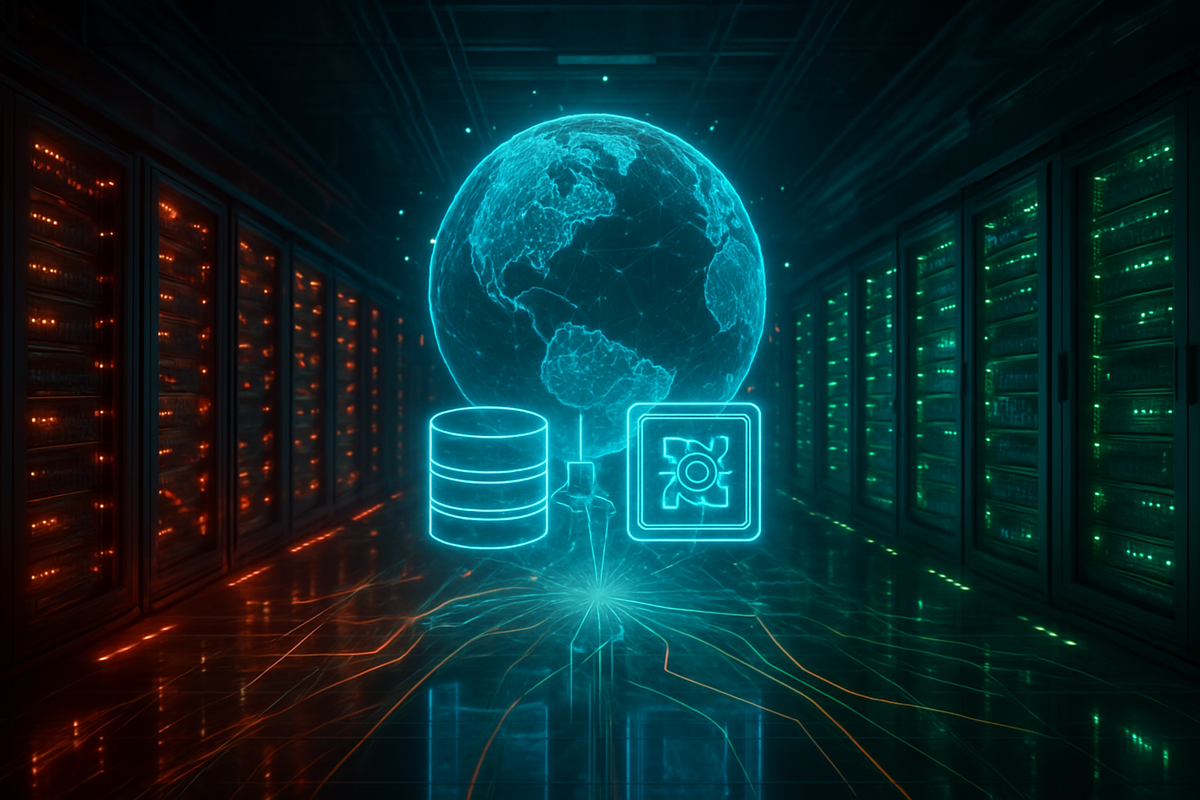
As of December 22, 2025, the narrative of the artificial intelligence revolution has shifted from a one-company show to a powerful duopoly of infrastructure. While Nvidia (NASDAQ: NVDA) continues to dominate the silicon layer with its Blackwell architecture, Oracle (NYSE: ORCL) has emerged as its most critical partner, transforming from a legacy database provider into the world’s premier "AI factory." This transformation was solidified earlier this month when Oracle reported a staggering $523.3 billion backlog in Remaining Performance Obligations (RPO), a figure that has sent shockwaves through Wall Street and established Oracle as the indispensable utility provider for the generative AI era.
The immediate implications of this partnership are profound. Oracle is no longer just selling software; it is building the physical and digital foundations upon which the next generation of AI models—including the highly anticipated GPT-5—will be trained. However, this breakneck expansion comes with a massive price tag. Oracle’s recent commitment to a $50 billion annual capital expenditure budget has triggered a debate among investors about the sustainability of the AI infrastructure boom, even as the company’s cloud growth continues to outpace its larger "Hyperscaler" rivals.
The $523 Billion Milestone: A Timeline of Oracle’s AI Ascent
The current market frenzy surrounding Oracle traces back to a series of strategic maneuvers in late 2024 and throughout 2025. The defining moment occurred in September 2025, when Oracle announced a landmark $300 billion, five-year agreement with OpenAI, known internally as "Project Stargate." This deal positioned Oracle Cloud Infrastructure (OCI) as the primary compute engine for the world’s leading AI lab, utilizing massive clusters of Nvidia GPUs. Following this announcement, Oracle’s stock surged 36% in a single day—its largest jump since 1992—hitting an all-time high of $327.76.
The momentum continued into the December 10, 2025, earnings report for Q2 Fiscal 2026. Oracle reported that its IaaS (Infrastructure-as-a-Service) revenue skyrocketed 68% year-over-year to $4.1 billion. More importantly, the company revealed its total RPO had reached $523.3 billion, a 438% increase from the previous year. This backlog represents nearly half a trillion dollars in guaranteed future revenue, largely driven by sovereign cloud contracts and massive AI training commitments.
Key to this success has been Oracle’s "co-engineering" relationship with Nvidia. Unlike other cloud providers that often prioritize their own custom silicon, Oracle has leaned heavily into Nvidia’s ecosystem. In late 2025, Oracle became the first to deploy the Nvidia Blackwell GB200 NVL72 platform at scale, building superclusters of 131,072 GPUs capable of delivering unprecedented zettaflops of compute power. This "Nvidia-first" strategy, championed by Chairman and CTO Larry Ellison, has made OCI the preferred destination for AI developers who require the highest performance without the overhead of proprietary hardware restrictions.
Winners and Losers in the AI Infrastructure Arms Race
In the current landscape, Nvidia (NASDAQ: NVDA) stands as the primary beneficiary of Oracle’s aggressive expansion. As Oracle’s CapEx guidance jumped to $50 billion for FY2026, a significant portion of that capital is flowing directly into Nvidia’s coffers for Blackwell and future-generation chips. This symbiotic relationship ensures that Nvidia has a guaranteed, high-volume buyer that is building the very data centers needed to house its hardware.
Conversely, traditional cloud giants like Amazon (NASDAQ: AMZN) and Microsoft (NASDAQ: MSFT) are finding themselves in a complex competitive position. While both remain massive players, Oracle’s specialized OCI architecture has proven more efficient for large-scale AI training, leading to a "multi-cloud" shift. In a surprising turn of events in 2025, Oracle successfully integrated its database services directly into AWS and Google (NASDAQ: GOOGL) Cloud, essentially turning its competitors into distribution channels. This "Oracle Database@Azure" and "Oracle Database@AWS" strategy has unlocked legacy enterprise data for AI applications, making Oracle a winner even when customers use other cloud platforms.
However, the "losers" in this scenario may be investors seeking short-term dividends or share buybacks. The massive capital requirements to build AI factories have turned Oracle’s free cash flow negative—reporting a $10 billion deficit in the most recent quarter. This "CapEx shock" has led to a 15% correction in Oracle’s stock price from its September highs, as the market grapples with the reality that the AI revolution requires an immense upfront investment before the $523 billion backlog can be fully realized as profit.
Wider Significance: The Shift to Sovereign Cloud and Agentic AI
The Oracle-Nvidia partnership is emblematic of a broader industry trend: the rise of "Sovereign Cloud." As nations increasingly view AI capabilities as a matter of national security, Oracle has pivoted to building localized data centers that keep data within national borders. This strategy has allowed Oracle to capture massive government contracts that were previously wary of the centralized nature of AWS or Azure. By 2025, Oracle’s sovereign cloud revenue has become a major pillar of its growth, providing a regulatory-friendly blueprint for AI deployment globally.
Furthermore, this event marks the transition from "Chatbot AI" to "Agentic AI." Larry Ellison has been a vocal proponent of this shift, where AI models don't just answer questions but perform complex tasks autonomously—such as managing supply chains or conducting scientific research. The massive compute clusters Oracle is building are designed specifically for these "agentic" workloads, which require significantly more persistent and reliable infrastructure than simple inference tasks.
Historically, this era mirrors the build-out of the fiber-optic networks in the late 1990s. While that era eventually faced a "dot-com" bust, the underlying infrastructure laid the groundwork for the modern internet. Today, Oracle and Nvidia are laying the physical foundation for an AI-driven economy. The regulatory implications are also mounting, as the sheer scale of these two companies' influence on the AI supply chain has begun to attract scrutiny from antitrust regulators in both the U.S. and the EU, who are concerned about the "vertical integration" of the AI stack.
What Comes Next: The Path to 2026 and Beyond
In the short term, the market will be hyper-focused on Oracle’s ability to execute its massive build-out. The primary challenge is not demand, but supply-chain logistics. Oracle must secure the power, cooling, and physical real estate to house 131,000-GPU clusters. Any delays in Nvidia’s chip delivery or local power grid upgrades could stall Oracle’s ability to turn its backlog into recognized revenue.
Long-term, the leadership transition at Oracle will be a critical factor to watch. On September 22, 2025, Safra Catz stepped down as CEO to become Executive Vice Chair, handing the reins to co-CEOs Clay Magouyrk and Mike Sicilia. This new leadership team must navigate the delicate balance of maintaining hyper-growth while eventually returning the company to positive free cash flow. If they succeed, Oracle could be revalued not as a software company, but as a "Magnificent" peer to the likes of Microsoft and Nvidia.
The potential for a strategic pivot toward custom silicon also remains on the horizon. While Oracle currently prides itself on "chip neutrality," the sheer volume of its spending may eventually necessitate the development of internal AI chips to reduce dependency on Nvidia and improve margins. However, for the next 12 to 24 months, the Oracle-Nvidia alliance appears unbreakable, as both companies race to build the "supercomputer network" that Ellison believes will define the next decade of technical supremacy.
Summary and Market Outlook
The collaboration between Oracle and Nvidia has fundamentally altered the competitive dynamics of the technology sector. Oracle’s transformation is nearly complete; it is now an infrastructure-first company with a $523 billion validation from the market’s most sophisticated AI players. The key takeaways for investors are the unprecedented 68% growth in OCI and the strategic "multi-cloud" partnerships that have made Oracle’s software ubiquitous across all major cloud platforms.
Moving forward, the market will likely remain volatile as it digests the "CapEx shock." Investors should watch for the pace of RPO conversion into actual revenue and any signs of cooling in AI demand from major labs like OpenAI. However, with a backlog that spans the next half-decade and a partnership with the world's leading chipmaker, Oracle has secured its place at the center of the AI universe. As we head into 2026, the question is no longer whether Oracle is a relevant player, but rather how much of the global AI infrastructure it will ultimately control.
This content is intended for informational purposes only and is not financial advice.