As of December 23, 2025, the artificial intelligence revolution has entered a grueling new phase. What was once a race to secure the most advanced silicon has transformed into a high-stakes battle for the physical infrastructure required to house it. The "mass deployment" era of 2025 is defined by a shift from silicon scarcity to physical scarcity, where the primary bottlenecks are no longer just chips, but the power grids, water supplies, and thermal management systems that keep the digital brains of the future from overheating. At the center of this storm sits Super Micro Computer (Nasdaq: SMCI), a company that has become the ultimate case study in the volatility and technical demands of the AI hardware market.
While the demand for generative AI remains insatiable, the logistical challenges of scaling have reached a fever pitch. Hyperscalers like Microsoft (Nasdaq: MSFT) and Amazon (Nasdaq: AMZN) are now projecting capital expenditures (CapEx) exceeding $400 billion collectively for 2025, yet they are finding that money cannot always buy a faster connection to the power grid. In major data center hubs, the timeline to connect a new facility to the utility grid has stretched to seven years, forcing a radical rethink of how AI infrastructure is built, cooled, and governed.
The Super Micro Saga: A Microcosm of AI Volatility
Super Micro Computer (Nasdaq: SMCI) remains the industry's most polarizing figure. After a tumultuous 2024 marked by the resignation of its auditor, Ernst & Young, and a looming Nasdaq delisting, the company entered 2025 fighting for its life. In a pivotal turn of events in early 2025, SMCI appointed BDO USA as its new independent auditor and successfully met its extended filing deadline on February 25, 2025. This move narrowly avoided a delisting catastrophe and allowed the company to refocus on its core strength: high-density, liquid-cooled server racks.
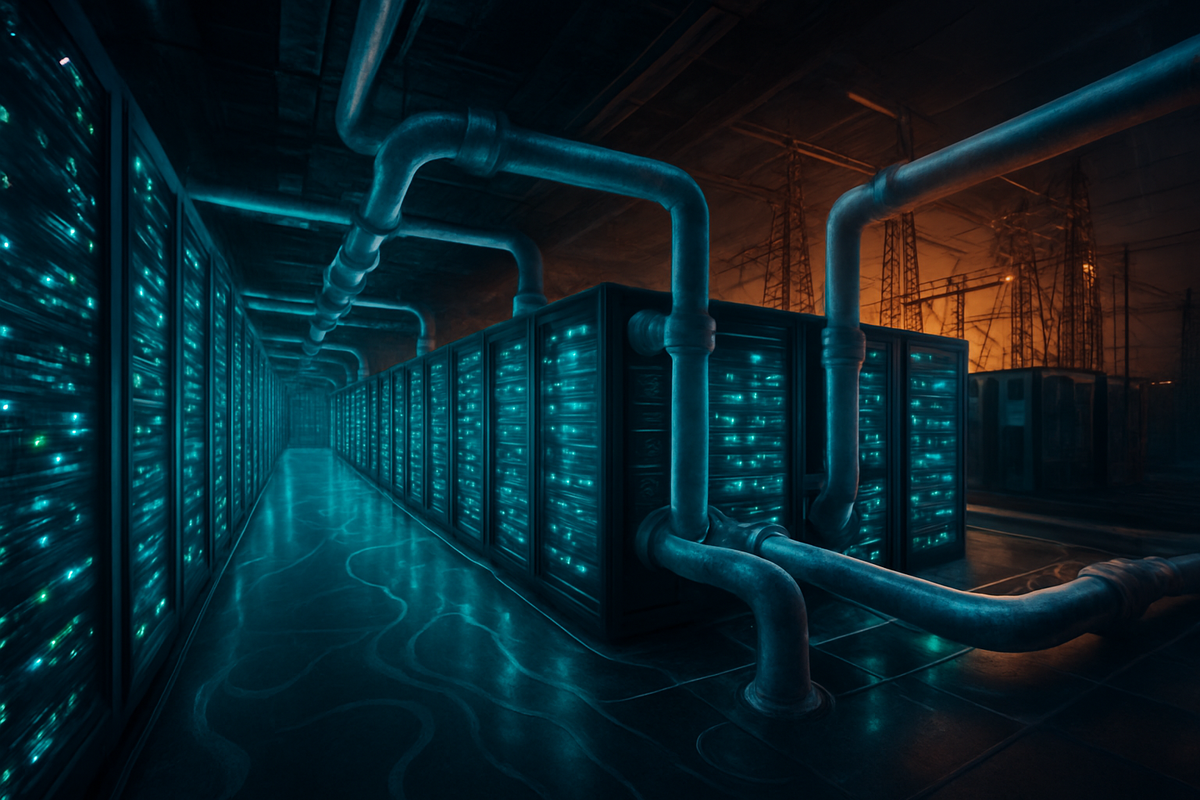
By late 2025, SMCI has leveraged its first-mover advantage in Direct Liquid Cooling (DLC) to manage a staggering $13 billion backlog. The company’s DLC-2 systems, which can reduce data center power and water consumption by up to 40%, have become the gold standard for deploying Nvidia’s (Nasdaq: NVDA) power-hungry Blackwell and Rubin architectures. SMCI now produces over 3,000 DLC racks per month, capturing roughly 70% of the liquid-cooling niche. However, the victory has been bittersweet; despite its technical prowess, SMCI’s stock continues to trade at a significant valuation discount compared to its peers, as investors remain wary of the internal control "adverse opinions" that accompanied its late 2024 financial filings.
Market reactions to SMCI's recovery have been mixed. While technical purists laud the company's ability to ship integrated Blackwell clusters faster than almost anyone else, institutional investors have increasingly hedged their bets. This skepticism allowed legacy competitors like Dell Technologies (NYSE: DELL) and Hewlett Packard Enterprise (NYSE: HPE) to claw back market share in 2025, particularly among enterprise and sovereign AI clients who value corporate stability as much as hardware performance.
Winners and Losers in the Infrastructure Gold Rush
The shift toward high-density AI has created a new class of "industrial tech" winners. Vertiv Holdings (NYSE: VRT) has emerged as a breakout star of 2025, with its stock climbing over 50% as it dominates the thermal management landscape. By providing the "plumbing" for AI—including liquid cooling manifolds and high-density power distribution—Vertiv has secured a record $9.5 billion backlog. Similarly, Eaton Corporation (NYSE: ETN) has successfully pivoted from a traditional electrical giant to an AI infrastructure powerhouse, following its $9.5 billion acquisition of Boyd Thermal, which allowed it to lead the market in cold plate technology for high-voltage AI factories.
On the other side of the ledger, traditional data center operators who failed to anticipate the shift to liquid cooling are facing a "stranded asset" crisis. Older facilities designed for air-cooled servers are often unable to handle the 120kW-to-300kW rack densities required by the latest Nvidia (Nasdaq: NVDA) chips. These operators are seeing their margins squeezed as they are forced into expensive retrofits or face obsolescence. Furthermore, specialized "Neocloud" providers like CoreWeave and Lambda have continued to win against traditional hyperscalers in specific niches, thanks to their ability to build purpose-built AI clusters without the legacy baggage of general-purpose cloud infrastructure.
Nvidia (Nasdaq: NVDA) remains the ultimate winner, but its role has evolved. In late 2025, Nvidia is no longer just a chipmaker; it is a data center architect. Through its "Nvidia-Certified Systems" program, it dictates the power and cooling specifications that companies like SMCI and Dell must follow, effectively controlling the entire stack from the transistor to the cooling tower.
The Wider Significance: Power, Water, and Geopolitics
The challenges facing SMCI and its peers are part of a broader trend where AI development is hitting the hard limits of physics and geography. In 2025, the U.S. power grid has become the ultimate arbiter of AI progress. The "harmonic distortions" caused by massive AI loads have led to regional load-relief warnings, prompting the Federal Energy Regulatory Commission (FERC) to implement new rules that shift the cost of grid upgrades entirely onto data center operators. This has spurred a move toward on-site power generation, with Microsoft and Google (Nasdaq: GOOGL) leading the charge into Small Modular Reactors (SMRs) and large-scale natural gas turbines to bypass grid delays.
Environmental concerns have also reached a boiling point. The staggering water consumption of AI cooling systems—projected to reach 6.6 billion cubic meters globally by 2027—has led to public protests and regulatory crackdowns in drought-prone regions. This has turned water management companies like Xylem (NYSE: XYL) into unexpected players in the AI trade, as hyperscalers scramble for wastewater reclamation and closed-loop cooling technologies to meet their "Water Positive" mandates by 2030.
Geopolitically, 2025 has seen a shift in strategy. The U.S. administration’s move to issue strategic one-year waivers for Nvidia’s H200 exports to China represents an "addiction strategy" designed to keep Chinese developers reliant on American software ecosystems. However, new "50 Percent Rules" have closed loopholes for foreign subsidiaries, creating a complex regulatory minefield for hardware exporters like SMCI and Dell who operate in a globalized supply chain.
What Comes Next: The Shift to Inference and Sovereign AI
Looking ahead to 2026, the industry is bracing for a pivot from training-heavy workloads to inference-heavy deployments. As large language models (LLMs) move from the lab to production, the demand for power-efficient inference hardware will skyrocket. This may provide an opening for Advanced Micro Devices (Nasdaq: AMD) and custom silicon efforts from Meta Platforms (Nasdaq: META) to challenge Nvidia’s dominance in the secondary market.
We also expect the rise of "Sovereign AI" to accelerate. Nations are increasingly viewing AI compute as a matter of national security, leading to the construction of state-funded data centers in Europe, the Middle East, and Southeast Asia. This trend will favor established players like HPE and Dell, who have deep experience navigating complex government contracts and local regulatory requirements.
Strategic pivots are already underway. Companies that were once focused solely on speed are now prioritizing "resiliency." This includes investing in diverse energy sources and modular data center designs that can be deployed in regions with underutilized power capacity, rather than crowding into overtaxed hubs like Northern Virginia.
Closing Thoughts: A New Industrial Reality
The story of AI infrastructure in 2025 is one of incredible growth tempered by the harsh realities of the physical world. Super Micro Computer’s (Nasdaq: SMCI) journey from the brink of delisting to a liquid-cooling leader highlights the high stakes of this market: technical excellence can provide a lifeline, but corporate governance and physical resource management are what ensure long-term survival.
For investors, the key takeaway is that the "AI trade" has moved beyond the chip. The real value is now being captured by the "industrial body" of AI—the companies that manage the power, the heat, and the water. As we move into 2026, the market will likely reward those who can solve the grid and cooling bottlenecks that currently cap the industry's potential. Watch for further consolidation in the thermal management sector and keep a close eye on utility-scale energy projects; in the world of AI, power is the new gold.
This content is intended for informational purposes only and is not financial advice.