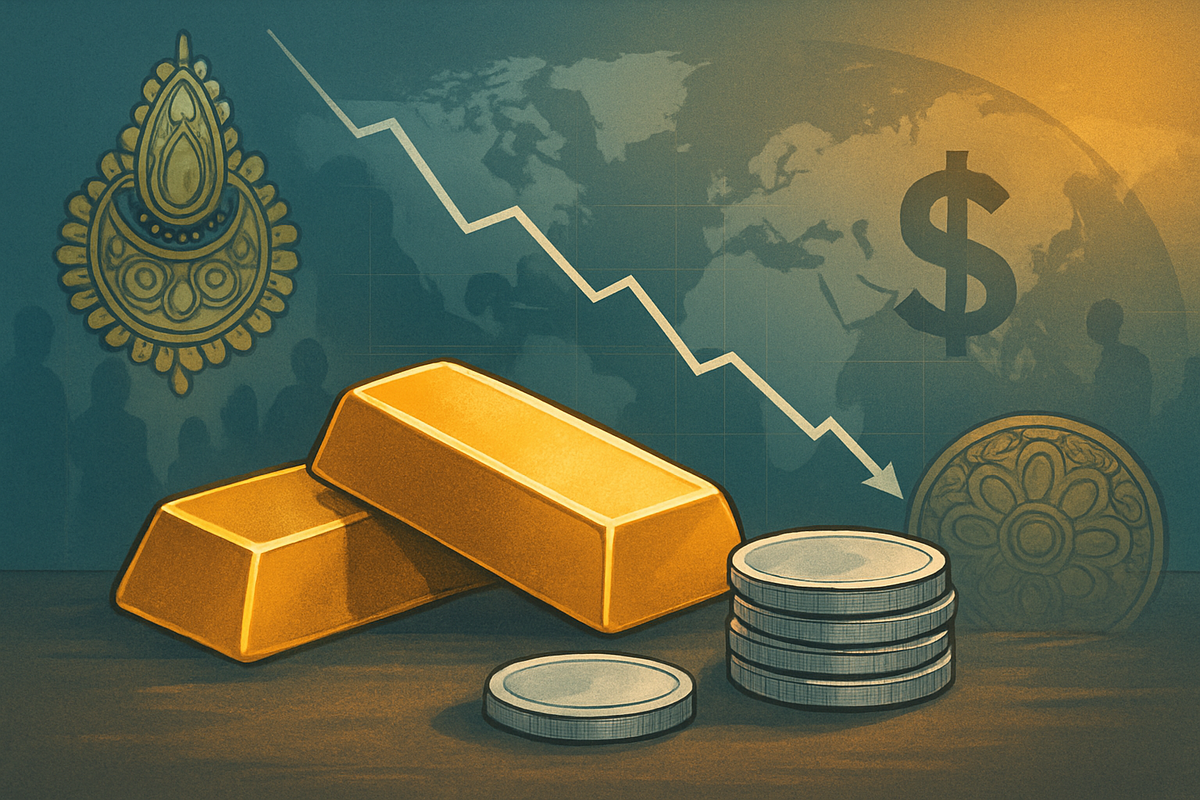
Mumbai, India – December 4, 2025 – The Indian precious metals market is witnessing a notable shift, with gold prices experiencing a slight decline, offering a potential strategic window for buyers, while silver, despite some recent fluctuations, has largely maintained its upward trajectory after a significant rally. This localized movement is not an isolated event but rather a direct reflection of a complex web of global economic indicators and geopolitical undercurrents, signaling a cautious sentiment among investors worldwide. The immediate implications for India range from potential boosts in consumer demand to adjustments in pricing strategies for jewelers and a re-evaluation of portfolios by investors.
The recent softening in gold prices in India, particularly on December 4, 2025, can be largely attributed to broader weak global trends, primarily driven by the anticipation of crucial monetary policy decisions from the US Federal Reserve. As markets eagerly await clarity on interest rate cuts, the non-yielding asset class is experiencing a tug-of-war between safe-haven demand and profit-taking activities. Meanwhile, silver's performance, characterized by its dual role as a precious metal and an industrial commodity, continues to be shaped by both investor sentiment and robust demand from key industrial sectors.
Detailed Market Movements and Influencing Factors
On December 4, 2025, the Indian gold market registered a minor but significant dip. The price of 24-karat gold saw a decrease of approximately 0.41%, or ₹530 per 10 grams, settling around ₹129,660 per 10 grams in major Indian cities. Other reports indicated a marginal drop of 0.09%, bringing the price to ₹130,070 per 10 grams, with some analysts even describing it as a "crash" as 10 grams of 24-carat gold fell by ₹220. This downward trend was not exclusive to December 4, as similar drops were observed on December 2, when 8 grams of 24-carat gold declined by about ₹240.
In stark contrast to gold's minor decline, silver prices in India exhibited a more mixed picture. While some reports indicated a slight decrease of ₹900 to ₹180,000 per kg on December 4, marking a second consecutive session of losses, many metropolitan areas reported stable prices, with silver holding at ₹191 per gram and ₹191,000 per kilogram on both December 3 and 4. This resilience comes after silver had experienced a substantial rally in the days leading up to December 4, reaching record highs, primarily fueled by strong industrial demand. The MCX March silver contracts also mirrored this slight decrease, falling by 0.08% to ₹182,200 per kg.
Key global players and factors are intricately linked to these price fluctuations. The US Federal Reserve's anticipated monetary policy shifts are paramount, with recent weak US job data significantly bolstering expectations for a rate cut. Markets are currently pricing in a high probability (around 89-90%) of a 25 basis point rate cut at the Federal Open Market Committee (FOMC) meeting scheduled for December 9-10. This expectation generally supports non-yielding assets like gold, as lower interest rates reduce the opportunity cost of holding them. However, some profit-taking by investors ahead of this crucial meeting also contributed to gold's slight dip. The US dollar's fluctuations also play a vital role; a softer dollar makes gold more affordable for international buyers, though the dollar index did see a slight rebound on December 4. Geopolitical tensions, such as the inconclusive US-Russia talks regarding the Russia-Ukraine conflict, continue to provide safe-haven support for gold, while robust industrial demand, particularly in sectors like electronics and renewable energy, remains a strong driver for silver, despite some recent reports of "reduced industrial demand" contributing to its minor decline.
Companies Navigating the Volatility
The recent fluctuations in gold and silver prices are poised to create both opportunities and challenges for various public companies within the Indian and global markets. Jewelry retailers and manufacturers are at the forefront of this impact. Companies like Titan Company Limited (NSE: TITAN), a major player in the Indian jewelry market with its Tanishq brand, might experience a temporary boost in sales volumes as consumers perceive the slight dip in gold prices as an opportune moment for purchases, especially during the ongoing wedding and festive season. However, sustained volatility could squeeze profit margins if inventory is procured at higher prices. Their ability to adapt pricing strategies quickly will be crucial.
Conversely, gold and silver mining companies, such as Hindustan Zinc Limited (NSE: HINDZINC), a significant producer of silver, could see their revenue and profitability affected by price declines. While a marginal dip might not have a drastic immediate impact, a prolonged downward trend would reduce the value of their mined output, potentially impacting future investment decisions and expansion plans. For companies heavily reliant on industrial demand for silver, like those in the solar panel or electronics manufacturing sectors, the continued strong industrial demand for silver, despite recent minor fluctuations, could be a boon, ensuring stable input costs or even benefiting from supply chain efficiencies if prices stabilize favorably.
Investment firms and financial institutions offering precious metal-backed products, such as Gold ETFs or sovereign gold bonds, will also feel the ripples. Funds like SBI Gold ETF (NSE: SBIGETS) or ICICI Prudential Gold ETF (NSE: ICICIGOLD) could see shifts in investor sentiment and flows. A bearish outlook on gold might lead to redemptions, while a perceived buying opportunity could attract new capital. Their performance is directly tied to the underlying asset's price, making them highly sensitive to market movements. Furthermore, banks involved in the import and financing of precious metals will need to manage their commodity exposure carefully, adjusting their hedging strategies to mitigate risks associated with price volatility.
Wider Significance and Market Implications
The recent fall in gold and silver prices in India, while seemingly localized, is deeply embedded within broader global industry trends, particularly the shifting landscape of central bank monetary policies and evolving investor risk appetites. This event underscores gold's enduring role as a safe-haven asset, whose value is inversely correlated with the strength of the US dollar and the prevailing interest rate environment. The market's intense focus on the US Federal Reserve's potential interest rate cuts highlights a wider trend where global liquidity conditions and the cost of capital heavily influence commodity prices, especially for non-yielding assets.
The ripple effects of these price movements extend beyond direct competitors to partners across the supply chain. For instance, a prolonged period of lower gold prices could put pressure on smaller jewelers and artisans who operate on tighter margins, potentially leading to consolidation within the industry. On the regulatory front, governments, including India's, often monitor precious metal prices closely due to their impact on trade balances, inflation, and public sentiment. Significant or sustained fluctuations could prompt policy considerations related to import duties, taxation, or even measures to stabilize the domestic market. Historically, periods of anticipated interest rate cuts by major central banks have often been followed by a resurgence in gold prices, as seen in various cycles over the past decades, suggesting that the current dip might be a temporary correction rather than a long-term decline.
Moreover, the divergent performance of gold and silver sheds light on their distinct market dynamics. Gold's movement is predominantly influenced by its store-of-value and safe-haven attributes, making it highly sensitive to macroeconomic uncertainty and monetary policy. Silver, on the other hand, benefits significantly from its industrial applications, particularly in burgeoning sectors like renewable energy and electric vehicles. This dual nature means that while both are precious metals, silver's demand profile can offer it more resilience or even growth opportunities during periods of strong industrial expansion, even when gold faces headwinds. The current scenario thus provides a fascinating case study in how these two metals respond differently to a complex interplay of financial and industrial forces.
What Comes Next: Navigating the Future
Looking ahead, the short-term trajectory for gold and silver prices in India will largely hinge on the outcomes of the US Federal Reserve's upcoming Federal Open Market Committee (FOMC) meeting on December 9-10, 2025. If the Fed indeed implements the widely anticipated 25 basis point rate cut, gold is likely to find strong support and could see a rebound, as lower interest rates reduce the opportunity cost of holding the precious metal. Conversely, any deviation from these expectations, such as a more hawkish stance or a delay in rate cuts, could trigger further volatility and potentially push prices lower. Silver, given its industrial demand drivers, might experience continued volatility ahead of US labor market data releases, but its long-term prospects remain positive due to its integral role in green technologies.
In the long term, strategic pivots and adaptations will be crucial for market participants. For jewelers and retailers, this might involve diversifying product offerings beyond traditional gold jewelry, increasing focus on silver or diamond segments, and enhancing inventory management to mitigate price risks. Mining companies might explore cost-cutting measures or invest in technologies to improve extraction efficiency to maintain profitability amidst potential price pressures. Investors, both institutional and retail, will need to carefully re-evaluate their asset allocation strategies, considering gold and silver not just as safe havens but also as components influenced by industrial demand and global economic cycles.
Potential market opportunities could emerge for astute investors looking to buy on dips, particularly if the current price correction is perceived as temporary. Furthermore, the increasing global focus on renewable energy and technological advancements could bolster silver's industrial demand, creating long-term growth opportunities for related industries and investors. Challenges include managing currency fluctuations, as a stronger Indian Rupee against the US Dollar could further dampen the appeal of imported gold and silver. Potential scenarios range from a robust rebound in precious metal prices post-Fed rate cut to a more prolonged period of consolidation if global economic uncertainties persist or deepen.
Comprehensive Wrap-Up and Investor Outlook
The recent dip in gold prices in India, juxtaposed with silver's resilient yet volatile performance, serves as a poignant reminder of the interconnectedness of global financial markets. The key takeaway is that local price movements are inextricably linked to broader international macroeconomic forces, most notably the US Federal Reserve's monetary policy, the strength of the US dollar, and evolving geopolitical landscapes. While gold experienced a minor downward adjustment on December 4, 2025, the overarching global outlook, particularly the strong anticipation of US interest rate cuts, suggests a potentially supportive environment for precious metals in the near term. Silver, despite its recent fluctuations, continues to benefit from robust industrial demand, positioning it for long-term growth.
Moving forward, the market is poised for a period of heightened sensitivity to economic data releases and central bank pronouncements. Investors should assess the current scenario not as a definitive downturn but as a strategic juncture influenced by a confluence of factors. The slight decline in gold offers a potential entry point for those looking to diversify their portfolios, while silver's industrial applications make it an attractive long-term prospect, albeit with short-term volatility.
Final thoughts on significance and lasting impact center on the precious metals' role as barometers of economic health and geopolitical stability. Their price movements reflect underlying anxieties and opportunities within the global system. What investors should watch for in the coming months includes the actual implementation and pace of US interest rate cuts, any shifts in the US dollar's strength, the evolution of geopolitical tensions, and critically, the trajectory of industrial demand for silver. These factors will collectively shape the narrative for gold and silver, guiding their performance and determining their lasting impact on investment strategies and the broader financial landscape.
This content is intended for informational purposes only and is not financial advice