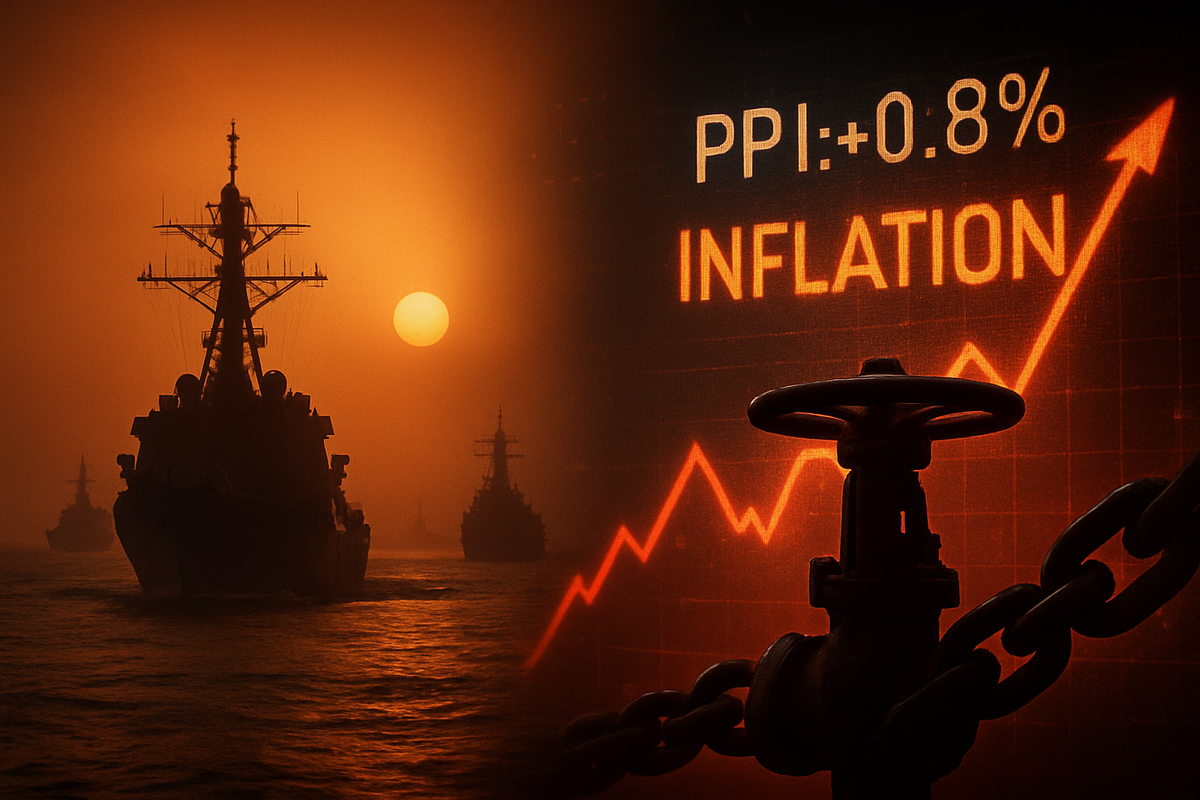
The global economy is currently reeling from a "perfect storm" of geopolitical and inflationary shocks that have revived the specter of stagflation—a rare and painful economic condition characterized by stagnant growth and persistent price increases. Over the past 72 hours, the convergence of a major military escalation between the U.S. and Iran and a shock 0.8% spike in the Producer Price Index (PPI) has shattered hopes for a "soft landing" in 2026.
As of today, March 3, 2026, the Brent crude market is trading above $82 per barrel, following the effective closure of the Strait of Hormuz. Economists warn that the combination of "cost-push" inflation from energy supply disruptions and "demand-pull" pressures from ongoing tariff regimes has created a policy trap for the Federal Reserve. For the average consumer, this means the cost of living is rising even as the labor market begins to show its first signs of genuine fatigue in years.
The Dual Shock of February 2026: A Timeline of Escalation
The current crisis began in earnest on Friday, February 27, 2026, when the Bureau of Labor Statistics released a harrowing PPI report. While markets expected a modest increase, Core PPI—which strips out volatile food and energy—surged by 0.8% month-over-month. This jump was primarily driven by a 2.5% leap in trade services margins and a 14.4% explosion in professional equipment wholesaling. Analysts pointed to the cumulative effect of recently imposed 10–15% global trade tariffs as the primary culprit, signaling that wholesale costs were being passed down the supply chain at an accelerating rate.
The economic anxiety turned into a geopolitical nightmare just 24 hours later. On February 28, 2026, the United States and Israel launched "Operation Epic Fury," a massive coordinated strike against Iranian nuclear facilities, IRGC infrastructure, and political leadership. Initial reports confirmed the death of several high-ranking officials, including the Iranian Supreme Leader, in the opening salvos. Iran’s retaliation, "Operation True Promise IV," saw hundreds of drones and missiles targeted at U.S. bases and energy infrastructure across the Gulf, including the Ras Tanura refinery in Saudi Arabia and the Ras Laffan LNG facility in Qatar.
The immediate market reaction was swift and violent. On Monday, March 2, Brent crude prices spiked by nearly 13%, briefly topping $82 per barrel. The Strait of Hormuz, which carries roughly 20% of the world’s petroleum and LNG, has become a "no-go zone" for commercial shipping. War-risk insurance premiums have reached six-year highs, effectively blockading the Persian Gulf. In the U.S., gasoline futures surged 9.1%, and European natural gas prices (Dutch TTF) jumped a staggering 41% following the strikes on Qatari facilities.
Sector Divergence: The Profiteers of Conflict and the Victims of Inflation
The financial markets have reacted with a sharp "K-shaped" divergence, as certain sectors thrive on the chaos while others face an existential squeeze. Defense contractors have been the primary beneficiaries of the military escalation. RTX (RTX:NYSE) and Lockheed Martin (LMT:NYSE) saw their shares climb by 6.2% and 3.4% respectively, as the demand for missile interceptors and advanced munitions soared. Northrop Grumman (NOC:NYSE) shares rose 6% after the Pentagon confirmed that its B-2 stealth bombers played a pivotal role in penetrating Iran’s hardened underground facilities.
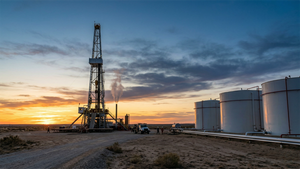
Energy giants have also seen a massive influx of capital as the geopolitical risk premium returned to oil prices with a vengeance. Occidental Petroleum (OXY:NYSE) rocketed nearly 7%, benefiting from its high operational leverage to crude prices. Integrated majors like ExxonMobil (XOM:NYSE) and Chevron (CVX:NYSE) rose between 4% and 5%, as their vast upstream production portfolios provided a natural hedge against the supply shock, even as their refining margins faced pressure from rising input costs.
Conversely, the "losers" of this new era are companies sensitive to fuel costs and consumer spending power. The airline industry has been decimated over the last two trading days; United Airlines (UAL:NASDAQ) and Delta Air Lines (DAL:NYSE) both plunged over 6% due to Middle Eastern airspace closures and the sudden spike in jet fuel. Retail and e-commerce giants are also feeling the heat. Amazon (AMZN:NASDAQ) dropped 2.2% as investors weighed the rising costs of its massive logistics network against a $200 billion AI capital expenditure program. Even Walmart (WMT:NYSE), typically a safe haven during downturns, saw its margins questioned as the 0.8% PPI spike suggested that wholesale costs might finally be rising faster than the company can raise prices for its budget-conscious shoppers.
Historical Echoes: Is 2026 the New 1974?
The current situation has invited inevitable comparisons to the 1970s stagflation era, yet economists note several critical differences. In the 1970s, the U.S. economy was significantly more energy-intensive, and inflation was driven by a wage-price spiral and absolute oil embargoes. Today, the economy is more efficient, but it faces new structural headwinds. The "AI Factor" has created a unique "Jobless Growth" environment in 2026; while productivity remains high, the labor market is weakening, with unemployment creeping toward 4.6% as companies automate more roles to offset rising costs.
Furthermore, the 1970s were defined by total supply cutoffs, whereas 2026 is defined by "cost-push" inflation from sweeping tariff regimes. These tariffs act as a persistent tax on goods, making the "last mile" of the Federal Reserve's 2% inflation target seemingly impossible to reach. Unlike the 1970s, where inflation expectations were "unanchored," current long-term expectations remain relatively stable, but the Fed is now trapped. If it raises rates to combat the 0.8% PPI spike, it risks crushing a labor market already struggling with AI-driven disruption. If it cuts rates to support growth, it risks letting energy-driven inflation spiral out of control.
The Path Ahead: Strategic Pivots and Market Scenarios
In the short term, the market will remain hyper-fixated on the status of the Strait of Hormuz. If QatarEnergy remains offline for an extended period, the global LNG shortage could trigger a secondary energy crisis in Europe and Asia, further fueling global PPI numbers. Companies will likely need to accelerate their "near-shoring" and automation efforts to bypass both the high costs of international shipping and the volatile costs of human labor.
Investors should prepare for a "Higher for Longer" interest rate environment that could last well into late 2026. The Federal Reserve is unlikely to provide a "Fed Put" (a rate cut to save the market) as long as the Iran conflict keeps energy prices elevated. This environment favors "quality" stocks with strong balance sheets and high pricing power—those that can pass on the 0.8% wholesale cost increases without losing customers. Conversely, highly leveraged companies in the tech and consumer sectors may face a significant de-rating.
A Final Assessment for the 2026 Investor
The events of early March 2026 mark a definitive end to the era of low-volatility growth. The dual shocks of "Operation Epic Fury" and the PPI surge have confirmed that stagflation is no longer a theoretical risk but a present reality. While the defense and energy sectors offer a temporary refuge for capital, the broader market must grapple with a world where supply chains are weaponized and energy security is no longer guaranteed.
Moving forward, the key metrics to watch will be the "Core-Services" component of the PPI and any signs of a ceasefire in the Persian Gulf. However, even if the military conflict de-escalates, the structural inflation baked in by global tariffs and AI-driven labor shifts suggests that the "easy money" days are over. For the strategic investor, the next few months will require a defensive posture, focusing on energy independence and companies with the technological edge to navigate a high-cost, high-inflation world.
This content is intended for informational purposes only and is not financial advice