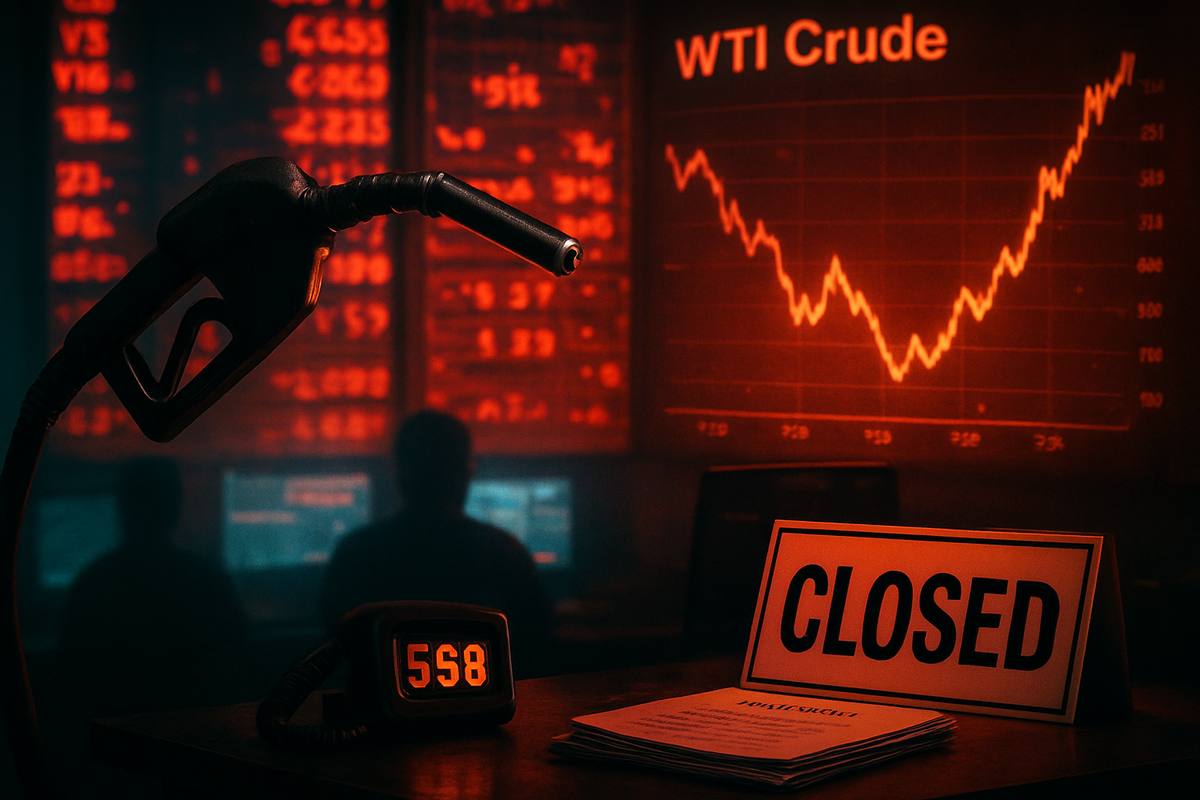
The ghost of the 1970s has returned to haunt Wall Street this morning, as a devastating combination of a dismal February jobs report and a geopolitical oil shock sent shockwaves through global markets. Investors woke up on March 6, 2026, to a "worst-case scenario" landscape: West Texas Intermediate (WTI) crude surged to $88.45 per barrel following an escalation of military conflict in the Middle East, while the U.S. Labor Department reported a shocking loss of 92,000 jobs in February. The dual blow of rising costs and a slowing economy—the classic definition of stagflation—has left the Federal Reserve in a tightening vise, with little room to maneuver.
Market reaction was swift and visceral. The Dow Jones Industrial Average plummeted over 900 points in early trading, while the S&P 500 and Nasdaq Composite each shed more than 1.5%. Perhaps more significantly, the "Fed pivot" that traders had spent months pricing into their 2026 outlooks began to evaporate instantly. Expectations for a June or July interest rate cut are being aggressively scaled back as analysts realize the Fed cannot easily lower borrowing costs to support a weakening labor market while energy-driven inflation is still accelerating toward a projected 4.5%.
A Perfect Storm: War-Stoked Inflation Meets a Cooling Labor Market
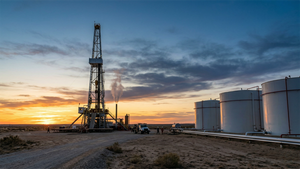
The primary catalyst for today’s market turmoil is the deepening crisis in the Middle East, specifically "Operation Epic Fury," a U.S.-led military campaign against Iran that escalated late last month. In a direct retaliation that has paralyzed global energy logistics, Iran’s Revolutionary Guard declared the Strait of Hormuz a closed military zone. This closure has effectively stranded nearly 20 million barrels of oil per day, or roughly 20% of the world’s supply. As WTI crude spiked toward $88, energy analysts warned that a prolonged blockade could see prices spiral toward the $150 mark, a level that would almost certainly tip the global economy into a deep recession.
Simultaneously, the February 2026 jobs report delivered what many are calling a "knock-down blow" to the narrative of a resilient U.S. consumer. The U.S. economy unexpectedly lost 92,000 jobs last month, a massive deviation from the 60,000 gain economists had forecast. The unemployment rate ticked up to 4.4%, and labor force participation fell to its lowest level since 2021. The weakness was particularly pronounced in manufacturing and leisure, where high energy costs and a massive Kaiser Permanente strike involving 31,000 workers added to the downward pressure. This "low-hire, low-fire" equilibrium is leaving companies paralyzed by geopolitical and economic uncertainty.
The initial reaction from major financial institutions has been one of pure panic. Analysts at Annex Wealth Management and Raymond James noted that the Fed’s hands are now effectively tied. Under normal circumstances, a job loss of this magnitude would warrant an immediate dovish shift and a commitment to rate cuts. However, with "warflation" driving up the price of everything from gasoline to groceries, a rate cut today could repeat the policy errors of the mid-1970s, where premature easing allowed inflation to become structurally embedded in the economy for a decade.
Winners and Losers: Energy Giants Surge While Transports and Retailers Bleed
In this stagflationary environment, the market is dividing sharply between those who profit from scarcity and those who are crushed by rising input costs. The energy sector stands as the lone beneficiary of the current chaos. ExxonMobil (NYSE: XOM) and Chevron (NYSE: CVX) both saw their shares climb as the surge in crude prices directly expands their profit margins. Investors are flocking to these names not just for growth, but as a hedge against the very inflation that is eroding the rest of the market. Even with the broader market in the red, these energy giants are viewed as "inflation shelters" in a storm that shows no signs of abating.
Conversely, the transportation and travel sectors are enduring a "bloodbath." Southwest Airlines (NYSE: LUV) and Delta Air Lines (NYSE: DAL) saw their stock prices crater as the prospect of $4.00-plus jet fuel prices threatens to wipe out their 2026 earnings projections. Similarly, logistics powerhouses like FedEx (NYSE: FDX) and Old Dominion Freight Line (NASDAQ: ODFL) are facing a double-edged sword: soaring diesel costs and a drop in shipping volumes as consumers pull back. Even the cruise industry was hit hard, with Norwegian Cruise Line (NYSE: NCLH) dropping over 6% on fears that discretionary travel will be the first casualty of the stagflation era.
The retail sector is also showing signs of significant strain. Giants like Walmart (NYSE: WMT) and Target (NYSE: TGT) are caught in a pincer movement; they must contend with higher supply chain costs while their core customers are forced to redirect discretionary spending toward gas and basic necessities. Even the tech darlings are not immune. While Nvidia (NASDAQ: NVDA) continues to report robust demand for AI infrastructure, its stock remained flat to down as macro-economic fears overshadowed company-specific performance. When the "risk-free rate" remains high and the economy is stalling, even the highest-growth companies struggle to maintain their premium valuations.
The "Fed Trap" and the Ghost of Arthur Burns
The wider significance of this moment cannot be overstated. We are witnessing the most serious challenge to the Federal Reserve’s "soft landing" narrative since the post-pandemic recovery began. Financial historians are drawing direct, uncomfortable parallels between the current Fed leadership and Arthur Burns, the Fed Chair from 1970 to 1978. Burns famously prioritized employment over inflation control during the 1973 oil embargo, leading to a period of "stop-go" monetary policy that eventually required the "Volcker Shock" of 20% interest rates to fix.
If the Fed reacts to today’s weak jobs report by cutting rates, they risk validating the market's fears that they have lost their stomach for the inflation fight. "Stagflation is the ultimate nightmare for a central banker," noted one senior analyst at Apollo Global Management. "You have two fires burning in opposite directions, and you only have one fire extinguisher. If you spray the 'unemployment fire' with rate cuts, you are effectively pouring gasoline on the 'inflation fire' caused by $88 oil." This policy dilemma is likely to keep volatility high for the foreseeable future.
Furthermore, this event highlights a shifting industry trend where geopolitical risk is once again the primary driver of market value. The era of "globalization and low-cost energy" that defined the 2010s is increasingly looking like a historical outlier. In 2026, the market is being forced to price in the reality that energy independence and supply chain security are more important than theoretical efficiency. This shift has massive regulatory and policy implications, likely leading to increased pressure on the administration to expand domestic energy production and fast-track defense spending.
The Road Ahead: Potential Scenarios and Strategic Pivots
As we look toward the remainder of 2026, the short-term outlook is dominated by the situation in the Strait of Hormuz. If diplomatic efforts fail to reopen the waterway, a "deep recession" scenario becomes the base case for most Wall Street firms. In this outcome, we could see unemployment rise toward 6% while inflation remains stubbornly above 4%, forcing the Fed to keep rates "higher for longer" despite the economic pain. Investors should prepare for a period of low or negative real returns in traditional equity markets, with a continued rotation into commodities, gold, and defensive value stocks.
However, a strategic pivot may be required for both companies and investors. Companies that can demonstrate "pricing power"—the ability to pass on rising costs to consumers without losing volume—will be the only survivors in a stagflationary world. We may also see a renewed focus on automation and AI as a means to offset rising labor and energy costs, though the benefits of these technologies may take years to fully manifest. For the Fed, the "pivot" to rate cuts has likely been delayed until at least July 2026, and even then, any cuts will be tentative and data-dependent.
Conclusion: A Market at a Crossroads
The events of March 6, 2026, mark a definitive end to the "soft landing" euphoria that characterized the start of the year. The combination of -92,000 jobs and $88 oil has fundamentally altered the risk calculus for every participant in the financial system. The key takeaway for investors is that the "Fed put"—the idea that the central bank will always step in to save the market—is currently neutralized by the threat of runaway inflation.
Moving forward, the market will be hyper-fixated on two metrics: energy price stability and wage growth. If oil continues its climb toward $100, no amount of labor market weakness will be enough to trigger a Fed rescue. Investors should watch the Strait of Hormuz more closely than any earnings report in the coming months. We have entered a period where the "macro" completely dominates the "micro," and in the world of stagflation, there are very few places left to hide.
This content is intended for informational purposes only and is not financial advice.