
Choosing wrong mlm software costs $200,000 over five years. Choosing right saves you that amount and gains you 18–24 months of operational speed. The difference isn't features. It's vendor architecture, support quality, and scaling philosophy.
I've evaluated 250+ MLM software vendors over 15 years. I've seen networks pick wrong platforms and spend three years trying to escape them. I've seen networks pick right and scale to millions of users without technical friction. The difference is evaluating vendors correctly.
The 12-Point MLM Software Evaluation Framework
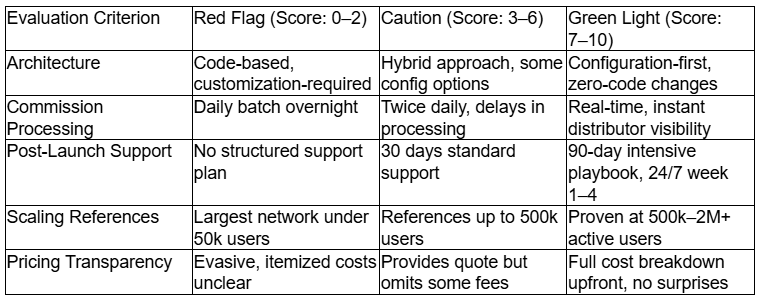
- Architecture: Configuration-based (score 10) vs. Code-based (score 0)
- Commission Processing: Real-time (10) vs. Batch (0)
- Compensation Support: Multi-model (10) vs. Single-model (0)
- Post-Launch Support: 90-day intensive (10) vs. No structured support (0)
- Pricing Transparency: Upfront all costs (10) vs. Hidden fees (0)
- Scaling Evidence: 500k+ users proven (10) vs. Under 100k references (0)
- Payment Integration: 9+ gateways (10) vs. 2–3 gateways (0)
- Vendor Stability: 10+ years established (10) vs. Startup under 3 years (0)
- Customer References: 10+ willing references (10) vs. None willing (0)
- Migration Support: Zero-data-loss, parallel systems (10) vs. Hope and pray (0)
- Regulatory Compliance: Multi-jurisdiction built-in (10) vs. Not addressed (0)
- Post-90-Day Support: Defined SLA and pricing (10) vs. Undefined (0)
The Fatal Mistakes Networks Make When Selecting Network Marketing MLM Software
In my 250+ evaluations, I've seen networks make four critical mistakes. Understanding them prevents $100,000+ in wasted deployment.
Mistake 1: Focusing on feature count instead of architecture. A vendor lists 47 features. Your team gets excited. You don't ask: "How is this built? Can you change the compensation logic without engineering?" If it's code-based, you've just locked yourself into $5,000–$20,000 per change. If it's configuration-based, changes cost $0–$500.
Mistake 2: Choosing based on demo instead of customer references. Every vendor's demo looks good. The question is: does it work for other networks at your scale? Ask for 10 customer references. Call them. Ask specifically: "Did the vendor meet their promises? What surprised you? What took longer than expected?" If a vendor can't provide 10 references willing to take your call, that's a red flag.
Mistake 3: Not asking about post-launch support. Vendors love talking about go-live. They hate talking about days 31–90. Ask: "What's my support SLA weeks 1–4? Do I have a dedicated project manager? What's the response time for critical issues? Is training included? For how many hours?" If the vendor fumbles these answers, you're on your own post-launch.
Mistake 4: Underestimating the cost of configuration and customization. Most vendors quote platform price and hide the real cost in integrations, CRM, multi-currency, and custom bonus rules. A vendor quotes $40,000. By go-live, you've spent $120,000. Ask upfront: "What's the total cost to deploy with all integrations I need?" If they can't answer, they're hiding costs.
Red Flags That Disqualify a Vendor Immediately
Some vendor behaviors are deal-breakers. If you see these, walk away.
- Can't provide 10 customer references. If a vendor has been around 5+ years and can't produce 10 willing references, something's wrong. Either customers are unhappy or the vendor is hiding them.
- Won't discuss post-launch support in writing. If support details aren't in the contract with clear SLAs and response times, you'll have problems. Get it in writing.
- Quotes platform price but can't itemize integrations and customization. Evasiveness on cost is a red flag. You'll discover hidden charges during implementation.
- No timeline for how long migration takes. If asked "how long does implementation take?" and they say "it depends," they don't have a process. Standardized implementations take 4–12 weeks. If yours is undefined, budget 5–7 months.
- Largest customer is under 100k users. Scaling is non-linear. A platform that works for 10k might fail at 100k. Ask about their largest deployment. If it's smaller than your growth target, they haven't proven scalability.
- Uses words like "robust," "powerful," or "cutting-edge." These are filler words from vendors who can't point to specific metrics. Ask for data instead of adjectives.
Case Study: Why One Network Chose Wrong and Paid the Price
A wellness network chose a vendor based on feature list (vendor listed 50 features, competitors listed 35). Deployment cost quoted: $35,000. They signed the contract without asking about post-launch support, customer references, or total cost of ownership.
By month 3, they'd spent an additional $85,000 in custom development, CRM integration, and consulting. Their largest customer reference was 30,000 users. They hit 50,000 and the platform began showing cracks: slow period closing, commission calculation errors, support overwhelmed.
At month 12, they wanted to switch platforms. But switching costs $100,000+. So they stayed with a platform they'd outgrown. Their growth stalled. They eventually sold to a competitor who had chosen a better platform two years earlier.
The Scoring System: How to Evaluate MLM Software Companies Objectively
Don't rely on your gut. Use the 12-point scoring system above. Score each vendor 0–10 on each criterion. Total score out of 120.
Scoring guidance: 100+ is a strong vendor. 80–100 is acceptable but has gaps (verify those gaps won't affect you). Below 80, keep looking.
Why scoring matters: it removes emotion from the decision. You can compare Vendor A (95) vs. Vendor B (78) objectively. You can show your executive team why you're choosing Vendor A even if Vendor B is cheaper.
The 12-point system isn't perfect, but it's better than picking based on feature count or demo impressiveness. It focuses on what actually matters: architecture, evidence, support, and transparency.
Download the 12-Point MLM Software Evaluation Checklist
Score vendors objectively. Share the results with your team. Make a defensible decision.
Get the Evaluation Checklist or Schedule a Vendor Assessment with our team.
FAQ: MLM Software Selection, Vendor Evaluation, and Buyer's Guide
What's the single most important question to ask a vendor?
"Show me 10 customer references at my scale of network size who went live 2+ years ago. I want to call them and ask: did you achieve your goals with this platform, and what surprised you?" This question eliminates most vendors because they can't produce 10 willing references or their references are much smaller than your network. References are the most honest vendor assessment you'll get.
How do I know if a vendor is going to charge me hidden fees?
Ask: "I want a detailed cost breakdown for deployment including platform, integrations, hosting, support for 12 months, and training. Can you provide that in writing?" If they give you evasive answers or say "it depends," they're hiding costs. Demand a complete itemization before signing. In my 250+ evaluations, vendors who won't provide itemized costs in writing end up charging 40–60% more than their initial quote.
Configuration-based vs. code-based architecture. Why does this matter so much?
Configuration-based means your ops team can change bonus rules, rank thresholds, and payout schedules without engineering involvement. Code-based means every change requires a developer, a sprint cycle, testing, and deployment delays (2–8 weeks). Over five years, if you make 12 changes per year (realistic for scaling networks), configuration-based saves you $240,000–$480,000 in engineering costs. Plus you move at market speed instead of engineering sprint speed. This difference alone justifies picking one vendor over another even if the code-based vendor is cheaper upfront.
What should post-launch support actually look like?
Weeks 1–4: Dedicated project manager. Daily check-ins. 24/7 support with 2-hour response time for critical issues. Live training sessions. Weekly all-hands meetings with your team. Weeks 5–12: Project manager transitions to weekly check-ins. Support remains available 24/7 but response time moves to 4 hours. Monthly strategy calls. After 90 days: Support transitions to standard business hours. If a vendor won't commit to this level of intensity weeks 1–4, you're taking on unnecessary risk. Rough first 90 days lead to distributor churn that's hard to recover from.
How long does MLM software implementation actually take?
Honest timeline: 4–12 weeks for standard deployment (configuration, integrations, testing, training, launch). This includes: 2 weeks planning and setup, 3–4 weeks development and integration, 2–3 weeks testing and refinement, 1–2 weeks training and documentation, 1 week launch and handoff. If a vendor says "3 weeks" they're either selling a very simple setup or they're lying. If they say "as long as it takes" they don't have a process. Ask for a detailed project timeline broken into phases. If they can't provide it, they don't have a repeatable process.
What's the difference between a cheap platform and a real platform?
Cheap platforms ($1,000–$5,000) handle 1,000–10,000 users, might break at scale, have minimal support, and no post-launch playbook. Real platforms ($6,000–$50,000 depending on features) handle 100,000+ users, have proven scaling evidence, include structured post-launch support, and provide a realistic roadmap. The true cost of a cheap platform is the rework, custom development, and eventual migration. By the time you realize it's not scaling, you've spent $50,000+ and lost six months. Choose a real platform from the start.