
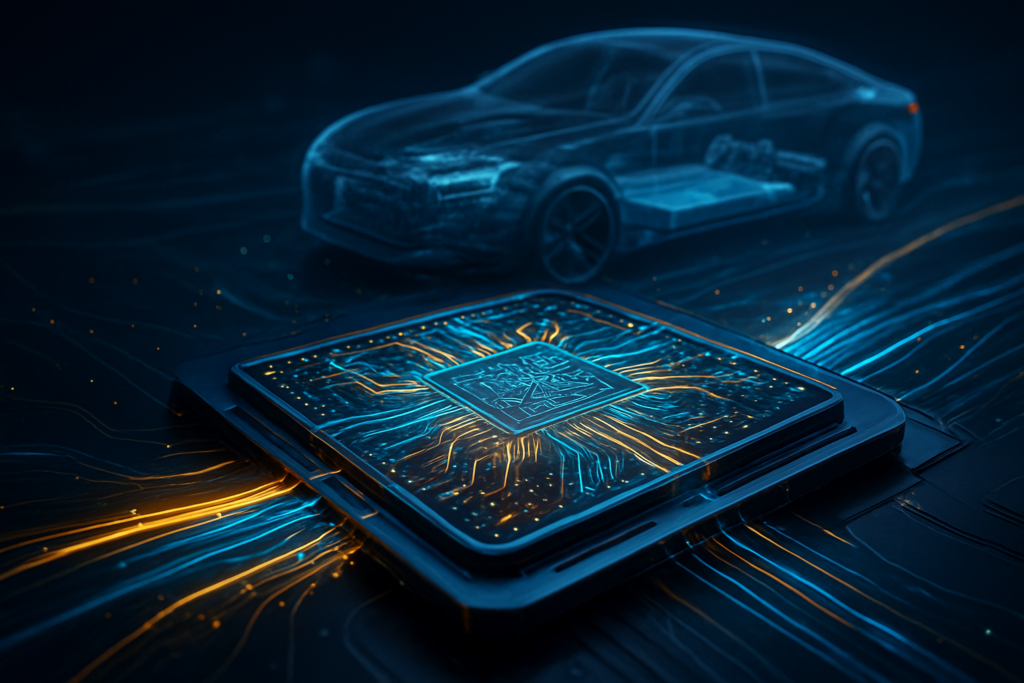
As the global transition to sustainable transportation accelerates, a quiet revolution is taking place beneath the chassis of the world’s most advanced electric vehicles. Silicon photonics—a technology traditionally reserved for the high-speed data centers powering the AI boom—has officially made the leap into the automotive sector. This week’s series of breakthroughs in Photonic Integrated Circuits (PICs) marks a pivotal shift in how 800V EV architectures handle power, heat, and data, promising to solve the industry’s most persistent bottlenecks.
By replacing traditional copper-based electrical interconnects with light-based communication, manufacturers are effectively insulating sensitive control electronics from the massive electromagnetic interference (EMI) generated by high-voltage powertrains. This integration is more than just an incremental upgrade; it is a fundamental architectural redesign that enables the next generation of ultra-fast charging and high-efficiency drive-trains, pushing the boundaries of what modern EVs can achieve in terms of performance and reliability.
The Technical Leap: Optical Gate Drivers and EMI Immunity
The technical cornerstone of this breakthrough lies in the commercialization of optical gate drivers for 800V and 1200V systems. In traditional architectures, the high-frequency switching of Silicon Carbide (SiC) and Gallium Nitride (GaN) power transistors creates a "noisy" electromagnetic environment that can disrupt data signals and damage low-voltage processors. New developments in PICs allow for "Optical Isolation," where light is used to transmit the "on/off" trigger to power transistors. This provides galvanic isolation of up to 23 kV, virtually eliminating the risk of high-voltage spikes entering the vehicle’s central nervous system.
Furthermore, the implementation of Co-Packaged Optics (CPO) has redefined thermal management. By integrating optical engines directly onto the processor package, companies like Lightmatter and Ayar Labs have demonstrated a 70% reduction in signal-related power consumption. This drastically lowers the "thermal envelope" of the vehicle's compute modules, allowing for more compact designs and reducing the need for heavy, complex liquid cooling systems dedicated solely to electronics.
The shift also introduces Photonic Battery Management Systems (BMS). Using Fiber Bragg Grating (FBG) sensors, these systems utilize light to monitor temperature and strain inside individual battery cells with unprecedented precision. Because these sensors are made of glass fiber rather than copper, they are immune to electrical arcing, allowing 800V systems to maintain peak charging speeds for significantly longer durations. Initial tests show 10-80% charge times dropping to under 12 minutes for 2026 premium models, a feat previously hampered by thermal-induced throttling.
Industry Giants and the Photonics Arms Race
The move toward silicon photonics has triggered a strategic realignment among major tech players. Tesla (NASDAQ: TSLA) has taken a commanding lead with its proprietary "FalconLink" interconnect. Integrated into the 2026 "AI Trunk" compute module, FalconLink provides 1 TB/s bi-directional links between the powertrain and the central AI, enabling real-time adjustments to torque and energy recuperation that were previously impossible due to latency. By stripping away kilograms of heavy copper shielding, Tesla has reportedly reduced vehicle weight by up to 8 kg, directly extending range.
NVIDIA (NASDAQ: NVDA) is also leveraging its data-center dominance to reshape the automotive market. At the start of 2026, NVIDIA announced an expansion of its Spectrum-X Silicon Photonics platform into the NVIDIA DRIVE Thor ecosystem. This "800V DC Power Blueprint" treats the vehicle as a mobile AI factory, using light-speed interconnects to harmonize the flow between the drive-train and the autonomous driving stack. This move positions NVIDIA not just as a chip provider, but as the architect of the entire high-voltage data ecosystem.
Marvell Technology (NASDAQ: MRVL) has similarly pivoted, following its strategic acquisitions of photonics startups in late 2025. Marvell is now deploying specialized PICs for "zonal architectures," where localized hubs manage data and power via optical fibers. This disruption is particularly challenging for legacy Tier-1 suppliers who have spent decades perfecting copper-based harnesses. The entry of Intel (NASDAQ: INTC) and Cisco (NASDAQ: CSCO) into the automotive photonics space further underscores that the future of the car is being dictated by the same technologies that built the cloud.
The Convergence of AI and Physical Power
This development is a significant milestone in the broader AI landscape, as it represents the first major "physical world" application of AI-scale interconnects. For years, the AI community has struggled with the "Energy Wall"—the point where moving data costs more energy than processing it. By solving this in the context of an 800V EV, engineers are proving that silicon photonics can handle the harshest environments on Earth, not just air-conditioned server rooms.
The wider significance also touches on sustainability and resource management. The reduction in copper usage is a major win for supply chain ethics and environmental impact, as copper mining is increasingly scrutinized. However, the transition brings new concerns, primarily regarding the repairability of fiber-optic systems in local mechanic shops. Replacing a traditional wire is one thing; splicing a multi-channel photonic integrated circuit requires specialized tools and training that the current automotive workforce largely lacks.
Comparing this to previous milestones, the adoption of silicon photonics in EVs is analogous to the shift from carburetors to Electronic Fuel Injection (EFI). It is the point where the hardware becomes fast enough to keep up with the software. This "optical era" allows the vehicle’s AI to sense and react to road conditions and battery states at the speed of light, making the dream of fully autonomous, ultra-efficient transport a tangible reality.
Future Horizons: Toward 1200V and Beyond
Looking ahead, the roadmap for silicon photonics extends into "Post-800V" architectures. Researchers are already testing 1200V systems that would allow for heavy-duty electric trucking and aviation, where the power requirements are an order of magnitude higher. In these extreme environments, copper is nearly non-viable due to the heat generated by electrical resistance; photonics will be the only way to manage the data flow.
Near-term developments include the integration of LiDAR sensors directly into the same PICs that control the powertrain. This would create a "single-chip" automotive brain that handles perception, decision-making, and power distribution simultaneously. Experts predict that by 2028, the "all-optical" drive-train—where every sensor and actuator is connected via a photonic mesh—will become the gold standard for the industry.
Challenges remain, particularly in the mass manufacturing of PICs at the scale required by the automotive industry. While data centers require thousands of chips, the car market requires millions. Scaling the precision manufacturing of silicon photonics without compromising the ruggedness needed for vehicle vibrations and temperature swings is the next great engineering hurdle.
A New Era for Sustainable Transport
The integration of silicon photonics into 800V EV architectures marks a defining moment in the history of both AI and automotive engineering. It represents the successful migration of high-performance computing technology into the consumer's daily life, solving the critical heat and EMI issues that have long limited the potential of high-voltage systems.
As we move further into 2026, the key takeaway is that the "brain" and "muscle" of the electric vehicle are no longer separate entities. They are now fused together by light, enabling a level of efficiency and intelligence that was science fiction just a decade ago. Investors and consumers alike should watch for the first "FalconLink" enabled deliveries this spring, as they will likely set the benchmark for the next decade of transportation.
This content is intended for informational purposes only and represents analysis of current AI and automotive developments.
TokenRing AI delivers enterprise-grade solutions for multi-agent AI workflow orchestration, AI-powered development tools, and seamless remote collaboration platforms.
For more information, visit https://www.tokenring.ai/.