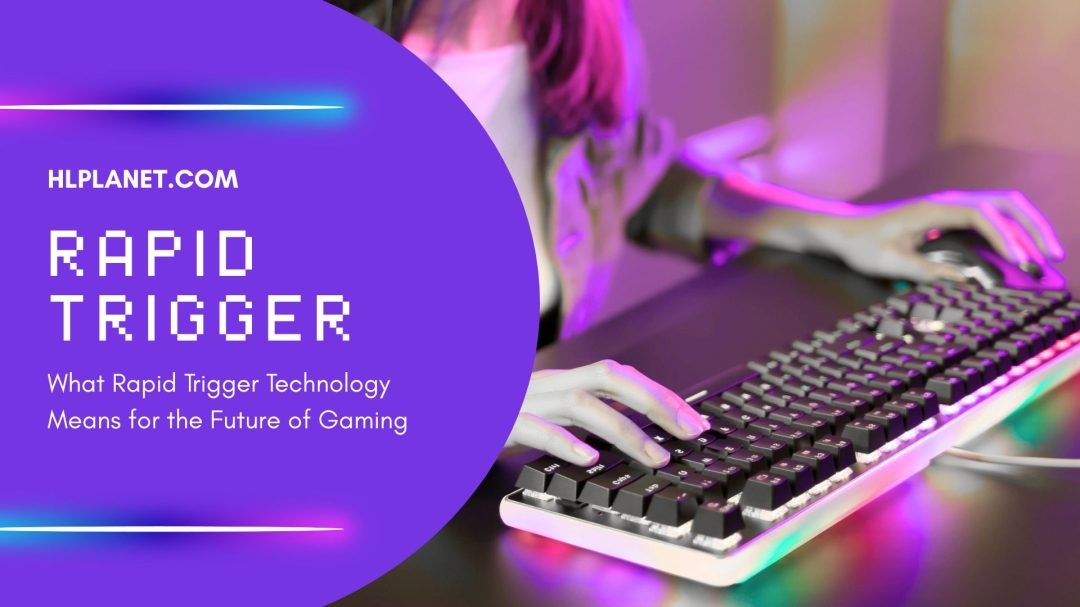
For decades, mechanical keyboards with physical switch contacts have been the gold standard for gamers and enthusiasts. But a new generation of keyboards powered by Hall Effect magnetic sensors and a feature called Rapid Trigger is changing everything. Competitive players, casual gamers, and peripheral reviewers alike are reporting that once you try Rapid Trigger, going back to traditional keyboards feels like playing with one hand tied behind your back.
According to experts at RapidTriggerKeyboard.com, which tracks the latest rankings and innovations in the space, the Rapid Trigger keyboard segment has seen explosive growth in 2025–2026, with dozens of new models launching across every price point and form factor.
What Is Rapid Trigger — and Why Does It Matter?
Traditional mechanical keyboards operate on fixed actuation and reset points. A key activates at a set depth — typically around 2mm — and won't reset until it physically returns above that threshold. This creates an unavoidable delay between the moment a player releases a key and the moment the game registers it.
Rapid Trigger eliminates this limitation entirely. By using Hall Effect magnetic sensors instead of physical metal contacts, the keyboard can detect key movement in real time with sub-millimeter precision. The key registers a new press or release the instant it changes direction — regardless of where it is in its travel. As reviewed by Marcus Richardson, keyboard reviewer at HLPlanet, this translates directly into faster strafing, quicker reaction times, and smoother inputs in competitive games like CS2, Valorant, and Apex Legends.
The result is a keyboard that responds to intent, not physics.
Hall Effect vs. Traditional Switches
The core difference between Rapid Trigger keyboards and conventional mechanical keyboards comes down to sensor technology:
Mechanical switches rely on physical metal contact to register a keypress. They are predictable and familiar, but fundamentally limited by the need for a physical actuation event.
Hall Effect magnetic switches use magnets and sensors to measure the exact position of a key at any point in its travel. There is no physical contact — and therefore no mechanical latency.
Rapid Trigger software layers on top of the sensor data, letting users define the minimum key movement needed to trigger a new press or release — sometimes as little as 0.1mm.
HLPlanet's guide to the best Rapid Trigger keyboards for gaming notes that top-performing models now achieve input latencies well below 1ms, a figure that was unthinkable with conventional keyboard technology just five years ago.
Not Just for FPS Players
While rapid trigger technology first gained traction among FPS and battle royale players, its benefits extend well beyond the shooter genre. Precision and responsiveness matter any time a player's skill is tested against tight timing windows — including in complex action-adventure and exploration games. Editors at MetroidvaniaReview.com, which covers a genre known for demanding precise platforming and split-second combat, note that increasingly, the players sharing high-level runs and speedruns online are mentioning their keyboard setups alongside other performance factors.
The takeaway: Rapid Trigger is no longer niche. It is becoming the expected baseline for any player who takes their setup seriously.
The Niche of Low-Profile Hall Effect Keyboards
One of the most significant recent developments in the Hall Effect market is the emergence of low-profile options. Until recently, players who wanted Rapid Trigger had to accept full-height keycaps and the larger footprint that comes with them. That is no longer the case. As detailed in HLPlanet's dedicated analysis of low-profile Hall Effect keyboards, a growing number of manufacturers are now shipping slim, travel-friendly models that deliver the same sensor accuracy and Rapid Trigger functionality in a significantly more portable package.
Models such as the Nuphy Air75 HE and the Melgeek MADE68 AIR are among those bringing low-profile Hall Effect to a wider audience — with price points that are increasingly accessible to mainstream buyers, not just enthusiasts.
Market Outlook
The mechanical keyboard market is one of the fastest-moving segments in gaming peripherals. Rapid Trigger and Hall Effect technology represent the clearest performance leap the category has seen since the shift from rubber dome to mechanical switches. With price competition intensifying — entry-level Hall Effect keyboards now available for under $50 — the technology is moving from a competitive advantage to an industry standard.
Industry observers expect the majority of new gaming keyboard launches in 2026 to include Hall Effect sensors and Rapid Trigger support as baseline features, rather than premium differentiators.
Media Contact
Company Name: HLPLANET
Email: Send Email
City: Manchester
Country: United Kingdom
Website: https://www.hlplanet.com