The leading cause of death worldwide is chronic inflammatory diseases. When the body is inflamed and under stress for long periods of time, the body’s heart rate increases, increasing the risk of fatality. A new study published in Brain, Behavior and Immunity by The Feinstein Institutes for Medical Research researchers shows that stimulation of the brainstem region where the vagus nerve originates, could help reduce inflammation and heart rate, and improve survival. This preclinical research opens new therapeutic avenues to address inflammation, and in turn, find ways to suppress heart rate by using vagus nerve stimulation in the brainstem.
This press release features multimedia. View the full release here: https://www.businesswire.com/news/home/20240515275090/en/
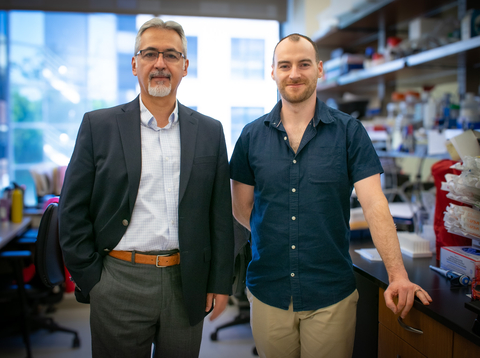
The Feinstein Institutes’ Dr. Valentin Pavlov and Dr. Aidan Falvey led the study. (Credit: Feinstein Institutes)
The study, led by Valentin Pavlov, PhD, professor, and Aidan Falvey, PhD, research scientist, both in the Institute of Bioelectronic Medicine, stimulated the vagus nerve in the brainstem of mice with inflammation. The results show that this stimulation could lower heart rate and reduce inflammation significantly. They also found that even a regimen of stimulation, which does not affect the heart rate, also suppresses inflammation and improves survival.
“Chronic inflammation is the root cause of many diseases, like diabetes, heart disease and cancer,” said Dr. Falvey, lead author of the paper. “Through this type of vagus nerve stimulation, we now realize that we can target infection, reducing inflammation all without affecting heart rate, thus lowering that fatality risk.”
The vagus nerve is often referred to as the body’s superhighway – it connects the brain with all major organs and controls functions like heart rate, breathing and gastrointestinal function. When the nerve is stimulated, it can reduce inflammation, which is a trigger for many diseases, and help the body’s immune system. Inflammation is an important immune response, however, if uncontrolled, can lead to serious conditions such as sepsis, Crohn’s disease, rheumatoid arthritis and other chronic inflammatory disorders.
This research highlights and suggests the potential for non-pharmacological, vagus nerve stimulation to eventually treat a variety of diseases, like sepsis – a leading killer worldwide, accounting for more than 8 million deaths each year – and other inflammatory disorders.
“We continue to study how vagus nerve stimulation is promising to treat a variety of diseases, and we’re studying how vagus nerve stimulation affects the body’s ‘flight or fight’ physiological response,” said Dr. Pavlov. “This research is important because we found that through stimulation of the vagus nerve in the brainstem, we can reduce harmful inflammation with or without effects on the heart rate.”
The Feinstein Institutes for Medical Research is the global scientific home of bioelectronic medicine, which combines molecular medicine, neuroscience, and biomedical engineering. At the Feinstein Institutes, medical researchers use modern technology to develop new device-based therapies to treat disease and injury.
Building on years of research in molecular disease mechanisms and the link between the nervous and immune systems, our researchers discover neural targets that can be activated or inhibited with neuromodulation devices, like vagus nerve implants, to control the body's immune response and inflammation. If inflammation is successfully controlled, diseases – such as arthritis, pulmonary hypertension, Crohn's disease, inflammatory bowel diseases, diabetes, cancer and autoimmune diseases – can be treated more effectively.
Beyond inflammation, using novel brain-computer interfaces, Feinstein Institutes' researchers developed techniques to bypass injuries of the nervous system so that people living with paralysis can regain sensation and use their limbs. By producing bioelectronic medicine knowledge, disease and injury could one day be treated with our own nerves without costly and potentially harmful pharmaceuticals.
“Understanding how the brain-body connections control the immune system is one of the fastest growing fields in science and medicine,” said Kevin J. Tracey, MD, president and CEO of the Feinstein Institutes and Karches Family Distinguished Chair in Medical Research, who is also a co-author of the paper. “Drs. Falvey and Pavlov’s discovery explaining how a specific part of the brain can stop inflammation in the body has remarkable implications for using computer chips to replace drugs in the coming years.”
Dr. Pavlov was recently elected into the American Institute for Medical and Biological Engineering Collect of Fellows Class of 2024 for his more than 20-year dedication to medical and biological engineering, and bioelectronic medicine.
About the Feinstein Institutes
The Feinstein Institutes for Medical Research is the home of the research institutes of Northwell Health, the largest health care provider and private employer in New York State. Encompassing 50 research labs, 3,000 clinical research studies and 5,000 researchers and staff, the Feinstein Institutes raises the standard of medical innovation through its five institutes of behavioral science, bioelectronic medicine, cancer, health system science, and molecular medicine. We make breakthroughs in genetics, oncology, brain research, mental health, autoimmunity, and are the global scientific leader in bioelectronic medicine – a new field of science that has the potential to revolutionize medicine. For more information about how we produce knowledge to cure disease, visit http://feinstein.northwell.edu and follow us on LinkedIn.
View source version on businesswire.com: https://www.businesswire.com/news/home/20240515275090/en/
Contacts
Julianne Mosher Allen
516-880-4824
jmosherallen@northwell.edu