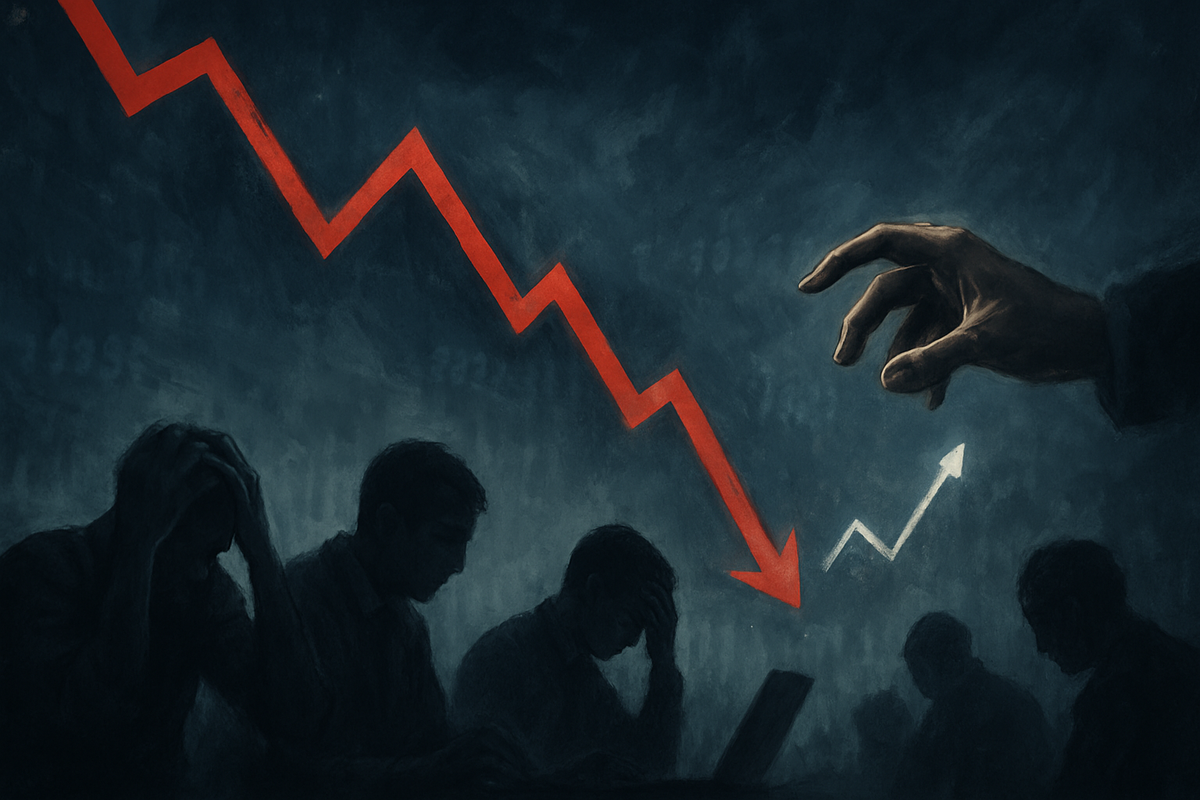
The financial markets, often perceived as bastions of rational decision-making, are, in reality, deeply swayed by the powerful currents of human emotion. As the global economy navigates its inherent cycles, the interplay of fear and greed emerges as a dominant force, particularly during periods of market downturns. This psychological phenomenon can transform rational investors into reactive participants, driving volatility and creating both peril and opportunity. Understanding these intrinsic biases is crucial for investors seeking to maintain discipline and navigate the turbulent waters of economic uncertainty.
The immediate implications of this emotional tug-of-war are profound. During a downturn, fear typically takes the driver's seat, leading to widespread panic selling, herd mentality, and an exaggerated focus on short-term losses. This collective anxiety can push asset prices far below their intrinsic value, creating a self-fulfilling prophecy of decline. Conversely, a counterintuitive form of greed, or perhaps desperate hope, can also manifest, causing some investors to "catch the falling knife" or hold onto losing positions too long, driven by the desire to avoid realizing losses or to secure quick rebounds.
The Anatomy of Market Panics: A Deep Dive into Investor Reactions
Market downturns, while triggered by various economic or geopolitical events, consistently reveal a predictable pattern of investor behavior heavily influenced by fear and greed. When negative news hits – be it an unexpected economic slowdown, a credit crunch, or a global health crisis – the initial reaction is often a swift and sharp decline in asset prices. This is where fear, amplified by cognitive biases, takes hold.
Historically, events like the Dot-com Bubble burst (2000-2002), the Global Financial Crisis (2008), and the COVID-19 market crash (2020) serve as stark reminders. In each instance, an initial shock led to widespread panic selling, as investors, driven by loss aversion, rushed to liquidate holdings to prevent further perceived pain. This was often exacerbated by herd mentality, where individuals mimicked the selling actions of others, assuming a collective wisdom or simply fearing being "left out" of the mass exodus. The availability bias also played a role, as recent negative headlines and vivid memories of past losses amplified the perception of risk, leading to an overestimation of the likelihood of continued decline. Key players, from individual retail investors to large institutional funds, contributed to this downward spiral, with automated trading systems often accelerating the velocity of price movements. Initial market reactions were characterized by extreme volatility, sharp declines in major indices like the S&P 500 (NYSE: SPY) and NASDAQ Composite (NASDAQ: QQQ), and a significant flight to perceived safe-haven assets such as U.S. Treasury bonds. Liquidity often dried up, making it difficult to execute trades without significantly impacting prices, further illustrating the breakdown of efficient pricing mechanisms under emotional duress.
Winners and Losers: Corporate Fortunes in the Face of Investor Sentiment
The emotional swings of fear and greed during market downturns create a distinct landscape of winners and losers among public companies. Businesses with strong balance sheets, resilient business models, and essential services often fare better, while highly leveraged or growth-dependent companies can struggle immensely.
Companies that tend to "win" or at least demonstrate resilience during periods of heightened fear are typically those in defensive sectors. Consumer staples (e.g., Procter & Gamble (NYSE: PG), Walmart (NYSE: WMT)), healthcare (e.g., Johnson & Johnson (NYSE: JNJ), Pfizer (NYSE: PFE)), and utilities (e.g., NextEra Energy (NYSE: NEE)) often see their stocks hold up better as their products and services remain in demand regardless of economic sentiment. These companies benefit from investors seeking stability and predictable cash flows amidst uncertainty. Furthermore, companies that are net cash positive or have low debt levels are better positioned to weather economic storms, avoid liquidity crises, and even acquire distressed assets at favorable valuations. Technology companies providing essential infrastructure or cloud services (e.g., Microsoft (NASDAQ: MSFT), Amazon (NASDAQ: AMZN) Web Services) might also demonstrate resilience as digital transformation continues irrespective of market sentiment.
Conversely, companies that tend to "lose" significantly are often those highly sensitive to economic cycles or dependent on discretionary spending. Luxury goods retailers, travel and hospitality companies (e.g., Marriott International (NASDAQ: MAR), Delta Air Lines (NYSE: DAL)), and highly cyclical industrial firms often see their revenues and profits plummet during downturns. Growth stocks, particularly those with high valuations based on future potential rather than current profitability, are also vulnerable as investors become risk-averse and prioritize immediate earnings. Highly leveraged companies face increased risk of default or covenant breaches as credit markets tighten and revenues decline. Furthermore, companies that rely heavily on consumer confidence or are exposed to volatile commodity prices can experience significant declines. The irrational selling driven by fear can also disproportionately punish fundamentally sound companies, creating opportunities for long-term value investors willing to brave the storm.
Broader Significance: Echoes of History and Future Implications
The psychological dynamics of fear and greed in market downturns are not isolated incidents but rather integral components of broader industry trends and historical market cycles. These emotional forces frequently amplify systemic risks, pushing markets to extremes that rational analysis alone cannot explain.
This phenomenon fits squarely into the cyclical nature of financial markets, where periods of irrational exuberance (greed) inevitably lead to corrections or crashes, followed by periods of fear-driven capitulation before eventual recovery. The "boom and bust" cycle is a testament to the enduring power of human emotion over purely economic fundamentals. Regulatory bodies, such as the U.S. Securities and Exchange Commission (SEC) and central banks like the Federal Reserve, often intervene during periods of extreme volatility, implementing measures like circuit breakers to halt trading or injecting liquidity into the financial system to restore confidence and prevent systemic collapse. These interventions acknowledge the emotional component of market movements and aim to mitigate its most destructive effects. Historically, the Panic of 1907, the Great Depression (1929), and Black Monday (1987) all showcased similar patterns of fear-induced selling, rapid price declines, and subsequent regulatory or monetary responses. Comparisons to these events highlight that while the triggers may differ, the human psychological response to uncertainty and loss remains remarkably consistent. The ripple effects extend beyond direct competitors, impacting suppliers, customers, and even the broader economy through reduced investment and consumer spending. Partners might find their growth plans curtailed or face increased counterparty risk.
Navigating the Storm: What Comes Next for Investors
Understanding the psychology of fear and greed is not merely an academic exercise; it offers crucial insights into what comes next for investors and markets following downturns. The short-term aftermath is typically characterized by continued volatility and uncertainty, but it also sows the seeds for long-term opportunities.
In the short term, markets often experience "dead cat bounces" – temporary recoveries that are quickly reversed – as investors grapple with conflicting signals and lingering fear. During this phase, disciplined investors look for signs of stabilization, such as a decrease in volatility, a slowing of negative news flow, and the emergence of clear leadership in certain sectors. Value investors begin to identify fundamentally strong companies whose stock prices have been irrationally depressed by panic selling. Strategic pivots for companies may include cost-cutting measures, shoring up balance sheets, and focusing on core competencies to survive the lean times. Market challenges include continued liquidity issues, potential credit defaults, and a general reluctance among investors to re-enter the market.
Long-term possibilities, however, often emerge from these periods of distress. Downturns typically prune weaker companies, allowing stronger, more adaptable firms to gain market share. Innovation often accelerates during tough times as companies are forced to find more efficient ways of operating. For investors, the long-term opportunity lies in buying high-quality assets at discounted prices. This requires a strong stomach and a long-term perspective, embodying Warren Buffett's famous advice: "Be fearful when others are greedy and greedy when others are fearful." Potential scenarios range from a swift "V-shaped" recovery, often seen after short, sharp shocks, to a more prolonged "U-shaped" or even "L-shaped" recovery, depending on the underlying economic damage and policy responses. The emergence of new market leaders and the revaluation of entire industries are common outcomes.
Conclusion: Mastering Emotions for Enduring Investment Success
The psychology of fear and greed stands as an immutable force in financial markets, particularly pronounced during downturns. These powerful emotions, amplified by inherent cognitive biases such as loss aversion, herd mentality, and availability bias, can lead to irrational decision-making, exaggerated price swings, and significant wealth destruction for those who succumb to their sway. However, for the disciplined and informed investor, understanding these emotional currents offers a profound advantage.
Moving forward, the market will continue to be a battleground between rational analysis and emotional impulses. Key takeaways from examining investor reactions to downturns include the critical importance of having a well-defined investment strategy, the discipline to stick to it through thick and thin, and the ability to differentiate between temporary market noise and fundamental shifts. Investors who can control their emotions and resist the urge to panic sell during fearful periods, or to engage in reckless speculation during periods of excessive greed, are often those who achieve enduring investment success.
What investors should watch for in the coming months includes not only economic indicators and corporate earnings but also shifts in market sentiment itself. Signs of capitulation (widespread selling at the bottom) can often precede a recovery, while renewed exuberance might signal an overheated market. Ultimately, the ability to remain calm, rational, and long-term oriented in the face of emotional market swings is the hallmark of a successful investor.
This content is intended for informational purposes only and is not financial advice