As of early February 2026, the financial world has officially crossed the Rubicon. Prediction markets, once relegated to the fringes of internet forums and academic theory, have fully integrated into the DNA of the global financial system. The tipping point arrived not with a single event, but through a series of massive institutional migrations that have turned "Event Contracts" into a standard fixture on the screens of retail investors and professional traders alike.
Currently, the market for Federal Reserve policy shifts serves as the most potent example of this transformation. On Kalshi, the probability of a 25-basis-point rate cut at the March 2026 meeting is currently trading at 64%, with over $450 million in open interest across the curve. This isn't just a niche bet anymore; it is the "real-time truth engine" being cited by major networks and used by hedge funds to hedge macro risk. The surge in interest is driven by a unprecedented level of accessibility, with prediction market data now flowing through the same pipelines as the S&P 500.
The Market: What's Being Predicted
While the 2024 election was the catalyst, the "Market" in early 2026 is no longer just about politics. The focus has shifted toward high-frequency economic indicators and corporate events. On Kalshi, the "Fed Funds Rate" contracts remain the liquidity kings, but new categories are exploding. Traders are now actively betting on quarterly earnings beats for companies like Apple Inc. (NASDAQ: AAPL) and NVIDIA Corporation (NASDAQ: NVDA), as well as the monthly Consumer Price Index (CPI) prints.
These markets are primarily trading on two dominant domestic platforms: Kalshi and the recently expanded event contract suite from Robinhood Markets, Inc. (NASDAQ: HOOD). Since Robinhood’s January 2026 launch of "Custom Combos," liquidity has reached record highs. Trading volume across the industry topped an estimated $45 billion in 2025, and February 2026 is already on track to break monthly records. The resolution criteria for these contracts are now strictly standardized, typically relying on official government data or audited corporate filings, providing a level of "settlement certainty" that was missing in the early days of the industry.
Why Traders Are Betting
The migration of traders into prediction markets is being fueled by three major technological and strategic shifts. First is the integration of Coinbase Global, Inc. (NASDAQ: COIN) into the Kalshi ecosystem. By leveraging Coinbase Custody and USDC for settlement, institutional players can now move millions of dollars into event contracts with the same speed and security they expect from the crypto or equity markets. This has eliminated the "on-ramp friction" that previously kept large capital on the sidelines.
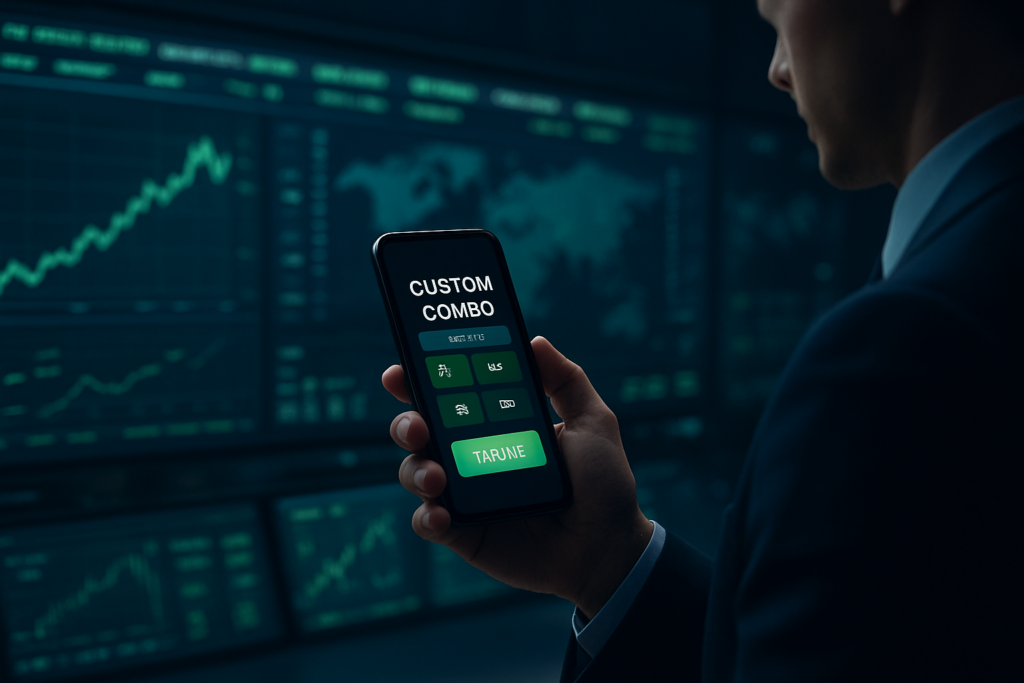
Second, the introduction of Robinhood's "Custom Combos" has revolutionized how retail speculators interact with the news. Similar to a parlay in sports betting but structured as a CFTC-regulated financial instrument, Custom Combos allow users to bundle up to 10 different outcomes—such as a Fed rate cut, a specific CPI print, and a tech earnings beat—into a single high-payout contract. This "gamification of macroeconomics" has brought a younger, more aggressive demographic of traders into the space.
Finally, the narrative has shifted because the data has become unavoidable. When CNBC (subsidiary of Comcast Corporation (NASDAQ: CMCSA)) and CNN (subsidiary of Warner Bros. Discovery, Inc. (NASDAQ: WBD)) began featuring live Kalshi tickers on-air in late 2025, it created a feedback loop. Traders are betting because they see the "market odds" mentioned in every major news cycle, treating the probability percentages as more reliable than traditional expert punditry or lagging opinion polls.
Broader Context and Implications
The mainstreaming of these platforms represents the birth of what Ethereum founder Vitalik Buterin famously termed "Information Finance" (InfoFi). By 2026, prediction markets are no longer just places to gamble; they are seen as the most accurate sensors of public and private information available. The Intercontinental Exchange, Inc. (NYSE: ICE), the parent company of the New York Stock Exchange, essentially validated this in late 2025 by investing $2 billion in the space and integrating prediction data into its professional terminals (ICE Connect).
This integration has profound implications for public sentiment. Unlike polls, which can be influenced by social desirability bias, prediction markets require "skin in the game." The resulting data is cleaner, faster, and less partisan. This has forced regulatory bodies, particularly the CFTC, to move from a posture of skepticism to one of structured oversight. The 2026 landscape is defined by a rigorous regulatory framework that treats event contracts as a legitimate asset class, alongside futures and options.
What to Watch Next
As we move toward the middle of 2026, the next major milestone is the full vertical integration of these platforms. Robinhood’s acquisition of a 90% stake in MIAXdx in January 2026 suggests that the firm will soon launch its own dedicated clearinghouse for event contracts, potentially cutting out middlemen and lowering fees even further. This could trigger a "fee war" that benefits retail traders.
The upcoming 2026 Midterm Elections will be the next "Stress Test" for these integrated systems. We should expect to see the first multi-platform "Election Night" where CNN and CNBC use real-time market data to call states or predict shifts in Congressional control before traditional models have enough data to do so. Watch for the emergence of "Cross-Platform Arbitrage," where traders exploit price differences between the crypto-native Polymarket and the regulated domestic exchanges like Kalshi.
Bottom Line
The mainstreaming of prediction markets via major financial platform integrations is the definitive financial story of 2026. By embedding event contracts into the tools that 100 million Americans already use—like Robinhood and Coinbase—the industry has moved past the "early adopter" phase. These markets are now a vital piece of the global information infrastructure, providing a hedge against uncertainty in an increasingly volatile world.
Ultimately, the rise of prediction markets tells us that in the digital age, market-based consensus is more valuable than ever. Whether you are a retail trader using Robinhood to bet on a "Custom Combo" of tech news or an institutional investor using Kalshi to hedge interest rate risk on a CNBC-branded dashboard, the message is clear: the future is not just something we wait for—it is something we price.
This article is for informational purposes only and does not constitute financial or betting advice. Prediction market participation may be subject to legal restrictions in your jurisdiction.
PredictStreet focuses on covering the latest developments in prediction markets.
Visit the PredictStreet website at https://www.predictstreet.ai/.