Shareholders of Texas Instruments would probably like to forget the past six months even happened. The stock dropped 22.9% and now trades at $156. This might have investors contemplating their next move.
Is there a buying opportunity in Texas Instruments, or does it present a risk to your portfolio? See what our analysts have to say in our full research report, it’s free.
Even though the stock has become cheaper, we're sitting this one out for now. Here are three reasons why TXN doesn't excite us and a stock we'd rather own.
Why Is Texas Instruments Not Exciting?
Headquartered in Dallas, Texas since the 1950s, Texas Instruments (NASDAQ: TXN) is the world’s largest producer of analog semiconductors.
1. Long-Term Revenue Growth Disappoints
A company’s long-term sales performance is one signal of its overall quality. Any business can have short-term success, but a top-tier one grows for years. Unfortunately, Texas Instruments’s 1.7% annualized revenue growth over the last five years was sluggish. This fell short of our benchmarks. Semiconductors are a cyclical industry, and long-term investors should be prepared for periods of high growth followed by periods of revenue contractions.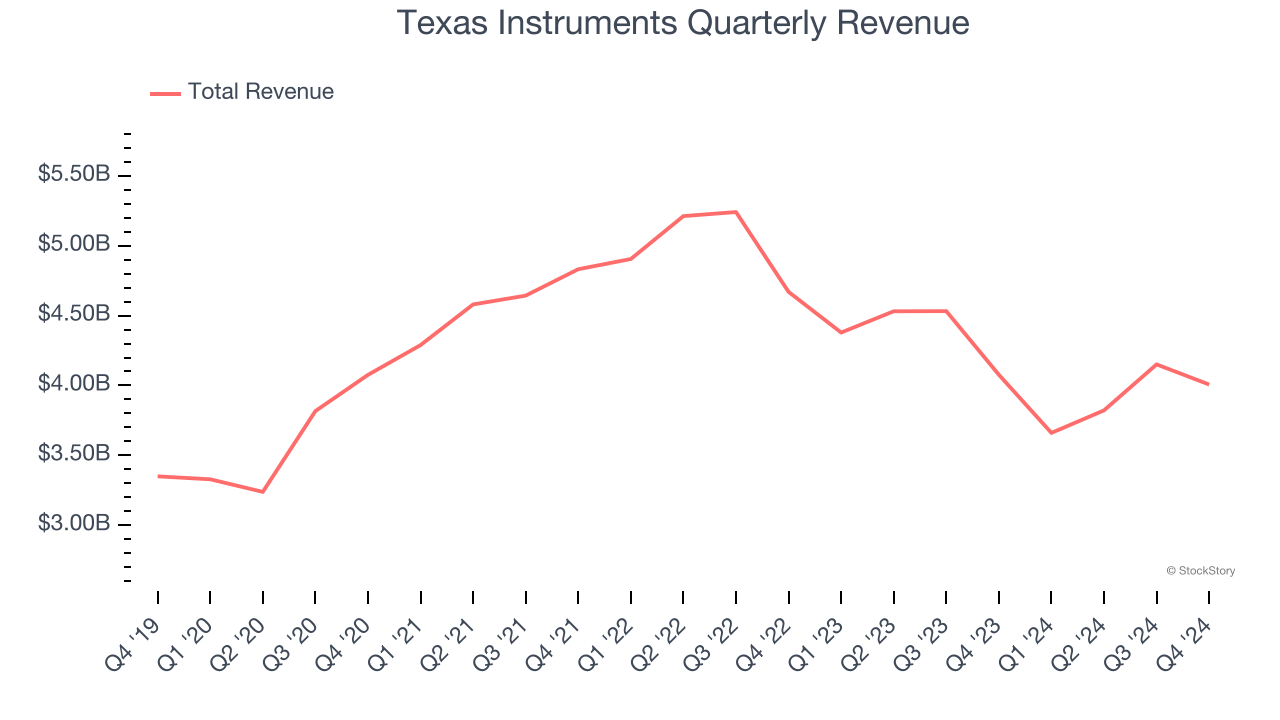
2. Shrinking Operating Margin
Operating margin is an important measure of profitability as it shows the portion of revenue left after accounting for all core expenses – everything from the cost of goods sold to advertising and wages. It’s also useful for comparing profitability across companies with different levels of debt and tax rates because it excludes interest and taxes.
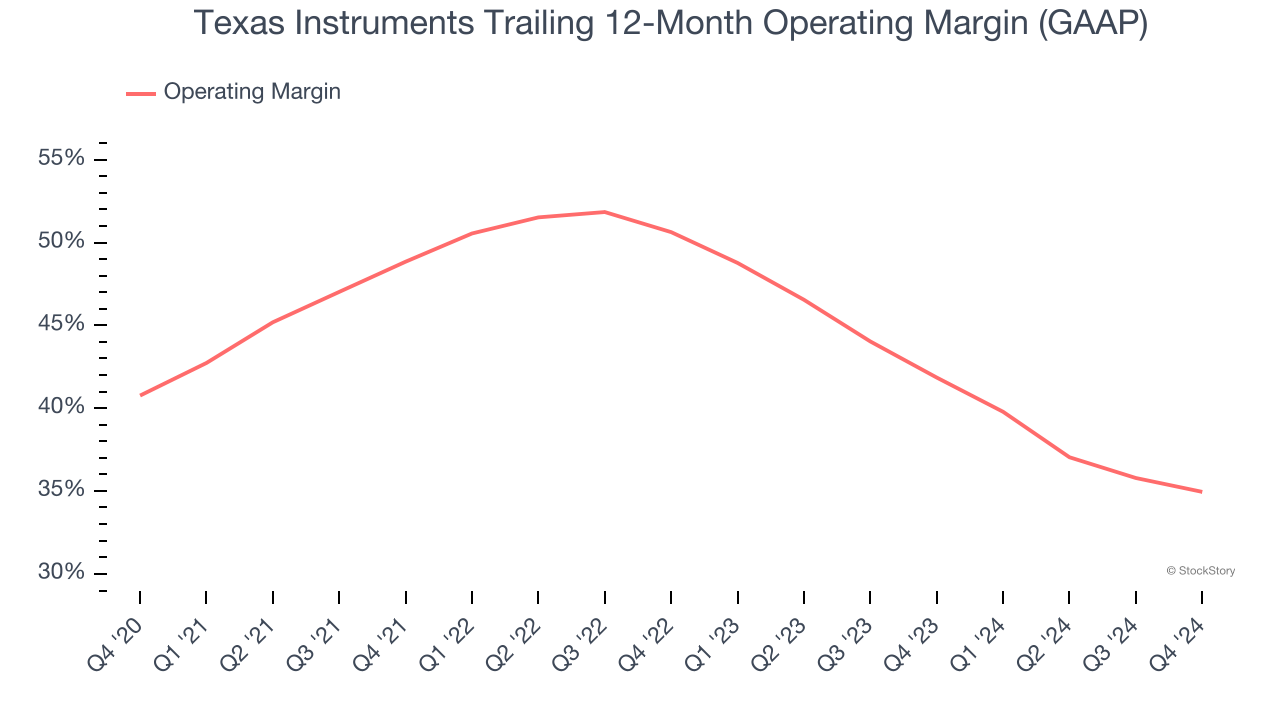
Analyzing the trend in its profitability, Texas Instruments’s operating margin decreased by 5.8 percentage points over the last five years. This raises questions about the company’s expense base because its revenue growth should have given it leverage on its fixed costs, resulting in better economies of scale and profitability. Its operating margin for the trailing 12 months was 34.9%.
3. Free Cash Flow Margin Dropping
Free cash flow isn't a prominently featured metric in company financials and earnings releases, but we think it's telling because it accounts for all operating and capital expenses, making it tough to manipulate. Cash is king.
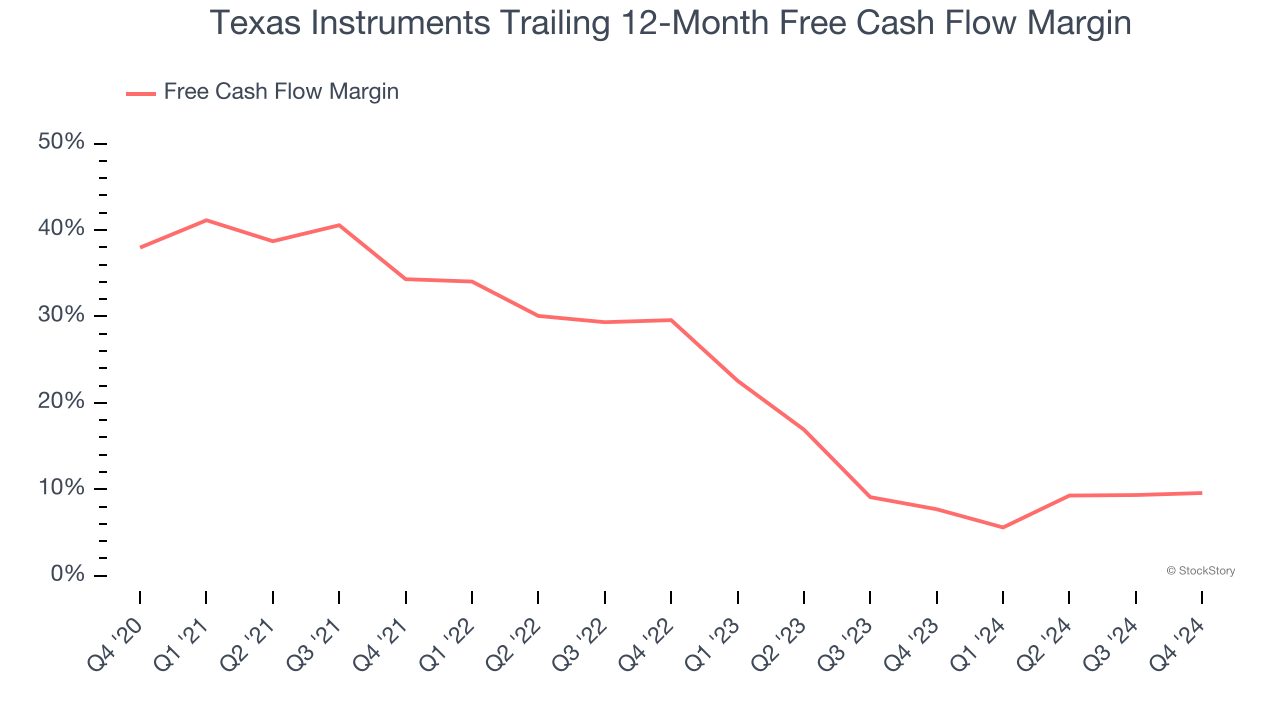
As you can see below, Texas Instruments’s margin dropped by 28.4 percentage points over the last five years. This along with its unexciting margin put the company in a tough spot, and shareholders are likely hoping it can reverse course. If the trend continues, it could signal it’s becoming a more capital-intensive business. Texas Instruments’s free cash flow margin for the trailing 12 months was 9.6%.
Final Judgment
Texas Instruments isn’t a terrible business, but it doesn’t pass our bar. Following the recent decline, the stock trades at 25.7× forward price-to-earnings (or $156 per share). This valuation tells us it’s a bit of a market darling with a lot of good news priced in - you can find better investment opportunities elsewhere. We’d recommend looking at one of Charlie Munger’s all-time favorite businesses.
Stocks We Like More Than Texas Instruments
The market surged in 2024 and reached record highs after Donald Trump’s presidential victory in November, but questions about new economic policies are adding much uncertainty for 2025.
While the crowd speculates what might happen next, we’re homing in on the companies that can succeed regardless of the political or macroeconomic environment. Put yourself in the driver’s seat and build a durable portfolio by checking out our Top 9 Market-Beating Stocks. This is a curated list of our High Quality stocks that have generated a market-beating return of 175% over the last five years.
Stocks that made our list in 2019 include now familiar names such as Nvidia (+2,183% between December 2019 and December 2024) as well as under-the-radar businesses like Sterling Infrastructure (+1,096% five-year return). Find your next big winner with StockStory today for free.