Today’s Date: January 26, 2026
Introduction
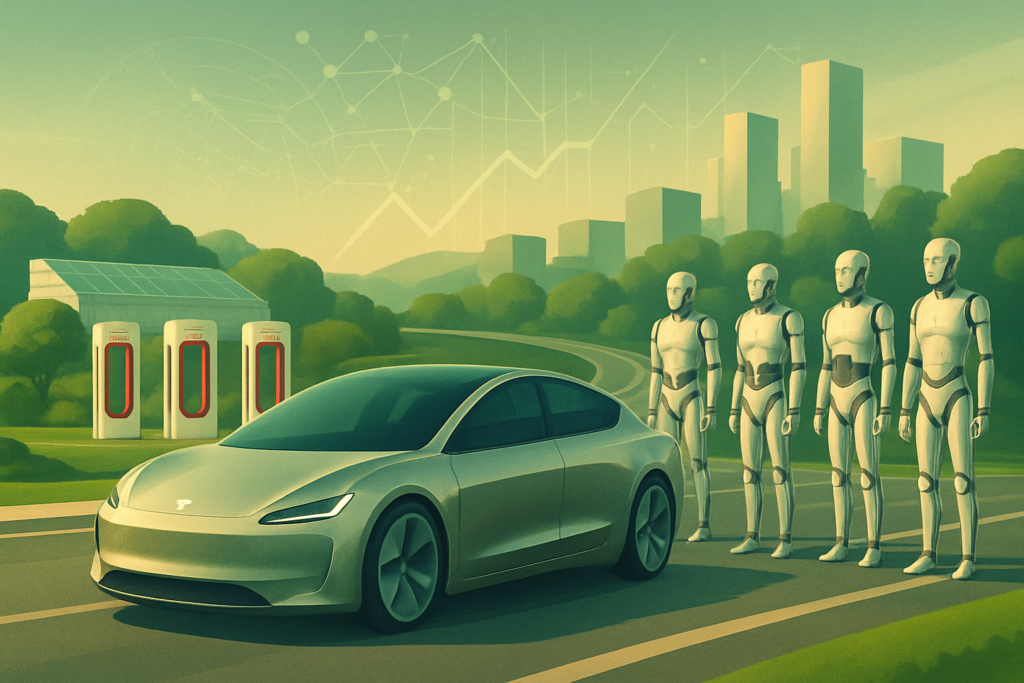
As of early 2026, Tesla, Inc. (NASDAQ: TSLA) stands at one of the most pivotal junctures in corporate history. Long regarded simply as an electric vehicle (EV) manufacturer, the company is currently undergoing a radical metamorphosis into an artificial intelligence and robotics powerhouse. With a market capitalization that has seen explosive growth and gut-wrenching volatility over the last 24 months, Tesla is no longer being valued solely on the number of cars it delivers, but on the "compute" it commands and the autonomous future it promises. This research feature delves into the current state of Tesla, focusing on the acceleration of the Optimus humanoid robot project, the launch of Unsupervised Full Self-Driving (FSD), and the macroeconomic tailwinds propelling its recent stock momentum.
Historical Background
Founded in 2003 by Martin Eberhard and Marc Tarpenning—and led into the mainstream by Elon Musk shortly thereafter—Tesla’s journey began with the "Master Plan" to transition the world to sustainable energy. From the niche Roadster to the mass-market Model 3 and Model Y, Tesla effectively forced the global automotive industry to electrify.
However, the "Third Chapter" of Tesla’s history began in earnest around 2021 with the announcement of the Tesla Bot (Optimus). Over the subsequent five years, the company shifted its internal focus from manufacturing hardware to solving "Real World AI." The acquisition of talent, the development of the Dojo supercomputer, and the refinement of neural networks have transformed Tesla from a car company into a diversified technology conglomerate.
Business Model
Tesla’s revenue streams are increasingly diversified across four primary segments:
- Automotive: Sales of Model S, 3, X, Y, and Cybertruck, along with the newly unveiled Cybercab.
- Energy Generation and Storage: The Powerwall, Megapack, and solar products. This segment has grown to be a significant profit driver, with 46 GWh deployed in 2025.
- Services and Other: Revenue from Supercharging, insurance, and vehicle repairs.
- AI and Robotics (Emerging): Revenue from FSD subscriptions and the early-stage deployment of Optimus units within industrial settings.
As of early 2026, the software-as-a-service (SaaS) model for FSD has become a core focus for investors, offering high-margin recurring revenue that contrasts with the capital-intensive nature of hardware manufacturing.
Stock Performance Overview
Tesla’s stock performance has been a roller coaster over the last decade.
- 10-Year View: TSLA remains one of the best-performing stocks in history, rewarding early investors with astronomical gains despite multiple "drawdowns" of 50% or more.
- 5-Year View: The stock faced significant headwinds in 2022-2023 due to rising interest rates but recovered sharply in late 2024.
- Recent Momentum: Over the last 12 months, the stock has rallied over 75%. Following the November 2024 U.S. election, Tesla shares surged toward $425 as investors bet on a more favorable regulatory environment for autonomous vehicles and Musk’s increasing influence in federal efficiency initiatives.
Financial Performance
Tesla’s financials in early 2026 reflect a company in transition. While automotive gross margins (excluding regulatory credits) have compressed to approximately 14.3% due to global competition and price adjustments, the Energy Storage division is nearing a $20 billion annual revenue run rate.
In its most recent quarterly filings, Tesla reported a healthy cash position of over $30 billion, providing a massive war chest for R&D. However, the Price-to-Earnings (P/E) ratio remains high compared to traditional automakers, reflecting the market’s belief that Tesla’s AI breakthroughs will yield exponential returns in the coming years.
Leadership and Management
Elon Musk remains the singular force behind Tesla’s strategic direction. His recent involvement in the Department of Government Efficiency (DOGE) has added a new layer of complexity to his leadership, with some investors fearing "CEO distraction" while others cheer the potential for reduced regulatory friction.
Key executives like CFO Vaibhav Taneja and Automotive SVP Tom Zhu have taken on larger operational roles, allowing Musk to focus on the "frontier" projects: AI5 chips, the Dojo supercomputer, and the Optimus roadmap. The board remains under scrutiny regarding Musk’s 2018 pay package and general governance, though shareholder support has historically remained robust.
Products, Services, and Innovations
The "Big Three" pillars of Tesla’s current innovation pipeline are:
- FSD v14.2: This version represents the pinnacle of Tesla’s end-to-end neural network approach, removing almost all human-coded heuristics in favor of pure machine learning from the fleet's data.
- Optimus Gen 3: The latest iteration of the humanoid robot features improved tactile sensing and 22 degrees of freedom in the hands, allowing it to perform intricate factory tasks.
- Cybercab: A steering-wheel-less vehicle built on the "Unboxed" manufacturing process, designed specifically for the upcoming Tesla Network (Robotaxi).
Competitive Landscape
Tesla faces a two-front war:
- Automotive Rivals: BYD Co. (OTC: BYDDY) has overtaken Tesla in total EV volume globally, while startups like Rivian (NASDAQ: RIVN) and Lucid (NASDAQ: LCID) compete in the premium American market.
- AI/Autonomous Rivals: Waymo (owned by Alphabet) currently leads in urban autonomous miles, but Tesla’s "vision-only" approach allows for faster scaling compared to Waymo’s localized, LIDAR-heavy maps.
Tesla’s competitive edge lies in its massive data flywheel—millions of cars on the road feeding video data back to its training clusters, a scale no competitor can currently match.
Industry and Market Trends
The "EV Winter" of 2024—marked by slowing consumer demand and high interest rates—has largely thawed. In 2026, the focus has shifted to the "Autonomous Summer." Global markets are moving away from traditional car ownership toward Transport-as-a-Service (TaaS). Furthermore, the labor shortage in manufacturing is driving a massive uptick in interest for humanoid robotics, a trend Tesla is perfectly positioned to capitalize on with Optimus.
Risks and Challenges
- Key Man Risk: Tesla’s valuation is intrinsically tied to Elon Musk. Any change in his status or focus remains a primary risk.
- Regulatory Hurdles: While the U.S. is becoming more permissive, the European Union and China have implemented stringent data sovereignty laws that could delay FSD rollout.
- Execution Risk: The transition to the "Unboxed" manufacturing process for the Cybercab is unproven at scale and could lead to production delays similar to the early days of the Model 3.
Opportunities and Catalysts
- The National AV Framework: A potential federal law in the U.S. to standardize autonomous vehicle regulations would be a massive catalyst, allowing Tesla to bypass the current state-by-state patchwork.
- Unsupervised FSD Expansion: Following the pilot in Austin, Texas, a successful rollout of unsupervised FSD in three more major cities by the end of 2026 could re-rate the stock as a software company.
- Optimus External Sales: If Tesla begins taking external orders for Optimus for industrial use, it opens a multi-trillion-dollar Total Addressable Market (TAM).
Investor Sentiment and Analyst Coverage
Wall Street remains deeply divided. "Bulls" see Tesla as the world’s most valuable AI company, pointing toward a future $5 trillion market cap. "Bears" argue that the automotive business is a commodity and that AI promises are "priced to perfection." Retail sentiment remains overwhelmingly positive, driven by a loyal community that views Tesla as a bet on the future of humanity rather than just a stock.
Regulatory, Policy, and Geopolitical Factors
The geopolitical landscape is a double-edged sword for Tesla. Its massive footprint in China (Giga Shanghai) makes it vulnerable to trade tensions, yet it remains the only Western automaker to enjoy significant success in the Chinese market. In the U.S., the "DOGE" era has signaled a move toward "deregulation through automation," which specifically targets the removal of barriers for autonomous fleets and AI development.
Conclusion
As of January 26, 2026, Tesla is no longer a car company trying to build software; it is a software and robotics company that happens to build cars. The success of the next 24 months hinges on two factors: the seamless transition to Unsupervised FSD and the successful deployment of Optimus on the factory floor.
Investors should watch for the April 2026 production start of the Cybercab and any updates on the "National Automated Vehicle Framework" as key indicators of the stock’s next leg. While the risks are substantial, the potential for Tesla to monopolize the autonomous transport and humanoid labor markets makes it the most consequential company of the late 2020s.
This content is intended for informational purposes only and is not financial advice.