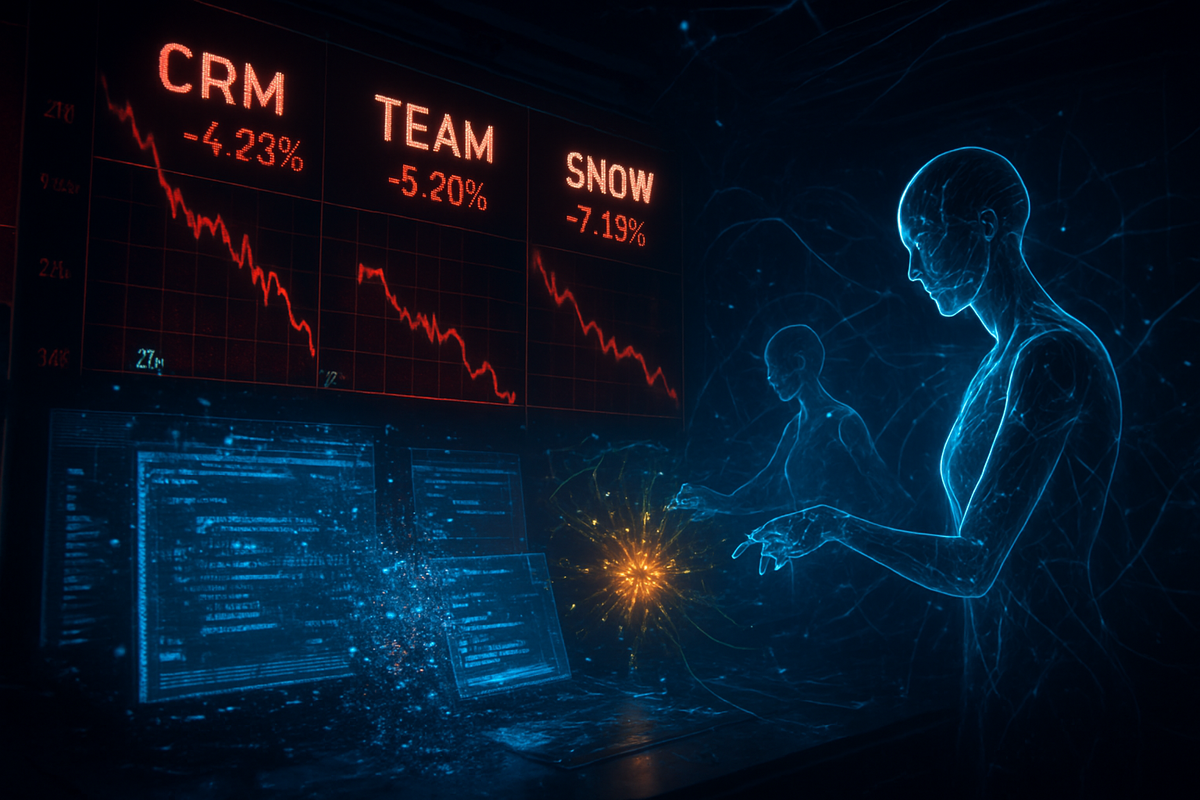
In the first quarter of 2026, the global financial markets witnessed a tectonic shift in the technology sector, colloquially dubbed the "SaaSpocalypse." What began as a cautious reassessment of software valuations in late 2025 accelerated into a sharp 15-20% correction across the B2B software and technology landscape. By mid-March 2026, an estimated $2 trillion in market capitalization had been erased, marking one of the most significant structural repricings in the history of the enterprise software market.
The primary driver of this volatility is no longer high interest rates or macroeconomic cooling, but a fundamental fear of AI-driven disruption. For decades, the "per-seat" subscription model served as the gold standard for software revenue, providing predictable, high-margin cash flows. However, the rapid emergence of Agentic AI—autonomous systems capable of executing complex workflows without human intervention—has led investors to question the long-term durability of seat-based licensing. As AI agents begin to replace human workers in administrative, creative, and technical roles, the very foundation of traditional Software-as-a-Service (SaaS) is being re-evaluated in real-time.
The Dawn of the Great Agentic Correction
The timeline of the correction traces back to the final weeks of 2025, when several high-profile enterprise Chief Information Officers (CIOs) reported a sharp reduction in seat renewals during the annual budget cycle. By January 2026, the iShares Expanded Tech-Software ETF (IGV) began a steep descent, plunging nearly 21% year-to-date by March 24, 2026. The market sentiment shifted from "AI as a feature" to "AI as a replacement," as data emerged showing that for every autonomous AI agent deployed, companies were reducing their human software seat requirements by a ratio of roughly 1:5.
Key players in the industry, from legacy giants to high-growth darlings, found themselves caught in a "valuation trap." Investors who once rewarded 20% growth with high revenue multiples began demanding proof of "AI-defensibility." The initial reaction was a widespread sell-off of any software firm heavily reliant on human-centric user interfaces (UI). Analysts at major firms like Morgan Stanley and Goldman Sachs noted that the "Rule of 40"—the metric where growth plus margin should exceed 40%—was no longer enough to sustain premium multiples if the underlying growth was tied to a shrinking human workforce.
Winners and Losers: From the Seat to the Signal
The casualties of this correction have been concentrated in the application layer. Companies like Atlassian (NASDAQ: TEAM), Monday.com (NASDAQ: MNDY), and Asana (NYSE: ASAN) have faced deep drawdowns, in some cases falling as much as 40-50% from their 2025 peaks. These platforms, which rely on team collaboration and project management, are perceived as highly vulnerable to "Agentic Automation," where AI agents manage tasks and project timelines without the need for a collaborative interface. Similarly, Adobe (NASDAQ: ADBE) has faced renewed scrutiny as open-source and specialized AI models challenge its dominance in the creative workflow.
Conversely, infrastructure software has emerged as the notable exception and a safe haven for capital. Investors have pivoted toward the "arms dealers" of the AI era—companies that manage the data and the underlying plumbing of these autonomous systems. Snowflake (NYSE: SNOW) and Datadog (NASDAQ: DDOG) have remained resilient, with some even posting gains amidst the broader carnage. The logic is clear: while AI might replace the person using the software, it still requires massive amounts of data storage, processing power, and observability. Cloudflare (NYSE: NET) has also seen strength, as the need for edge security and low-latency AI inference becomes non-negotiable for enterprise-grade agents.
Some "pivoters" are attempting to bridge the gap. Salesforce (NYSE: CRM) and ServiceNow (NYSE: NOW) initially saw their stocks stumble but have begun a tentative recovery as they aggressively move toward "outcome-based pricing." By charging for "tasks completed" rather than "seats occupied," these incumbents are attempting to capture the value generated by their new AI "Agentforce" platforms.
A Structural Shift in the Software Moat
This event represents more than just a market dip; it signifies a historic break from the "Software is Eating the World" era defined by Marc Andreessen. We are entering a period where "Data is the Moat." Historically, the switching costs and user familiarity with a specific software interface provided a massive competitive advantage. In the age of AI agents, however, the "interface" is increasingly invisible. If an AI agent can interact with an API directly, the aesthetic or ergonomic quality of the software’s UI becomes irrelevant.
The broader industry trend is a shift toward "Rational Exuberance," where the market recognizes the power of AI but is no longer willing to pay a premium for legacy software that fails to adapt. This mirrors the post-dot-com bubble of the early 2000s, where the infrastructure of the internet (fiber optics, routers) remained valuable while many of the original web applications were wiped out. Today, the "fiber optics" are the data warehouses and GPU clusters, while the "web apps" are the over-populated seat-based SaaS tools.
Navigating the Post-SaaS Landscape
Looking ahead, the software sector is likely to undergo a massive wave of consolidation and a shift in business models. In the short term, expect a prolonged IPO freeze for any B2B startup that is not "AI-native." Venture capital is already shifting away from application-layer startups toward those focused on AI orchestration and specialized "vertical AI" that replaces entire business processes rather than just augmenting them.
Strategic pivots will be required for survival. Software companies must transition from being "systems of record" to "systems of action." This will likely involve a painful transition to usage-based or outcome-based pricing models, which may temporarily compress margins but offer a path to long-term sustainability in an automated world. Those that fail to make this transition risk becoming "zombie SaaS"—profitable but stagnant companies with no growth path in a shrinking human-seat market.
The New Reality for Software Investors
The SaaSpocalypse of early 2026 has reset the expectations for the entire technology sector. The era of blind faith in recurring revenue is over, replaced by a disciplined focus on how much value a software tool actually generates in an autonomous economy. Investors have learned that "stickiness" is not a permanent state and that even the most dominant platforms can be disrupted if they are tied to a disappearing labor model.
As we move forward into the remainder of 2026, the market will likely reward companies that can prove their software is a "non-discretionary" part of the AI stack. Watch for the performance of infrastructure players and the success of "outcome-based" pricing pilots among the large-cap incumbents. The software sector isn't dying, but it is being reborn—and the rules for the next decade of investing are being written right now in the wake of this correction.
This content is intended for informational purposes only and is not financial advice.