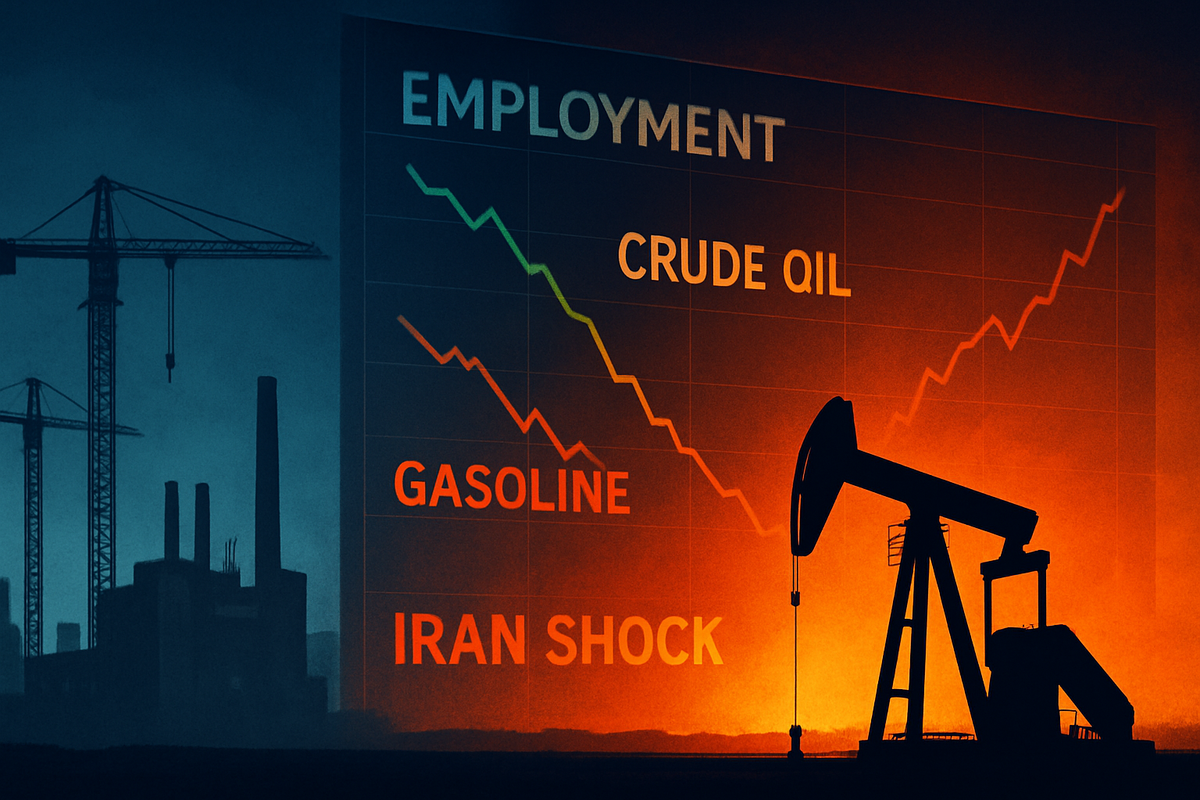
NEW YORK — The U.S. economy has officially entered a "worst-case scenario" as of March 6, 2026, with the specter of stagflation—a paralyzing combination of stagnant growth and high inflation—sending shockwaves through global markets. This morning’s Department of Labor report revealed a stunning contraction in the workforce, with nonfarm payrolls dropping by 92,000 in February. This unexpected decline, the sharpest since the post-pandemic stabilization, collided head-on with a geopolitical energy crisis that has pushed Brent crude oil prices above $91 per barrel, leaving the Federal Reserve with no easy path forward.
The immediate implications are dire for both consumers and investors. As unemployment climbs to 4.4% and energy costs act as a regressive tax on the American household, the "soft landing" narrative that dominated 2025 has evaporated. Market participants are now grappling with an economy where the traditional tools of monetary policy—raising rates to fight inflation or lowering them to stimulate growth—threaten to exacerbate one crisis while attempting to solve the other.
A Collision of Crises: The "Iran Shock" and the Labor Chill
The current economic paralysis is the result of a "perfect storm" that began brewing in late February 2026. A sudden escalation in military conflict involving Iran led to the de facto closure of the Strait of Hormuz, a critical maritime chokepoint. This "Iran Shock" has seen daily tanker transits plummet from 24 to just four, effectively removing 20% of the world’s oil and liquefied natural gas (LNG) supply overnight. Today, West Texas Intermediate (WTI) crude hit $86.57, its highest level in two years, while retail gasoline prices jumped 26 cents in a single week to average $3.25 per gallon.
Leading up to this energy spike, the U.S. labor market was already showing signs of exhaustion. After a sluggish 2025—the slowest year for job creation since the pandemic—today’s payroll miss of nearly 150,000 jobs relative to consensus estimates confirms a deeper rot. Major employers across the tech and industrial sectors have moved from "quiet hiring" to active retrenchment. The Federal Reserve, which had held interest rates steady at 3.5%–3.75% in January, now finds itself "boxed in." The central bank is split between hawks who fear an energy-driven inflation spiral and doves who see a recessionary abyss opening under the feet of the American worker.
Winners and Losers: The Great Portfolio Re-Shuffling
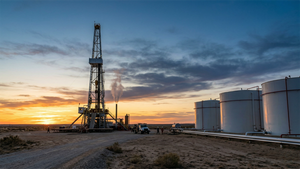
In this stagflationary environment, the market is aggressively bifurcating. Energy giants are the clear beneficiaries of the geopolitical premium. ExxonMobil (NYSE: XOM) and Chevron (NYSE: CVX) have seen their shares climb as they leverage record domestic production and "fortress" balance sheets to navigate the volatility. Similarly, Occidental Petroleum (NYSE: OXY) has outperformed the broader S&P 500, buoyed by rising crude prices and its strategic positioning in the Permian Basin. Defense and intelligence firms are also seeing a flight to quality, with Palantir Technologies (NYSE: PLTR) surging on increased demand for its conflict-analytics platforms.
Conversely, the "losers" list is growing and includes sectors most sensitive to fuel costs and discretionary spending. The airline industry has been devastated; American Airlines (NASDAQ: AAL), which notably does not hedge its fuel costs, saw its stock nosedive 5% following the energy spike. Peers like United Airlines (NASDAQ: UAL) and Delta Air Lines (NYSE: DAL) are facing similar headwinds as jet fuel prices in North America surpassed $1,000 per tonne. Meanwhile, retail is under siege. Target (NYSE: TGT) is struggling with declining comparable sales as middle-income budgets are squeezed by the pump, while logistics giants FedEx (NYSE: FDX) and United Parcel Service (NYSE: UPS) are grappling with the dual burden of rising industrial electricity costs and falling shipping volumes.
The Fed’s Impossible Choice and Historical Echoes
The wider significance of this moment cannot be overstated. We are witnessing a breakdown of the "Goldilocks" regime that fueled the 2024–2025 bull market. This event fits into a broader trend of deglobalization and geopolitical instability that has made supply chains more brittle and inflation more "sticky." Today’s 2.7% CPI print, while lower than the 2022 peaks, remains stubbornly above the Fed’s 2% target, especially as new 2026 tariffs begin to pass through 90% of their costs to domestic firms like Nike (NYSE: NKE) and Levi Strauss & Co. (NYSE: LEVI).
The historical precedent for this is the 1970s, where oil shocks repeatedly derailed growth and forced the Fed into a cycle of "stop-go" monetary policy. The ripple effects are already being felt by international partners. European markets are reeling as their energy dependency makes them even more vulnerable to the Hormuz closure than the U.S. This has created a regulatory nightmare for policymakers who must now decide whether to prioritize price stability or prevent a full-blown industrial depression.
What Comes Next: Navigating the "Vibecession"
In the short term, the market should prepare for a "lost quarter" or potentially a "lost year" of growth. Strategic pivots are already underway; companies are likely to accelerate automation to offset labor costs, a trend that could benefit AI-infrastructure plays like GE Vernova (NYSE: GEV) and Caterpillar (NYSE: CAT), which are seeing backlogs for generators and turbines stretch into 2028. However, the long-term outlook depends entirely on the duration of the Iran conflict and the Fed's willingness to "look through" energy inflation to save the jobs market.
Potential scenarios range from a "Hard Landing," where the Fed keeps rates high and triggers a deep recession, to a "Muddle Through" scenario, where energy prices stabilize and labor growth returns to a modest positive baseline. Investors should watch for a "flight to value," favoring companies with high essentiality and pricing power, such as Walmart (NYSE: WMT) and Costco Wholesale (NASDAQ: COST), which traditionally gain market share during periods of consumer belt-tightening.
The Bottom Line: A New Era of Defensive Investing
As of March 2026, the primary takeaway is that the era of "easy money" and predictable growth is over. The convergence of a 92,000-job loss and $90 oil marks a fundamental shift in the market's risk profile. Moving forward, the market will likely remain in a "defensive wait-and-see" mode, with high volatility as every data point is scrutinized for signs of the stagflation trap deepening.
Investors should closely monitor the 2-year U.S. Treasury yields and the FOMC’s upcoming March meeting minutes. The "vibecession"—the psychological state where consumers feel the economy is worse than the headlines suggest—has become a structural reality, with over 50% of Americans now reporting the use of a formal budget. For the coming months, the watchwords are capital preservation, energy exposure, and a wary eye on the Middle East.
This content is intended for informational purposes only and is not financial advice.