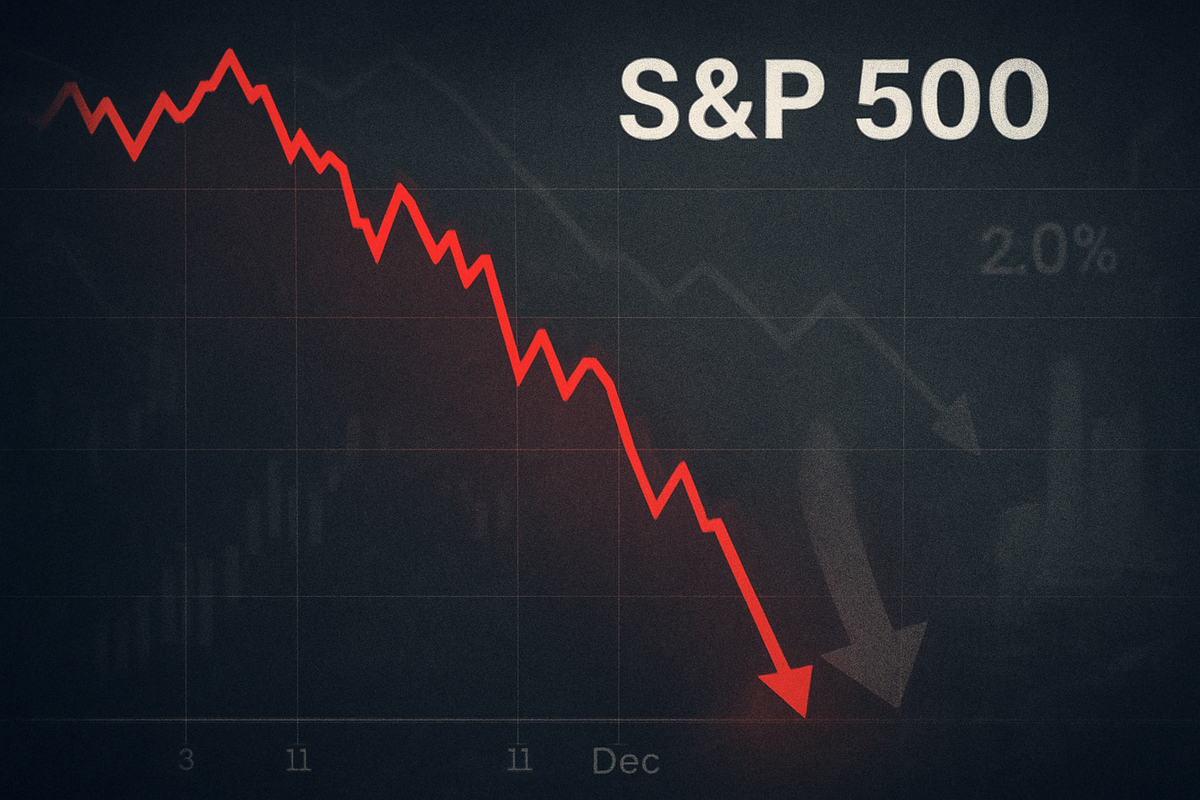
December 1, 2025 – The financial markets opened the final month of the year with a stark reminder of economic realities, as the S&P 500 experienced a significant decline, signaling a potential end to a prolonged period of robust growth. Investors, who had grown accustomed to upward momentum, are now facing a market that appears to be "rediscovering gravity," with asset prices adjusting to underlying economic fundamentals rather than speculative exuberance. This sharp correction on the first trading day of December has immediately cast a shadow over the optimistic outlook that characterized much of the preceding months.
The downturn is being attributed to a confluence of factors, including persistent inflationary pressures, a more hawkish stance from central banks than previously anticipated, and emerging signs of a slowdown in key economic indicators. This shift in sentiment suggests that the market’s previous valuations may have become stretched, prompting a recalibration as investors assess the true landscape of corporate earnings and future economic growth. The immediate implication is a heightened sense of caution and uncertainty across all sectors, as market participants brace for what could be a more volatile period ahead.
The Perfect Storm: Inflation, Hawkish Policy, and Economic Weakness Converge
The S&P 500's sharp decline on December 1, 2025, was not an isolated event but rather the culmination of several potent economic and geopolitical forces that have been brewing throughout the year. At the forefront of this market correction are persistent inflationary pressures that have refused to abate, forcing central banks to maintain a more restrictive monetary policy than investors had hoped. Throughout 2025, inflation rates consistently hovered above target levels, eroding consumer purchasing power and squeezing corporate profit margins, setting the stage for a re-evaluation of asset valuations.
A key catalyst for the market's sudden downturn was the central bank's unwavering commitment to its hawkish stance. Having implemented a series of interest rate hikes throughout the year, the central bank recently signaled its intention to keep rates "higher for longer," or even projected fewer rate cuts in 2026 than the market had optimistically priced in. This revelation dashed hopes for an imminent easing of monetary policy, sending bond yields spiking and making equities less attractive. Compounding this, the ongoing quantitative tightening (QT) program, which has steadily drained liquidity from the financial system, continued to exert downward pressure, creating a challenging environment for corporate profitability and overall market valuations.
Adding to the economic headwinds, a barrage of disappointing economic data in the weeks leading up to December 1 further solidified fears of an impending slowdown. The latest Gross Domestic Product (GDP) report revealed an unexpected contraction in the previous quarter, indicating that the economy was already losing momentum. Simultaneously, November's employment figures painted a grim picture, with significantly slowed job creation and an uptick in the unemployment rate, confirming a weakening labor market. Consumer sentiment data for November plummeted to near-record lows, reflecting widespread pessimism about personal finances and future economic conditions, signaling a potential sharp drop in crucial holiday season spending.
To exacerbate these domestic concerns, an unforeseen geopolitical event emerged as a significant shockwave. Reports of an escalating regional conflict, potentially impacting critical oil-producing regions or major global trade routes, sent commodity prices soaring and introduced immense uncertainty into global supply chains. This sudden surge in input costs for businesses, combined with the broader geopolitical instability, triggered widespread panic selling. Investors, already wary of stretched valuations, rushed to de-risk their portfolios, leading to the rapid and significant drop in the S&P 500 that marked the start of December.
Winners and Losers: A Shifting Landscape for Public Companies
The market's sudden downturn and the "rediscovery of gravity" are poised to redraw the lines between winning and losing sectors, profoundly impacting public companies. This environment, characterized by persistent inflation, rising interest rates, and slowing economic growth, creates a challenging landscape where agility and fundamental strength will be paramount.
High-growth technology companies and other "long-duration" assets are likely to face significant headwinds. Firms like Apple (NASDAQ: AAPL), Microsoft (NASDAQ: MSFT), and emerging tech innovators, which derive much of their valuation from future earnings potential, will see their present values diminish as higher interest rates increase the discount rate. Furthermore, many of these companies rely on external funding for expansion, and the combination of rising borrowing costs and reduced market liquidity due to quantitative tightening will make capital more expensive and harder to access, potentially slowing innovation and growth.
Similarly, the discretionary consumer sector is expected to bear the brunt of reduced purchasing power. Companies in retail, automotive, hospitality, and luxury goods, such as Starbucks (NASDAQ: SBUX) or Tesla (NASDAQ: TSLA), will likely experience a downturn in demand as consumers, grappling with inflation and higher debt servicing costs, prioritize essential spending. Highly leveraged companies across various sectors will also feel the squeeze, as rising interest expenses directly impact their profitability and cash flow, making it costlier to refinance existing debt or secure new financing.
Conversely, defensive sectors are anticipated to demonstrate greater resilience. Utilities, such as Consolidated Edison (NYSE: ED), which provide essential services like electricity and water, tend to have stable demand regardless of economic conditions, offering predictable revenue streams. Consumer staples giants like Procter & Gamble (NYSE: PG) or Coca-Cola (NYSE: KO), which produce everyday necessities like food and household goods, will also likely see sustained demand as consumers continue to prioritize these items. Healthcare companies, particularly established pharmaceutical firms, also offer a degree of stability due as healthcare spending is often non-discretionary.
Furthermore, companies with strong balance sheets, characterized by low debt and ample cash reserves, are exceptionally well-positioned to navigate this turbulent period. These firms possess the financial flexibility to weather economic storms, take advantage of market dislocations, or even acquire distressed assets, emerging stronger on the other side. Financial institutions, like JPMorgan Chase (NYSE: JPM), may also see increased net interest income as interest rates rise, potentially benefiting from the widening spread between lending and deposit rates. Energy and materials sectors, including companies like ExxonMobil (NYSE: XOM), could also see some benefit as commodity prices tend to correlate positively with inflation, bolstering their revenues in this environment.
A Paradigm Shift: The End of Easy Money and a Return to Fundamentals
The S&P 500's December 1 decline is more than just a bad trading day; it signals a profound paradigm shift in the financial markets, effectively marking the definitive end of the "easy money era." For over a decade, central banks maintained ultra-low interest rates and engaged in extensive quantitative easing, flooding markets with liquidity. This environment fueled speculative growth, particularly in the technology sector, and allowed companies to accumulate significant debt. Now, with inflation running persistently high, central banks are aggressively tightening monetary policy, making capital scarcer and more expensive. This fundamental change forces investors to pivot from chasing growth at any cost to prioritizing profitability, strong balance sheets, and intrinsic value.
This shift is already manifesting as a clear pivot from growth investing to value investing. For years, growth stocks, particularly in the tech sector, commanded premium valuations based on their distant future earnings potential. However, rising interest rates diminish the present value of those future cash flows, making them less appealing. Conversely, value stocks – companies with solid fundamentals, robust current cash flows, and often attractive dividends – are gaining favor. These companies frequently possess real assets or the pricing power necessary to navigate inflationary pressures, making them more resilient and appealing in the current environment. This reorientation of investment strategies is likely to be a defining characteristic of the market in the coming months and years.
The ripple effects of this market "rediscovery of gravity" will extend far beyond individual stock prices. Competitors, especially those with weaker balance sheets or less pricing power, will face intensified pressure, potentially leading to industry consolidation or even bankruptcies. Supply chains and partnerships will also be tested, as economic slowdowns and fluctuating demand necessitate agile adjustments. Globally, the interconnectedness of financial systems means that a significant downturn in a major economy like the U.S. can trigger declines in international exchanges, impact global trade, and lead to increased currency volatility, affecting export-oriented nations and overall global GDP growth.
In response to this challenging environment, regulatory bodies and policymakers will undoubtedly face increased scrutiny and pressure. Central banks will continue to walk a tightrope, aiming to tame inflation without plunging economies into deep recessions, potentially necessitating further adjustments to interest rates and quantitative tightening policies. Governments may consider fiscal stimulus measures, though concerns about already elevated public debt levels could limit their scope. Furthermore, lessons from past crises, such as the 2008 financial crisis, underscore the importance of robust financial regulation to prevent systemic risks, suggesting a renewed focus on ensuring banking sector stability and potentially stricter oversight in vulnerable sectors.
Historically, the current situation bears striking resemblances to the stagflationary period of the 1970s, where high inflation, slow economic growth, and rising unemployment plagued markets for a decade. Like today, that era saw oil price shocks and aggressive central bank action to curb inflation, ultimately leading to a severe recession but also paving the way for future stability. While the specific catalysts differ from the early 2000s tech bust, which was primarily a speculative bubble in internet stocks, both scenarios highlight the dangers of overvalued growth assets when market sentiment shifts. The key takeaway from these historical precedents is clear: markets are cyclical, and periods of exuberance are often followed by a return to fundamental valuations, prompting necessary, albeit painful, economic adjustments.
Navigating the New Normal: Scenarios and Strategic Imperatives
The S&P 500's stumble into December sets the stage for a period of heightened uncertainty, demanding strategic pivots from both companies and investors. In the short term, expect continued market volatility as central banks remain steadfast in their battle against inflation, likely through sustained high interest rates. This will continue to elevate borrowing costs, squeeze corporate profit margins, and dampen consumer spending, particularly impacting growth-oriented equities. The bond market will also remain sensitive, with potential for further price adjustments as rates normalize.
Looking further ahead, the long-term trajectory hinges on the effectiveness of inflation control and the pace of economic recovery. While a period of slower growth appears inevitable, an eventual rebound is anticipated. However, this recovery will likely unfold within a new paradigm, characterized by a more sustained higher interest rate environment and continued technological evolution. Companies will need to prioritize financial resilience, rigorously managing cash flow, assessing expenditures, and strengthening vendor relationships. Operational efficiency through digital transformation and automation will be key to cost reduction, while innovation and diversification will be crucial for meeting evolving customer needs and spreading risk. Strategic mergers and acquisitions may also emerge as opportunities for well-capitalized firms to consolidate market position.
For investors, adapting to this "new normal" means a shift in strategy. Asset allocation adjustments will be paramount, potentially reducing exposure to long-duration bonds and re-evaluating equity holdings. A strong emphasis on quality companies with robust fundamentals, stable earnings, and low debt will be critical. Defensive sectors like utilities, healthcare, and consumer staples, along with select dividend-paying stocks, may offer relative safety. Furthermore, considering short-term and floating-rate bonds, real assets, and commodities can provide diversification and potential inflation protection in this environment.
Potential scenarios for the broader economy range from a shallow recession—a brief, mild contraction followed by a relatively quick recovery—to a more challenging prolonged stagnation or even stagflation, where high inflation persists alongside weak growth and elevated unemployment. The central bank's ability to achieve a "soft landing"—curbing inflation without triggering a severe downturn—will be a defining factor. Government fiscal policy, though potentially constrained by existing debt, may also play a role in supporting economic activity. Ultimately, corporate resilience—the capacity of businesses to adapt, innovate, and strategically manage through disruptions—will be instrumental in shaping the market's trajectory and determining which entities emerge stronger from this period of rediscovered gravity.
Conclusion: A Market Reassessment and the Road Ahead
The S&P 500's December 1 decline serves as a critical inflection point, signaling a necessary market reassessment after an extended period of growth. The key takeaways from this event are clear: the era of easy money has concluded, and markets are now grappling with the fundamental realities of persistent inflation, higher interest rates, and slowing economic momentum. This shift will favor companies with strong balance sheets, predictable cash flows, and essential services, while challenging highly leveraged and growth-dependent sectors.
Moving forward, the market will likely remain volatile as central banks continue their fight against inflation, and economic data provides a clearer picture of the path ahead. Investors should prioritize diversification, focus on quality assets, and remain agile in their strategies. Watch for further cues from central bank communications, key economic indicators such as inflation reports, employment figures, and consumer sentiment, as well as geopolitical developments. The coming months will test the resilience of both corporations and investment portfolios, but also present opportunities for those who adapt to the market's rediscovered gravity and align with the new economic fundamentals.
This content is intended for informational purposes only and is not financial advice