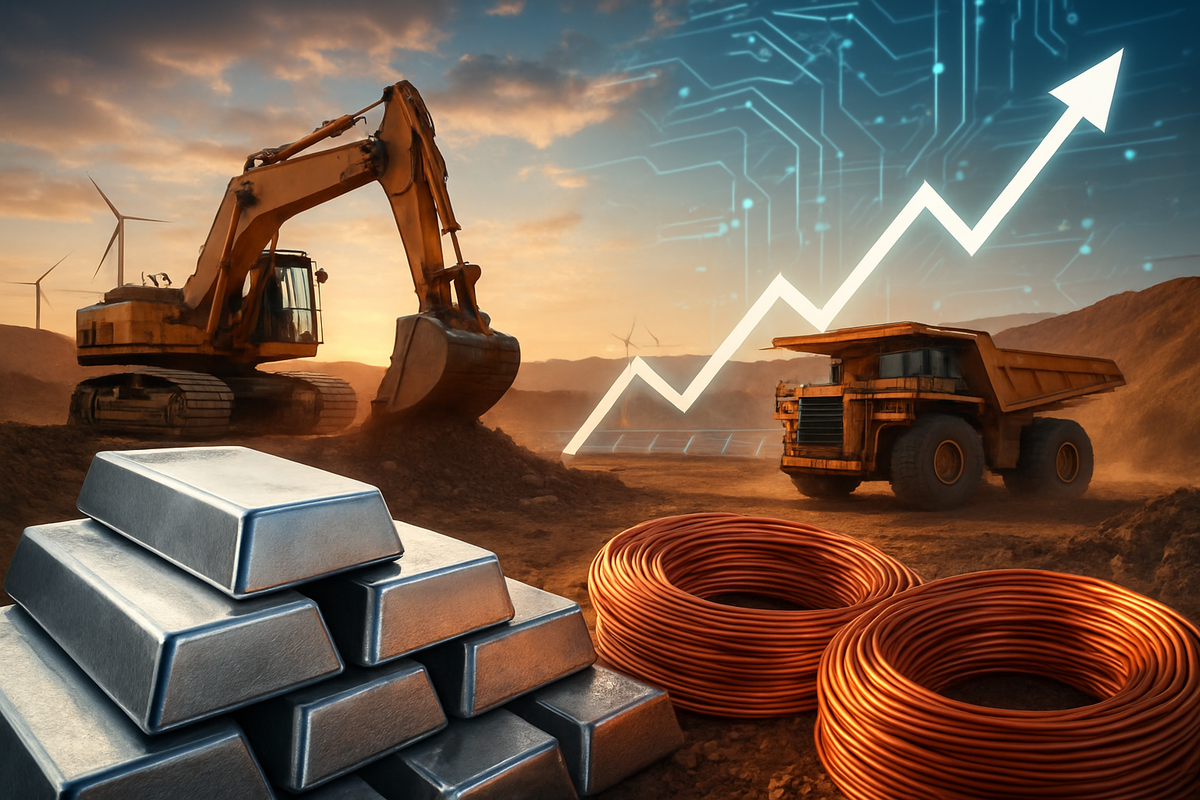
Poland's mining giant, KGHM Polska Miedź S.A. (WSE: KGHM), is experiencing a significant surge in its share price, directly fueled by the remarkable ascent of global silver and copper prices. As of December 1, 2025, the company's stock has hit new highs, reflecting a broader commodity boom that is reshaping the financial landscape for mining companies worldwide. This rally underscores a robust demand outlook for critical industrial metals and precious metals, signaling strong market confidence in the sector's future.
The dramatic increase in commodity values has translated into enhanced profitability and a strengthened financial position for KGHM, despite some operational adjustments. The immediate implication for KGHM and its peers is a substantial boost to revenues and a renewed impetus for investment in exploration and development, all while navigating persistent supply challenges that continue to drive prices upward.
Commodity Supercycle Ignites KGHM's Ascent
KGHM's impressive stock performance throughout 2025 is intrinsically linked to a historic rally in both silver and copper markets. The company's shares reached a new 52-week high of 212.50 on November 28, 2025, culminating in an 81.61% annual stock price performance for the year. This surge is a direct consequence of KGHM's significant exposure to these metals, with its earnings highly sensitive to global price fluctuations.
The timeline of events leading to this moment has seen a consistent upward trajectory for both commodities. Silver prices, for instance, have recorded an extraordinary rally, reaching an all-time high of $57.86 USD per troy ounce on December 1, 2025. This marks an almost 15% increase in just six days and an astonishing 88.27% jump compared to the same period last year, effectively doubling in price since its 52-week low. Copper has followed suit, trading at $5.22 USD per pound on December 1, 2025, up 27.34% year-on-year, with London Metal Exchange (LME) copper futures hitting a new high of $11,210.50 per ton on November 28, 2025.
Key drivers behind this commodity boom include expectations of US interest rate cuts, a weaker US dollar, and critically, robust industrial demand. The rapidly expanding solar power and electric vehicle sectors, where silver is a critical component, along with the global energy transition, artificial intelligence (AI) infrastructure, and data centers, are voraciously consuming copper. Despite some operational challenges for KGHM, such as a slight decrease in payable copper production in the first nine months of 2025 due to planned maintenance and a temporary drop in silver output in Q2 2025, the company has reported strong financial results. Its adjusted EBITDA for Q1 2025 surged by 60% year-over-year, and operating profit for the first nine months of 2025 increased by 16% year-over-year, reaching PLN 7.2 billion. The strong performance of its Chilean Sierra Gorda mine, a joint venture, also contributed significantly, fueled by higher production volumes and elevated metal prices.
Winners and Losers in the Commodity Rush
The ongoing commodity boom, particularly in copper and silver, is creating clear winners and losers across the global mining landscape, with KGHM Polska Miedź S.A. (WSE: KGHM) firmly positioned among the beneficiaries. For companies with significant reserves and efficient extraction capabilities for these metals, the current market conditions translate directly into elevated revenues and boosted profit margins. KGHM, being a major producer of both copper and silver, is experiencing a substantial uplift in its financial performance, allowing for stronger cash flows and the ability to fund strategic investments, such as the PLN 3.8 billion planned for new shafts and infrastructure in 2025.
Other major diversified mining companies with substantial copper and silver operations, such as BHP Group (ASX: BHP), Rio Tinto (ASX: RIO), and Freeport-McMoRan (NYSE: FCX), are also poised to benefit significantly. These companies are seeing their valuations climb as investors flock to assets that offer exposure to the critical materials driving the global energy transition and technological advancements. The increased profitability enables them to accelerate exploration efforts, expand existing operations, and potentially return more value to shareholders through dividends or share buybacks. Furthermore, companies involved in the supply chain for mining equipment and services are also experiencing increased demand as miners look to optimize production and capitalize on high prices.
Conversely, companies heavily reliant on these commodities as inputs for their manufacturing processes, without hedging strategies in place, could face increased cost pressures. Industries such as electronics manufacturing, automotive (especially electric vehicles), and renewable energy infrastructure development might see their raw material costs rise, potentially squeezing profit margins if they cannot pass these costs onto consumers. While the long-term demand outlook for these sectors remains strong, the short-to-medium term could present challenges in managing input costs. Additionally, smaller, less efficient mining operations or those with higher production costs may struggle to compete, even in a high-price environment, if they cannot leverage economies of scale or operational efficiencies.
Broader Implications and Market Shifts
The current surge in silver and copper prices, exemplified by KGHM's soaring shares, signifies more than just a momentary market fluctuation; it points to profound shifts in global industry trends and economic priorities. This commodity boom is largely driven by the accelerating global energy transition, which demands vast quantities of copper for renewable energy infrastructure, electric vehicles, and grid modernization. Silver, too, is critical for solar panels and various high-tech applications. The rapid expansion of artificial intelligence (AI) infrastructure and data centers further exacerbates demand for copper, creating a structural deficit that is unlikely to be resolved quickly.
The ripple effects of these elevated prices extend across the entire economic spectrum. Competitors and partners in the mining sector are recalibrating their strategies, with increased capital expenditure flowing into exploration and development projects. However, the inherent lead times for bringing new mines online mean that supply will struggle to keep pace with burgeoning demand in the near term, projecting copper deficits of 160,000 to 200,000 tonnes in 2025 and 200,000 to 330,000 tonnes in 2026. Silver is also anticipated to remain in deficit for the fifth consecutive year in 2025. This scarcity underpins the sustained bullish outlook.
Regulatory and policy implications are also coming to the forefront. Governments in resource-rich nations may consider revising mining taxes or royalty structures to capture a larger share of the increased profits, as evidenced by Poland's planned reduction in copper mining tax from 2026, aimed at encouraging investment. Environmental regulations and permitting processes for new mines are under renewed scrutiny, balancing the need for critical minerals with sustainability goals. Historically, commodity supercycles have often been characterized by similar patterns of intense demand, supply constraints, and subsequent policy adjustments, drawing parallels to previous periods of rapid industrialization and technological advancement.
The Road Ahead: Opportunities and Challenges
Looking ahead, the short-term outlook for KGHM (WSE: KGHM) and the broader mining sector remains largely positive, driven by the persistent supply-demand imbalance for copper and silver. In the immediate future, KGHM is poised to continue benefiting from high metal prices, translating into sustained profitability and potentially strong dividend payouts. The planned reduction in Poland's copper mining tax from 2026 is an additional positive catalyst that will further enhance the company's financial health. Mining companies will likely continue to prioritize operational efficiency and cost management to maximize returns in this favorable environment.
In the long term, the trajectory of these commodity prices will depend on several factors. While demand from the energy transition and AI infrastructure is expected to remain robust, the industry faces the challenge of bringing new supply online. This will require significant capital investment, technological innovation in extraction and processing, and navigating increasingly complex environmental and social governance (ESG) considerations. Potential strategic pivots for miners could include increased mergers and acquisitions activity to consolidate resources, greater investment in recycling technologies to supplement primary supply, and enhanced focus on sustainable mining practices to secure social license to operate.
Market opportunities will emerge for companies specializing in advanced exploration technologies, sustainable mining solutions, and those capable of rapidly scaling production. However, challenges such as rising input costs (energy, labor), geopolitical risks affecting supply chains, and potential shifts in global economic growth rates could introduce volatility. Investors should monitor the progress of new mining projects, global economic indicators, central bank policies regarding interest rates, and any significant technological breakthroughs that could alter demand or supply dynamics. The overarching narrative suggests a sustained period of elevated commodity prices, but with inherent risks that demand careful strategic planning and agility from market participants.
Navigating the New Commodity Landscape
The recent surge in KGHM's (WSE: KGHM) shares, propelled by soaring silver and copper prices, serves as a powerful testament to the unfolding commodity boom and its profound impact on the global financial markets. The key takeaway is clear: critical industrial and precious metals are experiencing a structural demand shift, primarily driven by the global energy transition, the proliferation of electric vehicles, and the rapid expansion of AI and data center infrastructure. This has translated into significantly enhanced profitability for major mining companies like KGHM, despite some localized operational adjustments.
Moving forward, the market is poised for continued strength in copper and silver, underpinned by persistent supply deficits that are unlikely to be resolved quickly due to long lead times for new mine development. Investors should recognize that this is not merely a cyclical upturn but potentially the early stages of a new commodity supercycle, where the fundamental demand drivers are long-term and transformative. The improved financial health of mining companies will likely lead to increased investment in exploration and development, but also a heightened focus on efficiency and responsible mining practices.
Final thoughts on the significance and lasting impact point to a recalibration of global supply chains and a renewed strategic importance placed on mineral resources. This era will likely see greater geopolitical competition for resource control and increased impetus for technological innovation in extraction and processing. What investors should watch for in the coming months includes the pace of global economic growth, further developments in renewable energy and EV adoption, central bank interest rate policies, and any new supply announcements or significant production disruptions. The commodity market is signaling a fundamental shift, and those who understand its drivers will be best positioned to navigate its opportunities and challenges.
This content is intended for informational purposes only and is not financial advice